
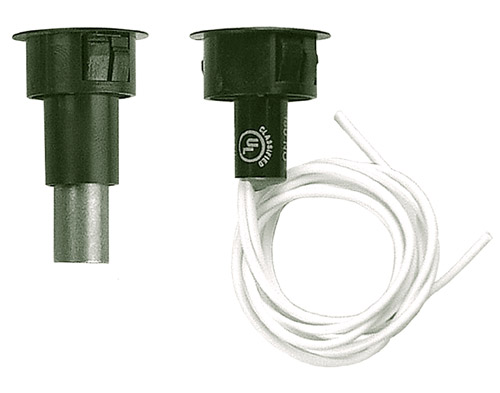
Securitron DPS-M vs DPS-W: Metal or Wood Door Switch
Posted by Kent on 26th Sep 2026
The Switch That Tells the Panel a Door Is Actually Closed
An integrator called last month after a delayed-egress door kept reporting open when it was latched tight. He had drilled the mounting hole to the same depth on a hollow-metal frame that he always used, on a job where the door leaf was solid wood instead of steel. The magnet never got close enough to the switch to trip it. Two different door position switches exist for exactly this reason, and picking the wrong one by habit instead of by door material is the single most common mistake we hear about on this part.
The Securitron DPS-M and DPS-W do the identical job: each reports open-or-closed status to an access control panel, a Securitron XDT delayed-exit timer, a DPA door-prop logic timer, or a BondSTAT/Senstat monitoring input. Both are concealed, recessed into a drilled hole in the door and frame, and both are a normally closed SPST switch with a working gap up to 3/4 inch. The one variable that decides which one you order is the material of the door itself.
DPS-M: Built for a Steel Door
The DPS-M (SKU DPS-M-BK) is built for a metal door and frame. Steel shields a magnetic field, so this version pairs a larger cylindrical magnet with a 1/2-inch-deep installation to punch through that shielding effect and still trip the switch reliably. Drill it into a wood door instead and you have solved a problem the DPS-M was never built to solve — the magnet is fighting shielding that is not there, and the shallower depth may not seat the way the install called for.
DPS-W: Built for a Wood Door
The DPS-W (SKU DPS-W-BK) is the same switch and magnet pairing set to a 15/16-inch-deep installation instead of 1/2 inch. Wood does not shield a magnetic field the way steel does, so the deeper recess is about matching the door's actual construction and hardware clearance, not about beating interference. Put the metal-door version into a wood leaf and the switch may sit at the wrong depth for the gap the door actually holds against the frame.
Same Drill Bit, Different Result
Both versions call for the identical 3/4-inch (19mm) diameter hole drilled straight through the door and directly opposite a matching hole in the frame. That is where the similarity ends. Order by door material first, then confirm the actual door-to-frame gap on the opening — Securitron rates both switches to a maximum 3/4-inch gap, and a door that has sagged past that on old hinges will not trip reliably no matter which version you install. Fix the gap before blaming the switch.
Where This Actually Gets Ordered Wrong
The mistake almost never happens on a new-construction job where a drawing calls out the door material. It happens on a retrofit where a tech grabs whatever DPS is on the truck because "it's the same part I used last time." A steel stairwell door and a solid-core wood office door twenty feet apart on the same floor need two different SKUs. If you are not sure what the leaf is made of, open it and look at the edge, or tell us the building type and door location and we will confirm rather than have you guess and drill twice.
Finish Options and Where to Actually Drill It
Both SKUs ship in more than one finish. The -BK suffix used above is black; Securitron also lists gray (-GY) and white (-WH) versions of the metal-door switch for matching a frame color instead of standing out against it. Match the finish to the door and frame color the same way you would a strike plate. A black switch on a stainless frame reads as an afterthought, and on an access-controlled door that detail gets noticed.
Placement matters as much as material. The hole goes near the top or bottom corner of the door and the matching point on the frame, clear of the hinge stile, the closer arm, and any kick plate or armor plate already mounted on the leaf. On a pair of doors, put the switch on the leaf that actually carries the locking hardware — the inactive leaf with a flush bolt does not need one unless the panel is monitoring both doors independently. Confirm which leaf the specification calls out before drilling either one.
Common questions
Can I use a DPS-M on a wood door if that's what I have on the truck?
Don't. The larger magnet is sized to fight steel's shielding effect, and the shallower depth is set for a metal door's typical hardware clearance. Order the correct SKU for the door material rather than force a fit and get an unreliable signal.
What's the difference in output signal between DPS-M and DPS-W?
None. Both are a normally closed SPST switch. The only difference between them is the magnet size and mounting depth matched to metal versus wood door construction.
Will the DPS work with a maglock installation?
Yes. It reports door position to the access control panel independently of the locking hardware, and pairs directly with Securitron's XDT and DPA logic timers for delayed-egress and door-prop applications.
What if the door gap exceeds 3/4 inch?
The switch is rated to a 3/4-inch working gap and will not report reliably beyond that. A sagging door or worn hinges widening the gap needs a hardware fix first, not a stronger magnet.
Does either version need external power?
No. Both are passive magnetic switches wired directly into the panel or timer's monitoring input — no separate power supply for the switch itself.
Shop the full Securitron access control line for maglocks, keyswitches, and monitoring hardware, or read how the M680 maglock handles a door you can't mortise and momentary versus maintained keyswitch wiring for the rest of the access control chain this switch feeds into.