
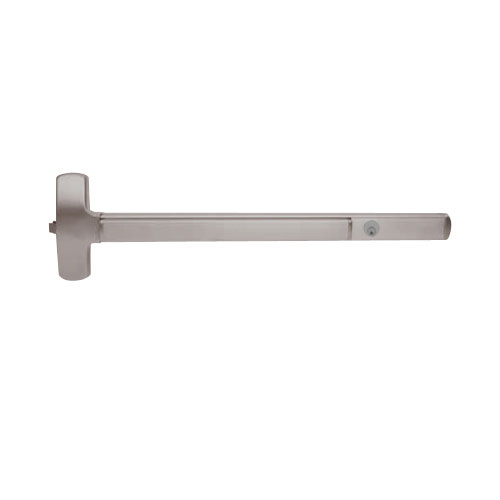
Falcon 25 Exit Device: Plain, CD25 Key Dogging or LD25
Posted by Kent on 27th Nov 2026
One letter on the front of the part number changes how the door behaves
Pull the Falcon 25 Series rim exit device out of the catalog and you will find the same bar in several versions that look identical on the shelf. The difference is a letter or two in front of the 25: a plain 25, a CD25 and an LD25. All three are exit-only rim devices. The letters decide whether the bar can be held back, and who gets to do it. That matters on the first busy morning, so it is worth sorting out before you order.
If you are still deciding between the Falcon 24 and 25 as a whole, start with the Falcon 24 versus 25 comparison and come back here for the dogging question.
What the three versions have in common
Per the catalog listings, each one is a rim-mounted device: a surface-applied push bar on the door face. A push-pad on the inside dogs and retracts the latch, and the outside face is blank, so the door is a one-way exit with nothing to operate from outside. The listings say the Falcon 24/25 Series is independently tested to ANSI/BHMA A156.3 Grade 1. They are not fire rated in these versions; the listing says non-fire-rated on all three, and the fire rated versions are a separate family with an F in front.
So the choice here is not about strength or grade. It is about dogging.
What dogging is, in plain terms
Dogging holds the push bar down so the latch stays retracted. The door then swings freely both directions, with no latch to catch the strike. A school can dog the main doors open during the day and let them latch at night. A retail back door can be left push-pull during a delivery. Used right, it is convenient. Used carelessly, it is how a door sits unlatched for a week because nobody remembers who dogged it.
The plain 25: the baseline
The listings for the base device, such as 25-R-EO-US26-3 in polished chrome, describe the exit-only function and nothing extra. The listing text does not add a dogging feature to the description of the base device. If you need a specific dogging method on a plain 25, ask us before you buy rather than assume it is there.
CD25: cylinder dogging
The CD in the part number stands for cylinder dogging, and the listing spells it out: a key holds the pad down for push/pull traffic. That puts the control with whoever carries the key. Staff can lock the bar down in the morning and release it in the evening, and a stranger cannot.
The CD version is the one I reach for when a building has a regular opening and closing routine and one person owns it. The catalog carries it in anodized aluminum as CD25-R-EO-US28-3 and in satin stainless steel as CD25-R-EO-US32D-3.
The cost of a key is a key to manage. If it ends up in a drawer and nobody knows whose it is, the door is stuck in whatever mode it was left in. Decide who holds it before the device goes in, and put it on the same key control list as the rest of the building.
LD25: less dogging
The LD listing says the configuration adds less dogging. It does not describe the hardware in more detail than that, and I am not going to guess at how it works. What the words say is that this version leaves the dogging feature out. The bar always returns and the latch always catches.
That is the right call on a door where nobody should ever be able to prop the bar down. A stairwell door, a corridor door that has to latch every time, a door where you are tired of finding it dogged open. Take the option away and you cannot have the argument. The catalog lists LD25-R-EO-US28-3 in anodized aluminum and LD25-R-EO-US32D-3 in satin stainless.
Picking by door, not by habit
- Door that is dogged open on a schedule, one person in charge: CD25. Key control comes with it.
- Door that must latch every time it closes: LD25.
- Door where you only need the basic exit function: the plain 25, with the dogging question confirmed with us first.
Do not pick CD because it sounds like more. If the door should never be held open, the extra feature is a liability.
Finish and listing notes
These devices come in anodized aluminum, satin stainless steel and a chrome finish. The finish letters are in the part number: US28 for the aluminum, US32D for satin stainless, US26 for chrome. The listing for the plain 25 in chrome calls it polished chrome in the title and bright chrome in the specification line, so if you are matching to existing hardware, ask us to confirm which chrome you will receive.
The part numbers end in -3 on the ones above, and some versions end in -4. The listings do not say what the last digit means. I will not decode it for you. Give us the door width and we will confirm the right one.
The listings also do not give the push bar length, the latch throw or the weight, and they do not list the strike. Confirm the strike and the door prep before you order, and tell us if the door is a double door or has a rail that interferes with the bar.
Check these before you place the order
- Is the door a labeled fire door? If it is, you want a fire rated version, not one of these.
- Who will hold the key if you choose CD?
- Do you need to monitor the door? If so, see the request-to-exit versions rather than adding a switch later.
- What finish does the existing hardware on the opposite door have?
The Falcon 25 is the budget-friendly end of the range, and our piece on when to spec it covers where that makes sense. The full range is on the Falcon page. Send us the door and what you want it to do, and we will name the part number.