
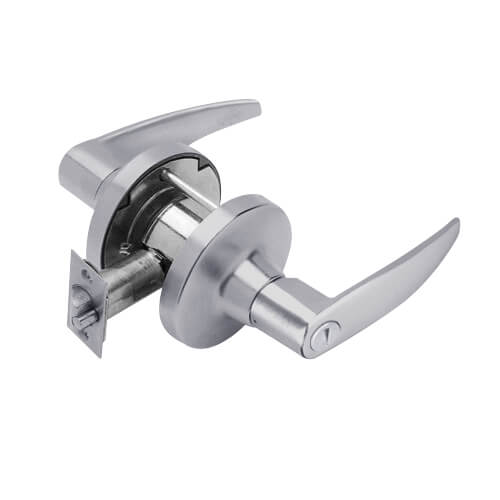
Falcon T291S vs T301S vs T571PD: Patient and Exam Room Locks
Posted by Kent on 26th Oct 2026
Patient rooms, exam rooms and offices need different locks
A clinic has more door types than most buildings. The exam room locks from inside so a patient can change in private. The staff office locks from outside so charts stay put. The linen closet never locks at all. Put the wrong lock on any of these and you either lock a patient in a room nobody can open, or leave a records room open all night. The Falcon T series covers every one of these doors in the same body, the same lever and the same Grade 1 chassis, and the only thing that changes is the function number.
This guide covers the T series functions a healthcare or small office buyer actually uses. For the school-door numbers see our guide to the T561 and T581, and for locks that hold a person on the inside see the T381PD and T411PD. All Falcon hardware starts at the Falcon page.
The five doors, and the number for each
| Door | Number | Listed function |
|---|---|---|
| Exam room, patient restroom | T301S | Privacy |
| Patient room | T291S | Hospital privacy |
| Resident or staff room | T571PD | Dormitory/Corridor |
| Staff office, records room | T521PD or T511PD | Office, entry/office |
| Linen or supply closet | T351PD | Closet |
The T series product pages call the whole family a Grade 1 cylindrical lever lock with a heavy duty chassis and vandal-resistant trim. It fits a standard 2-3/4 in. backset cylindrical prep. The levers on these listings are the Avalon style, and the Dane style is also listed in the same numbers.
T301S privacy and T291S hospital privacy
These two are the pair people mix up. Both are non-keyed and both lock from the inside. They differ in how the person on the hall side gets in.
- The T301S uses a push-button inside to lock the outside lever. The listing says an emergency tool releases it from the hall, and the inside lever always exits. It is the standard restroom and exam room lock.
- The T291S uses a thumbturn inside to lock the outside lever, and a coin release frees it from the hall. The listing calls it built for patient and exam rooms.
So the choice is how your staff open a locked room. A push-button lock with an emergency tool means someone has to carry the tool. A thumbturn with a coin release means any staff member with a coin can open it. The coin version is quicker in a hurry. Think about the person you are worried about when you choose. If a patient may lock themselves in and staff need to reach them fast, pick the one with the release your staff will actually carry.
T571PD dormitory: staff keep a key
The T571PD is keyed from the hall. The listing says the inside has a turn or push-button that locks the door for privacy, and a key always overrides from the hall. Egress is always free. That is the right lock for a resident room in assisted living, a staff sleep room, or any door where the occupant controls the inside but the facility needs the key. A T301S in the same place gives staff only an emergency tool, which is the exact reason people swap it out later.
Office and entry/office: T521PD and T511PD
Both are listed as keyed from the outside with an inside push-button that holds the outside lever locked after hours, and the inside lever is always free to exit. For a records room or a front office you key the outside and push the inside button when you want the door locked without a key. The listings give them different names, office on the T521PD and entry/office on the T511PD, and they do not spell out any further difference between them. If you are replacing an existing lock, match its number. If the old lock is gone, send us the door and we will help you pick between them.
T351PD closet: no latch, just a pull
This one surprises people. The listing for the T351PD says closet/single-dummy: a fixed trim with no latch operation, a pull for closets, wardrobes and one-side-only openings. It does not latch. Use it where a door needs a handle and no lock, or as the dummy side of a pair. If you need a closet that closes and latches, that is a different lock: the T101S passage lock latches with both levers working and no key. The T12 half dummy is the dummy trim for one side.
What to measure and check
- Which side is which. Decide which side of the door is the hall before you pick a keyed lock. The key goes on the hall side.
- Door thickness and bore. Confirm the thickness and the standard cylindrical bore on the existing door.
- Who carries the release. A privacy lock is only safe if staff have the tool or coin.
- The key plan. Do these doors go on your master key system? The keyed T-series listings show a 6-pin cylinder pinned to 5 chambers. If you need it keyed to an existing system, tell us when you order.
Common questions
What is the difference between a Falcon T301S and a T291S?
Both are non-keyed privacy locks. The T301S uses a push-button inside and an emergency tool outside. The T291S uses a thumbturn inside and a coin release outside.
Which Falcon T lock is right for an exam room?
The T301S privacy or the T291S hospital function. Pick by how your staff open a locked room from the hall.
Does the Falcon T351PD latch?
No. The listing describes a fixed trim with no latch operation.
What backset do Falcon T series locks use?
The listings give a standard 2-3/4 in. backset for cylindrical prep.
Is the Falcon T series Grade 1?
The listings describe it as a Grade 1 cylindrical lever lock, certified to ANSI/BHMA A156.2 Series 4000 Grade 1.