
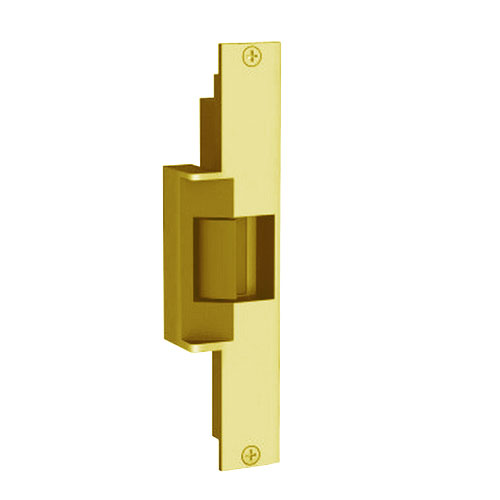
Folger Adam 310 vs 310-F: Fail Secure or Fail Safe for a Detention Door
Posted by Kent on 29th Sep 2026
Order the wrong mode on a detention or holding-area strike and you find out the hard way, usually during an actual power failure. A fail secure strike stays locked when the building loses power, which is exactly what a detention door needs. A fail safe strike unlocks when power drops, which is exactly what a rated egress path needs so people aren't trapped behind a dead strike in a fire. The Folger Adam 310 Series comes in both, built on the same industrial body, and picking between the 310 and the 310-F comes down to one question: what do you want this door doing the instant the power goes out?
What fail secure and fail safe actually mean on a strike
"Fail secure" means the strike keeper stays locked and the latch stays captured if power is cut, whether that's an intentional lockdown, a cut wire, or a building-wide outage. "Fail safe" means the opposite: the keeper releases and the door can push open the moment power stops flowing. Neither one is the "safer" choice in the abstract. The right mode depends entirely on what's on the other side of the door and what code governs that specific opening.
Folger Adam 310: fail secure, and the fire rating that comes with it
The 310 is Folger Adam's standard fail secure configuration, and it carries something the fail safe version does not: a UL 10C, 3-hour fire rating, listed for fail secure only. That's not a footnote. If the opening is a rated fire door, holding cells, secure corridors, and mechanical penthouses often are, the fail secure 310 is the only version of this strike that keeps the door's fire rating intact. Put a fail safe strike on that same opening and you've quietly voided the door assembly's rating, whether or not anyone catches it at inspection.
Beyond the fire listing, the 310 is built for abuse: ANSI/BHMA A156.31 Grade 1 certified, all-stainless-steel construction, static strength of 1,500 lbs and dynamic strength of 70 ft-lbs, with an endurance rating of 500,000 cycles. It's also UL 1034 burglary-resistant listed, which is the rating that matters on a door someone's actively trying to force rather than just walk through.
Folger Adam 310-F: fail safe, for a rated egress path
The 310-F is the same strike body, same Grade 1 certification, same 1,500-lb static strength and 500,000-cycle endurance rating, wired instead to release on power loss. This is the version code officials expect on an access-controlled egress door: a stairwell exit, a secure corridor door that still has to function as a fire exit, anywhere the building code prioritizes getting people out over keeping the door locked. Because it releases on power loss by design, it does not carry the UL 10C fire rating the fail secure version does, so it does not belong on an opening where the door assembly's own fire rating has to hold regardless of power state.
Both take the same latchbolt, the difference is wiring and rating only
Mechanically, the 310 and 310-F accept the same 1/2" or 5/8" throw latchbolt without a deadbolt, on single doors or pairs, and both work with cylindrical locks, mortise locks, and mortise exit devices. Both run on 12VDC at .51 amps with a plug-in connector, non-handed, and both are available in the same finish range. If you already have a 310 on order and the application turns out to need the other mode, you're not starting over on the mechanical side, you're changing the strike's internal wiring configuration and, if the opening is fire-rated, checking whether that changes what's allowed on that door.
How to decide which one your opening needs
Ask what the door is for first, not what feels more secure. A detention cell door, a secure storage vault, a server room where keeping people out matters more than a fire scenario getting them out fast: fail secure. A stairwell door, a corridor that doubles as a fire exit, any opening where the fire marshal or your local code official has a say: fail safe, and confirm with your AHJ before you finalize the spec. When the door is both rated and detention-grade, which happens more than people expect in correctional and behavioral-health work, that's a call for the facility's fire and security consultants together, not a default pick off a parts list.
Common questions
Can I convert a 310 fail secure strike to fail safe in the field?
Not on this series without ordering the correct part. The 310 and 310-F are wired differently at the factory to fail in opposite directions, and there's no field-reversible switch on the standard 310 body. Order the mode you need up front.
Does the 310-F carry the same UL 10C fire rating as the 310?
No. The 3-hour UL 10C fire rating on this series is listed for fail secure operation only. A fail-safe strike that releases on power loss cannot hold a fire door's rating, which is why the two configurations aren't interchangeable on a rated opening.
What voltage does the Folger Adam 310 series run on?
The standard configuration runs 12VDC at .51 amps through a plug-in connector. Confirm your access-control panel or power supply output matches before wiring it in, since the wrong voltage on any electric strike shortens its life or keeps it from cycling reliably.
Is the 310 series rated for a high-abuse detention opening?
Yes. It's built entirely of stainless steel, certified to ANSI/BHMA A156.31 Grade 1, rated for 1,500 lbs of static force and 500,000 open-close cycles, and separately UL 1034 burglary-resistant listed, which is the standard reason facilities spec this series over a lighter-duty commercial strike.
Detention, behavioral health, and secure-corridor doors almost never fall into a clean "obviously fail secure" or "obviously fail safe" bucket once the fire marshal gets involved. Call 877-365-5625 with the opening's fire rating and its security function and we'll confirm which 310 configuration actually clears both requirements before you order. See the full lineup on the Folger Adam hub, and if the strike also needs to report latch and lock status back to a monitoring panel, read Folger Adam 310 LCBMA: Monitoring a Detention Door Latch.