
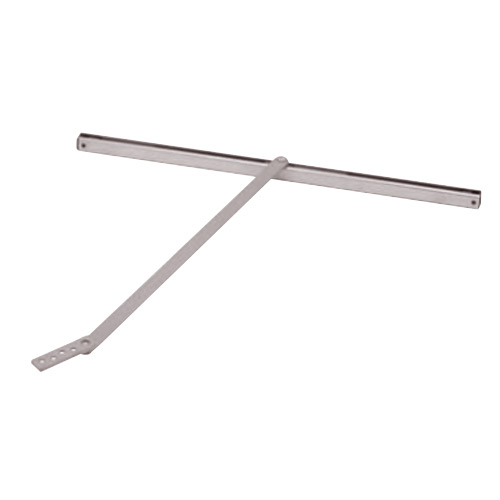
Glynn-Johnson 411H vs 411S: Hold-Open or Just a Stop
Posted by Kent on 14th Sep 2026
The jobsite problem this solves
Plenty of doors won't take a surface-mounted overhead stop. Maybe there's no wall behind the door to catch it, so the arm swings out into open air with nothing to stop against. Maybe the spec sheet says nothing shows on the face of a finished corridor door, and a surface unit bolted to the top rail fails that on sight. I run into both all the time in schools and office corridors, and the fix is the same: a concealed overhead arm mortised into the door top and the frame head. Nothing visible when the door is closed, no wall required. If you've already read up on a surface-mounted overhead stop and it won't clear your opening, this is the piece you order instead.
Glynn-Johnson, an Allegion brand, builds the 410 Series Medium Duty Concealed Overhead line for exactly this job. Before you order, you have to answer one question that has nothing to do with the door and everything to do with what you want the door to do once it's open: hold there on its own, resist a little and let go, or just stop dead with no hold at all.
Three functions, one mortise pocket
All three units in this comparison template into the same pocket in the door top and the same strike plate in the frame head. What changes is the mechanism inside, and that mechanism is the whole decision.
411H-US32D: hold the door open
Order the 411H-US32D, the Glynn Johnson 410 Series Medium Duty Concealed Overhead Hold Open in Satin Stainless Steel, when you want the door to stay put on its own. The H stands for exactly what it does: Hold Open. Push the door to its swing limit and the arm engages, and it stays there until someone pulls it shut. I spec this on corridor doors that get propped for cart traffic, deliveries, or classes changing over, where somebody would otherwise wedge a rubber doorstop under it and lose the doorstop within a week. A mechanical hold-open doesn't walk off and doesn't get kicked loose the way a floor stop does.
411F-US32D: friction, not a catch
The 411F-US32D shares the finish, the body, and the mortise with the H, but it's the Friction Hold Open version. The name tells you the difference: instead of a positive mechanical catch, the arm gives adjustable friction resistance. The door holds where you leave it because the arm resists movement, not because it locks into a detent. I use these less often than the H. Friction hardware wears, and a door that used to sit put on friction alone starts drifting shut on its own after enough traffic cycles. If someone wants a door that stays open every time without babysitting it, I point them to the H instead.
411S-US32D: stop only, no hold
For a door that shouldn't hold open at all, reach for the 411S-US32D, Stop Only, full name Glynn Johnson 410 Series Medium Duty Concealed Overhead Stop Only. It does one job: it keeps the door from swinging past its intended arc and slamming into a wall, a piece of casework, or whatever else is back there. No hold function of any kind. This is the right call on doors where you don't want the door held open, maybe a fire-rated corridor leaf on a closer that has to self-close every time, and you just need to protect the frame, the wall, and the door itself from over-swing damage. Don't put an S where the facility actually wants a hold-open function; you'll get a callback asking why the door won't stay put.
Sizing the arm to the door
The 410 Series runs in sizes from 411 through 415, and the sizing scales with door width. Wider doors need the next size up so the arm has enough leverage and travel without binding. Lock-Depot doesn't publish an exact width break for each size, and I'm not going to guess one here. What I do on a retrofit or a new install is measure the door and match it to the manufacturer's size chart before ordering, the same way I'd size a closer. Put a 411 on a wide pair leaf it's too small for and you'll feel it in the arm long before it fails outright. It binds and chatters instead of swinging clean. As an example of the next size up, the 412H-US32D carries the same Hold Open function as the 411H, just built for a wider opening. Same decision between H, F, and S applies at every size in the line.
Finish and what's in the catalog
Everything above is quoted in US32D, satin stainless, which is what I sell most on corridor and back-of-house doors because it doesn't show fingerprints the way bright work does. The 410 Series is also stocked in bright stainless (US32), satin bronze (US10), oil-rubbed bronze (US10B), satin brass (US4), and bright brass (US3) for jobs matching existing door hardware. If you're outfitting more than one opening on the same building, it's worth pulling up the Glynn-Johnson hub and checking what else in the line shares that finish before you order piecemeal.
Common questions
Can I swap a 411S for a 411H on the same door later?
No, not without pulling the whole unit and re-templating the mortise for the new mechanism. The H, F, and S bodies aren't field-convertible between functions. Decide the function you need before you order, not after the door's already drilled.
Do I need a wall behind the door for these to work?
No, that's the entire point of a concealed overhead arm. It mortises into the door top and the frame head and does its job internally, so there's nothing hanging out into the corridor and no wall required to catch anything. That's what separates the 410 Series from a surface-mounted stop.
Which one should I pick if I'm not sure?
Go with the 411H if the door needs to stay open reliably during work hours, that's my default recommendation for corridors with cart or foot traffic. Reach for the S only when you specifically do not want the door held open, such as a self-closing fire door that just needs over-swing protection.
Does the size number affect the function options?
No, the 411, 412, and every size through 415 come in the same H, F, and S function choices. The size number is about matching arm leverage to door width, not about which functions are available.