
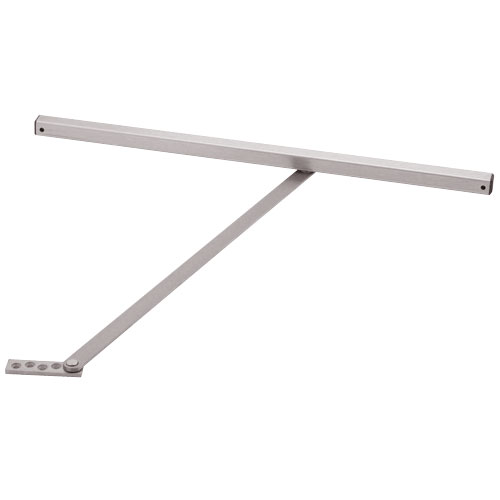
Glynn-Johnson 450: Overhead Stop for a Door That Slams Into a Wall
Posted by Kent on 11th Aug 2026
Walk any building long enough and you find the door that opens too far. The lever punches a hole in the drywall behind it, the closer arm gets sprung because someone threw the door back hard, or a gust catches an entrance and slams the leaf past where it should stop. A closer controls how a door shuts. It does not control how far it opens. For that you want an overhead stop, and the Glynn-Johnson 450 Series is the medium-duty surface unit that does the job.
What an overhead stop does that a closer does not
An overhead stop mounts up on the door and frame like a closer, but its whole purpose is the open swing. It sets a hard stop at a chosen degree, usually somewhere around 85 to 110, so the door cannot travel past it. The wall behind is safe. The closer arm is not getting over-extended and sprung. And on a windy entrance, the leaf is not whipping open to its mechanical limit and shocking the hinges every time. Glynn-Johnson is Allegion, the same house as LCN and Von Duprin, and their overhead stops are what get specified when a door needs its open swing controlled and there is no wall bumper or floor stop that will do it cleanly.
The 450 is the medium-duty surface-applied line. Surface-applied means it bolts to the face of the door and the frame soffit, so you can add it to an existing opening without routing the door. Medium-duty is the right weight for a normal interior or light exterior commercial door. On a heavy, high-abuse, or institutional door that gets slammed as a matter of habit, step up to the heavy-duty concealed line instead. For the everyday office, corridor, classroom, or restroom door that just needs to quit hitting the wall, the 450 is the correct pick and it will not cost you what a concealed unit does.
Stop, or stop and hold open
The 450 series comes as a plain stop and as a stop with a friction hold-open. Decide which you want before ordering, because they mount the same but behave differently:
- Stop only. The door swings to the set degree and goes no farther, then the closer brings it back every time. Use this where the door should always close, a corridor cross-door, a door near a fire barrier where you cannot leave it parked open.
- Stop with hold-open. The same hard stop, plus a friction detent at the open point that parks the door there until someone pushes it closed. Use this on a receiving door, a break room, a supply door people want to prop while they move through repeatedly.
Do not use a hold-open on a fire door
This is the trap worth naming. A friction hold-open parks a door open and keeps it there. A fire door has to close and latch on its own so it can do its job when the alarm sounds, so a mechanical friction hold-open is the wrong device on any fire-rated or smoke-barrier opening. If the door is labeled and you want it to stay open legally, that is a job for an electrified hold-open tied to the fire alarm, not a friction stop. On a fire door, spec the stop-only version of the 450 and let the closer do the rest.
Finish
The stop is visible up on the door, so match it to the closer and the rest of the trim. US32D satin stainless is the common commercial finish and hides wear well. US10 satin bronze suits a darker, warmer opening. The 452H and 451H model variants cover the stop and hold configurations in the same finishes.
Common questions
Doesn't the closer already stop the door?
No. A closer controls the closing swing and speed. It does not set a hard open-limit. To stop a door hitting the wall behind it you need an overhead stop or a floor or wall bumper. The overhead stop is the cleanest fix when a floor stop would trip people or a wall bumper won't reach.
Surface or concealed overhead stop?
Surface bolts onto an existing door and frame with no routing, which is why it is the retrofit answer. Concealed hides in the door but needs the door prepped and is built heavier. The 450 is the medium-duty surface line for normal commercial doors.
Stop only or hold-open?
Stop only where the door must always close. Stop with hold-open where you want the door to park open on its own. Never put a friction hold-open on a fire door.
What do you need from me to order?
The door's hand, whether it is regular or parallel arm, the degree of opening you want (measured off the wall or fixture behind it), and the finish. Give us those and the stop drops in right.
Lock Depot stocks the Glynn-Johnson 450 Series surface overhead stop in stop-only and hold-open configurations and the common commercial finishes. Start at the Glynn-Johnson hub, or if the real problem is the door slamming shut rather than swinging too far open, read LCN 4040XP: Stop a Heavy Commercial Door From Slamming. Or call 877-365-5625 with the hand, the swing degree you want, and whether the door is fire-rated, and we will send the right stop.