
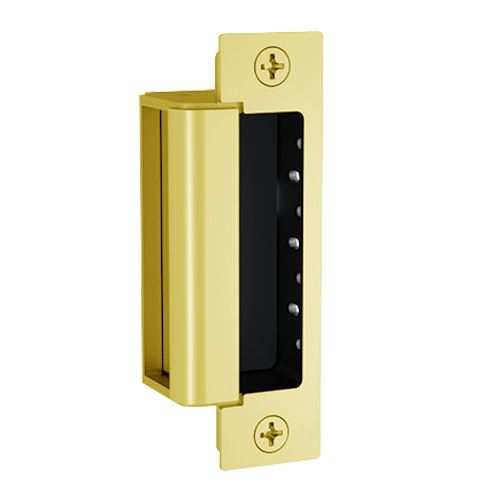
HES 1600 CS vs CLB vs CDB vs 1500C Electric Strike
Posted by Kent on 7th Oct 2026
Which HES complete pac fits the lock on your door
The HES 1600 and the HES 1500 look nearly alike on a parts list. Both are the newer modular electric strike platform. Both are rated for 1,500 lbs static and 70 ft-lbs dynamic. Both run on 12 or 24 volts, AC or DC. The difference is a deeper cavity, and that is why people order the wrong strike. This article sorts out the 1600-CS, 1600-CLB, 1600-CDB and the 1500C.
The one question that decides it
Does the lock on the door have a deadbolt that throws into the strike? A mortise lock with a deadbolt throw does. A plain latchbolt-only lock does not.
The HES catalog copy puts it plainly: the 1600 has a deeper cavity, 1-5/8", to handle up to a 1" deadbolt. If the opening has a mortise lock with a deadbolt throw, the 1600 is the strike. The 1500 has no deadbolt accommodation. That is the 1600's job. So a 1500C on a door with a deadbolt throw is the wrong strike, and the fix is to swap it for a 1600 and redo the cutout.
What they share
- Strength: 1,500 lbs static, 70 ft-lbs dynamic.
- Voltage: dual 12/24 VDC/VAC, and the copy says PoE friendly.
- Adjustability: built into the body, with interchangeable faceplates and field-replaceable parts.
- Finish: offered fully finished in 8 colors so it does not stick out next to your lever trim.
The 1600 copy adds ElectroLynx connectors and million-cycle endurance.
1600-CLB: latchbolt only, deeper cavity
The CLB is the complete pac for latchbolt locks. It comes with the J, KD and KM faceplates. You get the deeper 1600 body, but the pac is built around a latchbolt. The 1600-CLB-605 in bright brass is the listing, $620.40 in our catalog, and it is also listed in satin brass. Use it when the lock only has a latchbolt and the frame was already cut for the deeper cavity.
1600-CDB: deadbolt only
The CDB is the deadbolt version. It is for the case where the strike has to capture a deadbolt and nothing else. The 1600-CDB-605 is the same $620.40 as the CLB. Most doors with a mortise lock want the CS, below, so the CDB is the specialty pick. If you are not sure you need it, you probably need the CS.
1600-CS: latchbolt and deadbolt
The CS is the one for the typical mortise lock with a deadbolt throw. The HES copy lists it as the pac for latchbolt plus deadbolt. The 1600-CS-605 is $723.36 in our catalog, about $103 more than the CLB or CDB. That is the price of getting both in one pac. Buying a CLB and a CDB separately costs $1,240.80, so do not split them unless you have a reason.
1500C: the shallower strike, latchbolt only
The 1500C is the complete electric strike on the 1500 platform. HES copy says it replaced a lot of 1006 installs for latchbolt-only applications. It does not take a deadbolt. The 1500C-605 is $620.40, the same as the 1600-CLB. So if the lock has only a latchbolt, price does not push you either way. The deciding factor is the cavity depth in the frame. Check what you have before you choose.
The 1500 is rated UL 10C fire rated for 3 hours on single doors, fail-secure only, and outdoor rated. It has monitor options up to DLMS, if you need dual lock monitors with strike monitoring. The 1600 copy lists UL 10C fire rated, UL 1034 outdoor rated, and a field selectable fail-secure or fail-safe setting. If fail safe matters on your door, that line is the reason to look at the 1600 first.
Where the wrong order comes from
Almost every wrong HES order I have seen starts with a hardware schedule that says "HES 1500" or "HES 1600" and nothing about the lock behind it. Somebody orders the number off the schedule, the strike arrives, and the mortise lock throws a deadbolt that has nowhere to go. The opposite happens too: a 1600 goes into a door that never needed the extra depth, and the installer pays for a deeper cut in the frame for nothing. Look at the lock first. Pull the lock case if you have to, and see whether a bolt comes out of the edge besides the latch.
Fail secure and fail safe in practice
A fail secure strike stays locked when power is cut, and the door can still be exited by turning the lever. A fail safe strike unlocks when power is cut. HES copy says the 1600 is field selectable between the two, which keeps one part number on the shelf for both jobs. The 1500C listing says fail-secure only on fire rated single doors. Check which one the code and the door call for before the strike goes in, because swapping it afterward means opening the frame again.
Which one
- Mortise lock with a deadbolt throw: 1600-CS.
- Latchbolt-only lock, frame cut for the deeper cavity: 1600-CLB.
- Strike has to capture only a deadbolt: 1600-CDB.
- Latchbolt-only lock, shallower cutout, fail-secure: 1500C.
Before you order
- Look at the lock. Does a deadbolt throw out into the frame?
- Measure the cavity depth you have in the frame.
- Confirm the fire rating you need and whether the door needs fail safe or fail secure.
- Check the power supply: 12 or 24 volts, AC or DC.
- Pick the finish to match the lever trim.
Common questions
Does the 1500 take a deadbolt?
No. HES says the 1500 has no deadbolt accommodation. That is the 1600.
How deep is the 1600 cavity?
1-5/8", which handles up to a 1" deadbolt.
What is in the CLB pac?
The J, KD and KM faceplates, for latchbolt locks.
Is the 1600 fail safe or fail secure?
Field selectable. The catalog copy says you set it in the field.
Does the 1500C work on a fire door?
HES lists it UL 10C fire rated for 3 hours on single doors, fail-secure only.
The full range is on our HES electric strike page. For the older 1006 with its monitor and faceplate choices, see the 1006 guide. For coastal doors, read the 9600 windstorm write-up.