
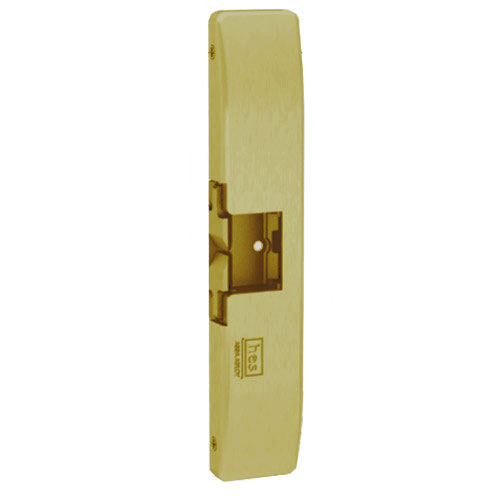
HES 9600: The Windstorm-Rated Strike for a Coastal Door
Posted by Kent on 16th Aug 2026
The submittal comes back with one line circled. The door is rated, the frame is rated, the exit device is rated, and the strike is not. That is how a coastal opening fails review: everything on the schedule holds up except the part that catches the latch. If the authority having jurisdiction on your Gulf or Atlantic coast job is enforcing a windstorm rating, the HES 9600 electric strike is the part that clears it. It is ANSI/SDI 250.13 severe windstorm certified, Florida Building Code approved, and the strongest surface mount strike HES builds.
The strike is where a rated opening quietly fails
You can hang a rated door in a rated frame, hang a rated exit device on it, and still lose the assembly at the strike. The point of a windstorm opening is that it stays latched while the building is under pressure and something hits it. An ordinary strike is a thin stamped body with a keeper on a spring. Under real load it deforms, the keeper rolls, and the latch walks out. Nothing on the door broke. The opening still failed.
I have had contractors argue that a heavy-duty strike ought to be good enough because it is heavy duty. That is not a strength argument. It is a paperwork argument, and you do not win it with a spec sheet that carries no certification.
Specifying a windstorm-rated electric strike on a coastal door
On a submittal the certification does one job: it lets the reviewer close the line. The AHJ is not going to test your strike. They will ask for the paper that says somebody already did. A strike without it leaves the line open no matter how solid the part is.
The 9600 is built for rim exit devices with up to a 3/4" Pullman latch. Check that before anything else. Plenty of submittals get rejected twice, once for the rating and once because the windstorm strike does not match the device on the door.
What the two numbers mean: 2,000 lbs static, 120 ft-lbs dynamic
The 9600 carries 2,000 lbs static and 120 ft-lbs dynamic. Two different failures, not interchangeable.
Static
Static is steady force. The building pushing on the door and holding, which is what a pressure differential does in a storm and what a pry bar does on any other Tuesday. It is load the strike takes without letting the latch go.
Dynamic
Dynamic is a hit. Energy, not weight. Debris in the air arriving all at once. A part can hold enormous steady load and still shed a keeper when something strikes it, which is why the rating carries both numbers. On a coastal opening the dynamic number is usually the one the reviewer cares about, because that is the failure that puts the wind inside the building.
Both numbers come off the housing. The 9600 is a 3/4" thick stainless steel body, a different class of part from folded sheet metal. You can feel it in your hand before you ever mount it.
Surface mount, and why that matters on a retrofit
The 9600 mounts to the surface. No frame cutting. On new construction that is convenience. On a retrofit it is the reason the job pencils, because the frame is often part of what got rated and inspected. Cut it for a mortised strike and you are explaining that cut to the same reviewer who just rejected you. Nobody is pulling a rated frame to add access control.
Base and cover are separate, which sounds minor and is not. Mount the base, get the latch entering clean, then cover it. Re-aligning a one-piece strike later means re-drilling the jamb. It runs 12/24 VDC dual voltage, so it drops onto most existing access control power without a new supply.
Latch monitoring: when the job actually needs it
Three versions. Most openings want the plain one.
- 9600-606, the standard strike in 606 satin brass.
- 9600-606-LBM, with latchbolt monitor. It reports whether the latch is in the keeper.
- 9600-606-LBSM, with latchbolt strike monitor, which adds monitoring of the strike on top of the latch.
Buy monitoring when something downstream has to know the door is secured and not merely closed. A monitored perimeter opening on a school or hospital. A storm shelter or emergency operations building where somebody confirms the envelope is sealed before the weather arrives. A door position switch tells you the door is shut, not that the latch caught.
On a plain access controlled entry with nobody watching a panel, monitoring buys you nothing. I have talked people out of it more than once. If the system has no input for the signal, you are paying for a wire that dead-ends in the wall.
Stocked finishes are 606 satin brass and 612 satin bronze. Match the finish to the exit device trim, not to the door.
The trap: this strike is not fire rated
The 9600 is a windstorm strike. It is not fire rated. That catches people, because plenty of coastal openings carry a wind requirement and a fire label both, and the tougher part does not cover the lighter duty.
If the opening needs fire and wind, look at the HES 9500. If the device uses a squarebolt instead of a Pullman latch, the HES 9700. I am not quoting specs on either from here. Call 877-365-5625 with the label on the door and the device on it and we will put you on the right one.
And if none of this applies, do not buy this strike. On an ordinary interior metal frame with a card reader and no windstorm requirement, a 9600 is several times the strike the door needs. Read HES 1006 vs 1500: Electric Strike for a Card-Reader Metal Frame instead and put the money into the reader.
Common questions
Is the HES 9600 approved for Florida Building Code?
Yes. The 9600 is Florida Building Code approved and ANSI/SDI 250.13 severe windstorm certified, which is what the reviewer wants on the submittal. Send us the AHJ comment and we will confirm the 9600 answers it.
Is the HES 9600 fire rated?
No. It is a windstorm strike only. If the opening needs both fire and wind, look at the HES 9500, and if the device uses a squarebolt instead of a Pullman latch, the HES 9700. Call 877-365-5625 with the door label.
Will the 9600 work with my mortise or cylindrical lock?
The documented application is rim exit devices with up to a 3/4" Pullman latch. If your opening has something else on it, call before ordering rather than assuming it crosses over.
Do I have to cut the frame to install it?
No. The 9600 surface mounts, which is why it works on a retrofit where the frame itself is part of the rated assembly.
Lock Depot stocks the HES 9600 in 606 satin brass and 612 satin bronze, plain and in the -LBM and -LBSM monitored versions, brand new with the full manufacturer warranty. Browse the line on the HES electric strikes hub, or call 877-365-5625 with the exit device on the door, whether the opening carries a fire label, and what the reviewer wrote on the rejection.