
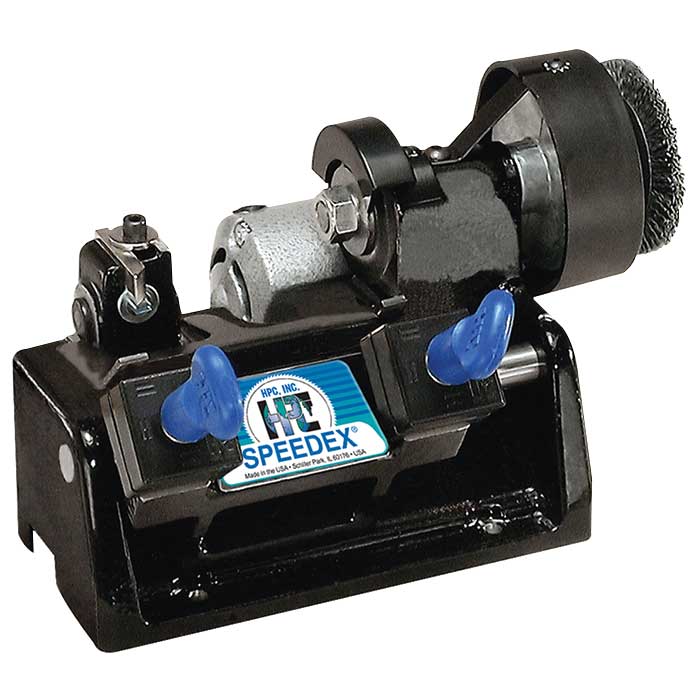
HPC 9120RM vs 9160MC: Sizing a Speedex Key Duplicator
Posted by Kent on 13th Sep 2026
A shop buying its first real duplicator, or replacing one that finally quit, usually gets stuck between two questions that sound the same but aren't: how much can this machine cut, and how much do I actually need it to cut. HPC's Speedex line answers that with two machines built at different points on the same curve, plus a separate code machine for the jobs a duplicator can't touch at all.
9120RM Mini Speedex: the budget machine that still cuts double-sided auto keys
The HPC 9120RM Mini Speedex handles residential, automotive including double-sided profiles, padlock, and mailbox keys on a 120VAC, 1/10 hp, 1.5 amp motor. What separates it from other budget duplicators is that it doesn't punt on double-sided automotive keys the way some entry machines do — it's built with bronze bearings and 4-way jaws that handle everything from a small padlock key to a large-bow commercial blank, and at 16 pounds it travels well if a shop also wants to run it out to a job site occasionally. For a counter that mostly cuts residential and light commercial with the occasional car key, this is the machine that covers the range without the price of the machine one tier up.
9160MC Premier Speedex: more capacity, still not the top of the line
The HPC 9160MC Premier Speedex steps up to residential, commercial, and automotive edge-cut keys on standard 120V power. It's positioned deliberately between the Mini and HPC's higher-capacity Power Speedex: more cutting capacity and precision than the 9120RM, without the jump in price to the top-tier machine. For a shop doing steady commercial volume alongside residential and edge-cut automotive work, the 9160MC is the one that avoids both under-buying a machine that chokes on the harder cuts and over-buying capacity that mostly sits idle.
Duplicator or code machine: they solve different problems
A duplicator, whether the 9120RM or 9160MC, needs an original key to trace from. The HPC 1200CMB Original Blitz Code Machine doesn't — it cuts directly from a manufacturer's bitting code, which is the job when there's no working original to trace, only a code card or a code pulled from the lock itself. It's been the industry-standard code machine since 1978, cutting automotive, commercial, residential, high-security, flat steel, and tubular keys, with an optional tubular adapter and a rotating cutter head that switches between standard cuts and Medeco angle cuts in seconds rather than requiring a second machine. A shop that only ever traces from an existing key doesn't need it. A shop that regularly gets a customer with no key at all, only a code, does.
Buying for the counter you actually run
The honest way to size this decision is against the last month of real jobs, not the hardest job that might walk in someday. A shop that's turned away zero code-only jobs in the last year doesn't need the 1200CMB yet. A shop cutting double-sided automotive keys weekly on a machine not built for them is the 9120RM's exact use case, and paying for the 9160MC's extra commercial capacity when the job mix is mostly residential is money spent on capability that sits unused. Buy the Premier Speedex when commercial and edge-cut automotive volume justifies it; buy the Mini Speedex when it doesn't.
Wear parts keep a duplicator cutting to spec
Both Speedex machines rely on tracer and cutter components that wear with use, and a worn tracer is what turns a working duplicator into one producing keys that are close but don't quite turn the lock. HPC's own Hudson double-sided tracer, sized for the 339 machine family at 4mm and 5mm, is the kind of spare a shop should keep on the shelf rather than order after a customer calls back with a bad cut. Budget the wear parts as part of the machine's real cost, not as a surprise six months in.
Both Speedex machines are manual, and that's a feature
HPC lists both the 9120RM and 9160MC as manual machines, meaning the operator guides the tracer along the original key by hand rather than the machine indexing cuts automatically. That's not a knock against them next to a fully automatic machine costing several times more; a manual duplicator gives an experienced counter person direct feel for a worn or damaged original key, and the chance to compensate by hand where an automatic machine would just copy the wear straight into the new blank. The tradeoff runs the other way for a shop hiring less experienced counter staff: a manual machine's output quality tracks the operator's skill more directly than an automatic one's does, which is worth weighing against the price difference before assuming manual always means simpler to run.
Common questions
What's the real difference between the 9120RM and 9160MC?
The 9120RM covers residential, double-sided automotive, padlock, and mailbox keys on a lighter-duty motor. The 9160MC adds commercial and automotive edge-cut capability with more capacity and precision, positioned below HPC's top-tier Power Speedex.
Do I need a code machine if I already have a duplicator?
Only if the shop takes code-only jobs with no working original key to trace. A duplicator traces from an existing key; a code machine like the 1200CMB cuts from a bitting code alone.
Can the 1200CMB cut high-security and tubular keys?
Yes, including flat steel and tubular keys with an optional adapter, plus a rotating cutter head that switches to Medeco angle cuts without a second machine.
Is the 9120RM too light-duty for a full-time shop counter?
Not for residential and light commercial volume with occasional automotive work. It's built with bronze bearings and 4-way jaws specifically to hold up under regular counter use, not just occasional cutting.
What wear part fails first on a Speedex duplicator?
The tracer is the usual first sign of trouble — a worn tracer produces keys that look right but don't quite turn the lock. Keep a spare on hand rather than diagnosing a bad cut as a bigger problem.
For a different piece of hardware a shop counter stocks alongside its cutting equipment, mounting a lockset on a steel gate with no wood core to screw into, see Keedex Gate Boxes: Mounting a Lockset on a Steel Gate. The full HPC key machine and parts line is on the HPC hub.