
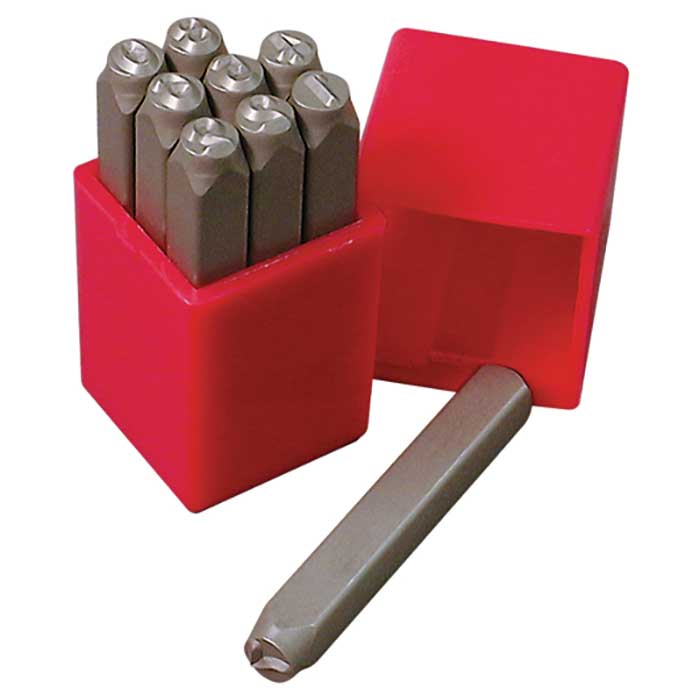
HPC Key Stamps: HCF and HCL Sets, LDND, LDNC and SA-7
Posted by Kent on 10th Nov 2026
A stamped key tells the customer which key it is
A ring of six identical brass keys is a support call waiting to happen. Nobody can tell the back door from the stockroom, so they try each one in the dark. A number or a short code struck into the bow fixes that for good. It does not rub off the way ink does, and it does not fall off like a tag.
HPC makes the hand stamps for the job. The catalog has number sets, letter sets, two warning stamps and an aligner. This piece covers which to buy and what each one will and will not do. The rest of the key shop bench is on the HPC page.
Number sets and letter sets
The names carry the decision. HCF is the figure set, numbers. HCL is the letter set. Each comes in two character sizes, so there are four stamp sets in all:
| Numbers (HCF) | Letters (HCL) | |
|---|---|---|
| 1/8 in. characters | HCF-1/8 | HCL-1/8 |
| 3/32 in. characters | HCF-3/32 | HCL-3/32 |
The listing for the number sets puts it this way: for room numbers only, the HCF set is enough. To stamp names or codes that mix letters and numbers, you need both sets in the same character size. Do not buy a 1/8 in. letter set and a 3/32 in. number set and expect them to line up on one key. Pick a size and match it.
1/8 in. or 3/32 in.
The difference is arithmetic. 1/8 in. is .125 in. and 3/32 in. is about .094 in., so the larger set strikes a character roughly a third taller. The listings do not say which key bows or tags suit which size, and I will not claim a rule the catalog does not give.
What I can tell you from the bench is to choose by the surface. A large flat bow, a brass tag or a plate takes the 1/8 in. set and reads from arm's length. A narrow bow, a key head with a hole and an edge, or a lot of characters on a short line wants the 3/32 in. set. If the bow has less room than your code needs, the smaller set is the only one that will fit it on. Test on a scrap blank before you strike a customer's key.
The listing for the letter set describes the stamps as hardened steel, for marking keys, hooks, plates and tags by hand. You set a character, strike it, and move to the next.
What to stamp, and what not to
The HPC listing suggests a master key symbol, a room number, the bitting, or the name of the place the key opens. Stamping a key is a service you can sell with every key you cut.
My own advice is to leave one of those out. Do not stamp the bitting on a key that leaves the building. A bitting code on a bow lets anyone who reads it cut a copy without ever holding the key. A room number, a door name or a key-system code that means nothing to a stranger is the right content.
- Good: Room 214, Boiler, Stock, a lettered position code from your own key system.
- Also good: a key number that ties to your records, the same number as the tag on a loaner board.
- Avoid: bitting, anything that identifies the lock brand and keyway to a stranger, the customer's address.
Do Not Duplicate and Do Not Copy: LDND and LDNC
LDND stamps Do Not Duplicate. LDNC stamps Do Not Copy. Both are hardened steel hand stamps, and the listings say the die bites cleanly into brass and nickel-silver blanks. You strike the warning into the key bow so the message travels with the key. A paper tag falls off, and an engraved warning does not.
Be straight with the customer about what the warning does. The listings say it cuts down on unauthorized copies at the corner kiosk. It is a deterrent. A stamp does not stop anyone willing to copy the key, and a shop that cuts without checking is cutting without checking. If you need copies controlled, the restricted keyway is what controls them. The stamp is a first filter, and a cheap one.
LDND and LDNC are the same job with different wording. Pick the wording your customers recognize. Many facilities managers will tell you which phrase is on their existing keys, and matching it keeps a ring looking consistent.
The aligner: SA-7
The SA-7 is a stamp aligner. The catalog lists it as an HPC steel hand stamp and gives no further description. It carries no dimensions and no stated use, so I can tell you what the name says and no more: an aligner for keeping characters in line. If you strike a code of four or five characters by eye, the line drifts and the letters wander. A tool that holds the line is worth asking about when your stamping volume gets high enough to care.
Because the listing is thin, call or write before you order if you need to know whether the SA-7 works with a given character size. I would rather say that than guess.
Stamping a key without wrecking it
- Support the bow flat on a solid steel block. A bench top flexes and the key bounces.
- Check the blank. Brass and nickel-silver take a stamp cleanly, per the listings. A hardened or plated key may mark poorly or crack, so test.
- Strike each character with one firm blow, square on. Do not rock the stamp.
- Space the characters evenly. Mark the first and last positions lightly with a scribe if you are working freehand.
- Stamp the bow, never the blade or the shoulder. The cuts and the shoulder set the fit of the key.
- Deburr with a light pass of a file or a brush. A raised ridge catches a pocket lining.
If you keep a rack of keys by number, the HPC key board and tags piece covers the loaner and permanent numbered tags that pair with a stamped key.
Common questions
Do I need both HCF and HCL?
Only if your code mixes letters and numbers. For room numbers alone, the HCF number set is enough. Buy both in the same character size for mixed codes.
Can I mix 1/8 in. and 3/32 in. sets?
You can own both, but on one key stick to one size. Mixed sizes look uneven.
Does a Do Not Duplicate stamp stop copying?
No. It is a deterrent that cuts down on casual copies. A restricted keyway is the real control.
What does the SA-7 do?
It is a stamp aligner. The catalog gives no more detail than that, so contact us if you need to know whether it fits your character size.
What do the stamps cut into?
The listings say brass and nickel-silver blanks. Test on a scrap key before you stamp a customer's key.