
HPC Key Board and Tags: Loaner vs Permanent
Posted by Kent on 10th Oct 2026
Most key problems are record problems
A key leaves the building. Nobody wrote down who took it. Three months later a door gets opened that should not have, and the only fix is to rekey the whole floor. I have seen that bill. It is always bigger than the cost of the board and tags that would have prevented it.
HPC sells the pieces of a simple key control system, and they are cheap. Here is how three of them fit together: the KB-10P key board, numbered loaner tags, and permanent numbered tags.
The board: where keys live
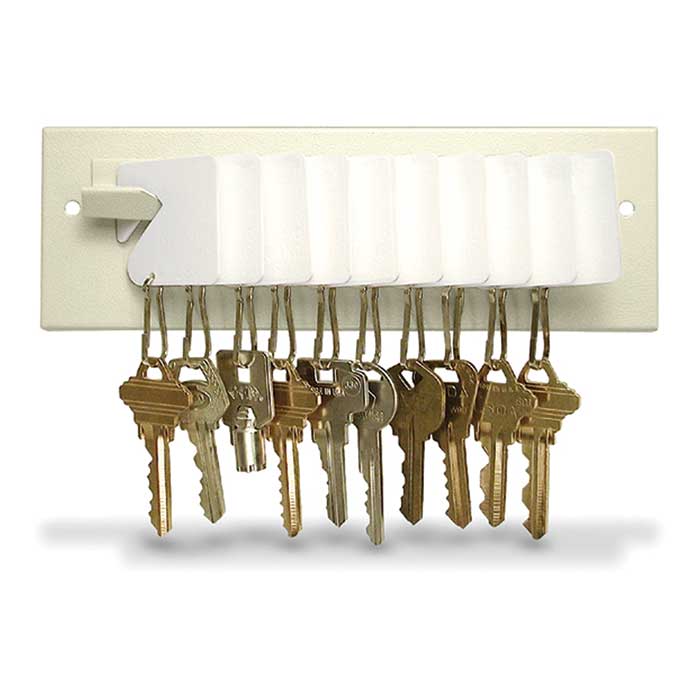
The HPC KB-10P is a steel key board that comes with 10 plain tags and mounting screws. The listing puts it at 8.7 in. wide by 2.4 in. tall, small enough for a wall, the inside of a cabinet door, or a key control room. It is steel, not a plastic hook strip, and that matters on a board that gets handled all day.
The plain tags are blank. You label them with whatever your system uses: suite numbers, door names, a key code. One caution I give every customer. Do not write the address or the door name on a tag that leaves the building. A key marked "Suite 4 front door" is a key anyone can use. That is the job of the numbered tag, below.
Numbered tags: identify the key without advertising it
HPC makes two styles of numbered tag. Both are stamped at the factory with a consecutive range, 20 to a set. The numbering is fixed, so there is nothing to wear off and nothing to misread. The number means nothing to a stranger. Your log is what ties it to a door.
Loaner tags
The NLT-341-360 is a set of 20 numbered loaner tags, stamped 341 through 360. Their job is tracking a key once it leaves your hands. When you give a key to a tenant, a contractor or a service tech, you clip on a numbered tag and write the number and the person in your log. The key goes out as number 347, your book says 347 went to the HVAC crew, and when it comes back the loop is closed. The listing says they are built for HPC's KeKab key cabinet system but work on any board, hook or ring.
Permanent tags
The NPT2T-61-80 is the heavier permanent style, 20 to a set, stamped 61 through 80. Same job of identifying a key without advertising what it opens. The difference is that they are meant to stay legible for years on a working ring. If you have ever had a cheap tag go blank or crack off a busy key, you know why the permanent version is worth it on keys that get handled every day.
Which tag goes where
- Permanent tags stay on the keys that live on the board: your master, your building keys, the keys everyone uses.
- Loaner tags go on the key that is leaving, whether a duplicate pulled for the occasion or the working key clipped out for a day.
Keep the two ranges separate. The sets above run 61 through 80 for permanent and 341 through 360 for loaner, so they do not overlap. If you buy more later, the ranges are consecutive, so you can extend the sequence without a gap. That is the reason they are stamped in ranges in the first place.
A system that works in ten minutes
- Mount the board in a room only you control. A board in a hallway is a bulletin board for thieves.
- Tag every key with a permanent number. Not the door name.
- Keep one master log. Permanent number, door, and how many copies exist.
- Put a loaner tag on anything that leaves. Write the loaner number, the person, the date out, the date back.
- Check the log every month. Anything out more than a week gets a phone call.
That is it. No software, no subscription. A property manager with 20 doors can run this off a clipboard.
Where it stops working
A board and tags track keys. They do not stop a key from being copied. A stamped "Do Not Duplicate" key can still be cut at a hardware store counter. If copying is the real risk, you need a restricted keyway, and our Pro-Lok keyway article covers that side. If you cut your own keys, our HPC Speedex comparison covers the machine.
The listings do not say what the tags are made of or how they attach, and I will not guess. If you need to know before you order, ask us.
Who needs this
Three kinds of customer buy this setup, and they use it differently.
- Property managers with a dozen or more units. The board holds the spares, the permanent tags name each key by number, and the loaner tags go on whatever a contractor borrows for the day.
- Small facilities and churches. Many hands, few keys, no written record. A board in the office and a log book fixes that.
- Locksmith shops. The board holds customer keys waiting for pickup. A numbered tag means the customer's name is not hanging on a key in a shop window.
The log is the system
People buy the board and the tags and skip the log. The log is the part that works. A simple page is enough: the tag number, what it opens, who holds it, date out, date back. Without it, you have an organized board and no accountability. With it, when a key goes missing, you know who held it last and which doors are exposed. That decides whether you rekey one door or a floor.
Keep the log in a different room from the board. If both walk out together, you have lost the keys and the record of who had them.
Common questions
How many tags come with the KB-10P?
Ten plain tags, plus mounting screws.
Are the numbered tags sold individually?
The listings we checked are sets of 20, each stamped with a consecutive range.
Do the loaner tags only work with HPC cabinets?
No. The listing says they are built for HPC's KeKab system but work on any board, hook or ring.
What is the difference between loaner and permanent tags?
Loaner tags track a key that is leaving. Permanent tags are the heavier style for keys that stay on a working ring.
What size is the board?
8.7 in. wide by 2.4 in. tall.
See the full line on our HPC page. Tell us how many doors and how many people carry keys, and we will size the tag order.