
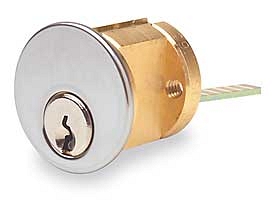
Ilco Rim Cylinder: Matching a Keyway With No Original Key
Posted by Kent on 18th Sep 2026
A rim cylinder job goes sideways more often than a mortise cylinder job, because half the time the customer hands you a broken housing and no working key at all. You're matching a keyway off a stamp, a cam shape, or a guess, not off a key you can hold up to a comparison card. Get the keyway wrong and the customer's existing keys don't turn it, which on a rim lock means a return trip and an apology.
What a rim cylinder actually replaces
Rim cylinder is the term for the surface-mounted cylinder on a night latch or rim-mounted exit device, the kind you see on the inside or outside face of a door rather than bored into it. Ilco's 7075 series rim cylinders are machined from solid brass bar stock to OEM specifications, sold with a screw cap and a 5-pin cylinder, and available across the keyways that actually show up in the field. That last part is the whole job: the cylinder body is nearly identical across brands, what changes is the keyway cut into the plug, and that's the one dimension you cannot eyeball.
Reading the keyway instead of guessing it
The 7075SC10 is cut to the Schlage C keyway, the most common commercial keyway you'll run into on storefront night latches. The 7075KS10 matches Kwikset, common on lighter residential and light-commercial rim hardware. The 7075RB10 is cut to the Corbin Russwin D1 keyway, which shows up on older commercial buildings that standardized on Russwin decades ago and never re-keyed off it. Ilco also stocks the same body in Schlage E and Arrow keyways, so the keyway list runs wider than the three I lead with here, but these three cover the calls I get asked about most.
If you have the old cylinder in hand, the keyway is usually stamped on the face of the plug or can be read off the key if one exists. If you don't, and the customer just knows "it's a Schlage-brand building" or "we've always used Russwin," that's a starting point but not a confirmation, buildings get re-keyed onto a different keyway during a renovation more often than owners remember. Pull a working key from another door on the same system before you order, if one exists, rather than trusting the building's reputation.
Keyed alike, keyed different, and why it matters on a rim job
Some of these cylinders ship keyed different, meaning every unit is cut to its own random bitting out of the box. Others, like the Russwin D1 version, ship keyed alike in pairs, useful when you're replacing cylinders on a pair of doors and want one key to work both without a separate keying job. Neither option gets you onto the building's existing master key system. If the door needs to stay on a master, that's a keying decision for a locksmith to make at the counter with the building's bitting list, not something you solve by picking a SKU off a shelf.
Master key and grand master options exist on this line through Ilco's broader catalog, but they require actual bitting information from whoever controls the building's key system. Don't guess a master wafer combination to save a trip. A rim cylinder that's wrong by one keyway is an easy fix. A rim cylinder that's wrong by one master pin is a lock that quietly won't work with the building's control key until someone notices, which is worse.
Rigid or lazy tailpiece: the part that actually connects to the lock
The keyway gets the cylinder to accept the right key. The tailpiece is what gets it to actually operate the lock, and it's the detail that trips up a rim cylinder swap even after the keyway is right. Each 7075-series cylinder ships with a rigid tailpiece installed and a free lazy-action tailpiece included in the box, so you're not stuck guessing which one the job needs before you leave the shop. A rigid tailpiece turns solid with the plug and works for most standard night latches. A lazy-action tailpiece has a spring-loaded give to it, which matters on hardware with a separate deadlocking or auxiliary latch function that needs the tailpiece to disengage smoothly rather than fight the mechanism. Try the rigid tailpiece first since it's already installed, and if the latch binds or feels like it's fighting itself on the throw, swap in the lazy-action piece from the box before you assume the cylinder itself is wrong.
The cylinder measures 1-1/8" in length and ships with two keys, a trim ring, a mounting plate, and break-off installation screws, so a standard swap doesn't require sourcing separate hardware. Confirm the door's existing cylinder length before ordering if the application isn't a standard rim night latch, since a housing built for a different length cylinder won't seat the collar correctly even with the right keyway.
Body material and why solid brass matters here
Rim cylinders sit exposed on the face of the door, unlike a mortise cylinder that's largely protected inside the lock body. That exposure is why solid brass bar stock construction matters more here than it might on hardware you can't see or touch from outside: brass resists the corrosion that a pot-metal or plated-steel body picks up fast on an exterior door, and it holds up better to the low-grade pick and shim attempts a surface-mounted cylinder is more exposed to than a recessed mortise plug.
If the door in front of you takes a threaded cylinder instead, one that screws into a mortise lock body rather than mounting to the face of a night latch, that's a different Ilco part entirely. Our guide to matching an Ilco mortise cylinder covers length, cam shape, and keyway for that job.
Common questions
How do I identify a rim cylinder's keyway without the original key?
Check the stamp on the face of the plug first. If there's no legible stamp, pull a working key from another door on the same building system if one exists, rather than guessing off the brand name alone, since buildings get re-keyed onto a different keyway more often than owners remember.
What's the difference between the 7075SC10, 7075KS10, and 7075RB10?
Only the keyway. The 7075SC10 cuts to Schlage C, the 7075KS10 to Kwikset, and the 7075RB10 to the Corbin Russwin D1 keyway. The cylinder body, pin count, and cap are the same across the line.
Can I get one of these keyed to match my building's master key system?
Not by ordering a stock SKU. Master and grand master keying on this line needs actual bitting information from whoever controls the building's key system, brought to a locksmith counter, not guessed from a part number.
Why does a rim cylinder need to be solid brass?
It sits exposed on the face of the door instead of recessed like a mortise cylinder, so it takes more corrosion exposure and more pick and shim attempts. Solid brass bar stock holds up to both better than a plated or pot-metal body.
How do I know if I need the rigid or lazy-action tailpiece?
Start with the rigid tailpiece, since it comes pre-installed. If the latch binds or the throw feels like it's fighting the mechanism, swap in the free lazy-action tailpiece included in the box, since some rim hardware with a separate deadlocking or auxiliary function needs that spring-loaded give to disengage cleanly.