
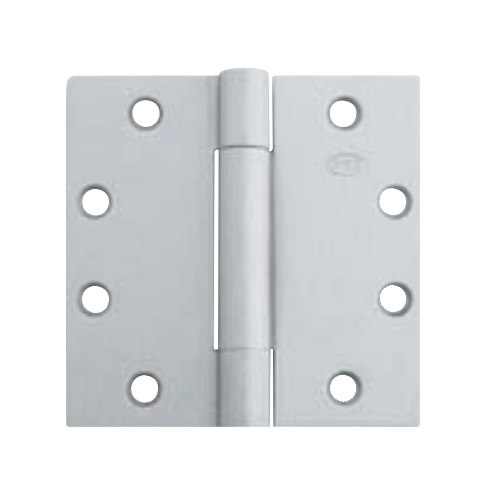
Ives 3CB1WT Wide Throw Hinge: Sizes 4-1/2 x 5 to 5 x 8
Posted by Kent on 15th Nov 2026
A wide throw hinge is a clearance fix
Some doors will not open as far as they should. The edge hits the casing, or the lever bangs the wall, or the door stops at 90 degrees when the opening needs it to swing clear. The hinge is often the reason. A standard hinge holds the door close to the frame. A wide throw hinge holds it farther out, so the door has room to clear whatever sticks out past the frame face.
The Ives 3CB1WT is that hinge. It is a 3-knuckle, concealed bearing, full mortise butt hinge in steel, listed for standard weight doors with medium frequency use. It is the wide cousin of the 3CB1 that most openings get. The two are not interchangeable by guesswork, and the sizes are where people go wrong.
Reading the size
The catalog lists five sizes, always written height first, then open width:
| Size | Height | Open width | Satin chrome example |
|---|---|---|---|
| 4-1/2 x 5 | 4-1/2 in. | 5 in. | 3CB1WT-4-5x5-652 |
| 4-1/2 x 6 | 4-1/2 in. | 6 in. | 3CB1WT-4-5x6-652 |
| 5 x 6 | 5 in. | 6 in. | 3CB1WT-5x6-652 |
| 5 x 7 | 5 in. | 7 in. | 3CB1WT-5x7-652 |
| 5 x 8 | 5 in. | 8 in. | 3CB1WT-5x8-652 |
Compare that to the plain 3CB1, which the catalog carries as 3-1/2 x 3-1/2, 4 x 4, 4-1/2 x 4-1/2 and so on, where the width matches the height. On the wide throw, the width is larger than the height. That extra width is the whole point. The 3CB1 sizing piece covers the standard sizes and the heavy weight and non-removable pin options.
When a door needs one
This is the trade's use of the term, not a figure from the listing. A door hung in a frame with thick casing, deep trim or a recessed opening will swing into that trim before it reaches the angle you want. Widen the hinge and the door pivots farther from the frame, so the edge clears. You see it on:
- Doors that must swing flat against a wall, so the opening is not blocked.
- Frames with heavy casing or a deep reveal.
- Openings where a wide lever or pull needs room behind the open door.
If the existing door opens fully without scraping, you do not need a wide throw. A standard hinge is simpler, and the screw holes will match what is already in the frame.
Measure the old hinge first
Open the old hinge flat on the bench. Measure the height of the leaf along the pin. Then measure from the outside edge of one leaf to the outside edge of the other. Those two numbers are your size. Write them down before you order.
- Measure height and open width of the hinge in place.
- Check the leaf pocket in the door edge and the frame. A wider hinge needs a wider mortise on at least one side.
- Count the hinges on the door and check they all match.
- Match the finish to the lock and closer on the same opening.
The listing gives the overall size. It does not break the width down by door leaf and frame leaf, and it does not give the screw hole pattern or the leaf thickness. Those come off the old hinge, or off the manufacturer's template. We do not guess them.
What the listings say about the build
All five sizes are 3-knuckle steel full mortise hinges with concealed bearings, listed for standard weight and certified to ANSI/BHMA A156.1. The 5 x 8 listing goes further: removable pin, and wood and metal screws included. The shorter listings describe the hinge but do not repeat the pin and screw lines, so confirm both on the size you are buying instead of assuming the 5 x 8 details carry over.
The bearings sit inside the knuckles, so you do not see them. That keeps the look clean on a door that is seen every day. For why bearings matter at all, and how ball bearing and plain bearing differ, see the 3CB1 and 3PB1 bearing comparison.
It is a standard weight hinge. If the door is heavy or sees constant traffic, the heavy weight 3CB1HW line is the one to look at. The 3CB1WT listing makes no heavy duty claim. Match the hinge to the door weight before you match it to the clearance.
Ten finishes
Every size comes in ten finishes, from primed steel to satin chrome. Sample SKUs in the 4-1/2 x 5 size:
| Code | Finish |
|---|---|
| 600 | Primed for paint, steel (3CB1WT-4-5x5-600) |
| 632 | Bright brass plated |
| 633 | Satin brass plated |
| 639 | Satin bronze plated |
| 640 | Oil rubbed bronze |
| 641 | Oxidized satin bronze |
| 643 | Satin bronze, blackened |
| 646 | Satin nickel plated |
| 651 | Bright chrome plated |
| 652 | Satin chrome plated (3CB1WT-4-5x5-652) |
The primed finish is the one to order if the hinge will be painted with the door. Order every hinge on a door in the same finish, because a mismatched hinge reads as a mistake even from across the room.
What the catalog does not tell us
- How far a given size moves the door off the frame. We have the open width, not a clearance figure.
- Leaf thickness, hole spacing, and whether the leaves are equal.
- Load rating per hinge, or the door weight each size carries.
- Any fire rating. The listing makes none, and we make none for it.
If the opening is a rated door, get the hinge requirement from the door label and the specification. Do not pick on the clearance alone.
The rest of the line is on the Ives page. If the door is tearing hinge screws out of the frame, the continuous hinge piece covers a different fix.
Common questions
What does wide throw mean on a hinge?
It means the open width is larger than the height, so the door sits farther from the frame when open. The listing names it Wide Throw. The 5 x 8 is the widest in the catalog.
Is the 3CB1WT a replacement for a 3CB1?
Only if the wider leaf fits the mortise. The sizes are different, the pocket is usually different, and you may have to rework the frame. Measure before you swap.
What door weight is the 3CB1WT for?
The listing says standard weight, medium frequency use. It does not give a pounds figure. For a heavy door, look at the heavy weight 3CB1HW instead.
Do the screws come with it?
The 5 x 8 listing says wood and metal screws are included. The other four sizes do not say, so confirm before you assume.
How many finishes does it come in?
Ten, from primed for paint to satin chrome, in all five sizes.