
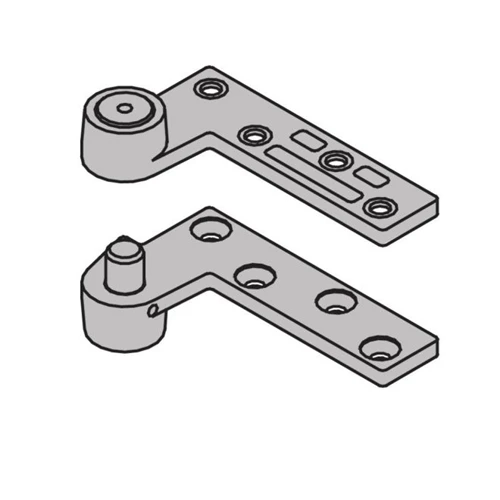
Ives 7212 Offset Pivot: Top, Bottom, Left, Right
Posted by Kent on 11th Oct 2026
A pivot carries the door. It does not just hold it
Most doors hang from the frame on hinges. A pivot set turns that around. The door's weight goes down through a bottom pivot into the floor structure, and a top pivot at the head keeps it upright. The Ives catalog puts it plainly: pivots reduce stress on the frame by distributing the door weight through the floor and structure, which makes them the ideal solution for heavy doors.
The Ives 7212 is a 3/4 in. offset pivot, and it comes as a pair of parts. There is a top pivot and a bottom pivot, and each comes in left hand and right hand. That is four part numbers for one door, and getting the pair wrong is the most common order mistake on this product. This guide walks through which two you need.
The four parts
- 7212-TOP-US26D-LH: top pivot, left hand, satin chrome. Header mount.
- 7212-TOP-US26D-RH: top pivot, right hand, satin chrome. Header mount.
- 7212-BTM-US26D-LH: bottom pivot, left hand, satin chrome. Jamb mount.
- 7212-BTM-US26D-RH: bottom pivot, right hand, satin chrome. Jamb mount.
The catalog lists the top pivot as a header mount and the bottom pivot as a jamb mount. The set is certified to ANSI 156.26 Grade 1.
For one door you buy one top and one bottom of the same hand. A left hand door gets the left hand top and the left hand bottom. A right hand door gets the right hand pair. Never mix them.
How to figure out the hand
Hand is the part everyone second guesses, so settle it before you order. The usual method for door hardware: stand on the push side, where the door swings away from you, and look at where the hinge edge sits. Hinge edge on your left means left hand. Hinge edge on your right means right hand. If the door swings toward you from where you stand, step around to the other side and read it from there.
For a pivot set the pivot axis sits where the hinge edge would be, so the same rule holds. If you are replacing an existing set, look at what is on the door now and match it. If the door is new or the old hardware is gone, mark the hinge edge on the door and check the swing before you order. A wrong hand pair cannot be flipped.
What the catalog tells you about capacity
The listing gives the numbers that matter for sizing:
- Maximum door load: 200 pounds.
- Vertical adjustment: 3/16 in., with a positive locking mechanism.
- Door thickness: use with a 1-3/4 in. minimum door thickness, with a 1/8 in. bevel in 2 in.
- Offset: 3/4 in.
The 200 pound ceiling is the number to check before anything else. A solid wood door, a thick glass door or a clad door can pass 200 pounds without trying. Weigh the door or look up its spec. If it is near the limit, ask us before you order, because I will not stretch a published rating for you.
The 3/16 in. vertical adjustment is useful. A door that hangs right on the day you install it will drift as the floor settles or the building moves. The locking adjustment lets you lift the door back to level without pulling it. Set it with the door hung and the reveal at the head even all the way across.
What the offset does
An offset pivot places the pivot point away from the face of the frame. For the 7212 the offset is 3/4 in. That puts the swing axis in a known position relative to the jamb and the door edge, which affects how the door clears the frame as it opens and where the gap sits when it is closed. It is set by the manufacturer's template. Use the Ives template and do not eyeball it.
If you are replacing an old pivot set on a door that has been hanging for years, do not assume the new set lines up with the old holes. Check the existing floor and header prep against the template before you buy.
A short installation checklist
- Confirm the door weight and thickness against the 200 pound and 1-3/4 in. numbers.
- Confirm the hand with the method above. Write it on the box.
- Prep the floor structure. The bottom pivot carries the door weight, so it needs solid backing at the jamb. Do not mount it in thin material.
- Set the top pivot at the header and check it is directly above the bottom pivot axis. A plumb line works.
- Hang the door, then adjust. Use the vertical adjustment to level the door at the head, then lock it.
- Cycle the door fifty times and look again. A pivot that is not plumb shows up as a door that drags or swings closed on its own.
When a pivot is the wrong call
A pivot suits heavy, wide doors and doors where frame stress has become a problem. It is not an upgrade for a light interior door that hangs fine on butt hinges. If the issue is a door that tears out its hinge screws and the door is a standard weight, a continuous hinge is usually the better fix. Our guide to the Ives 700 continuous hinge covers that case, and our piece on hinge bearing types covers when a good butt hinge is still the answer.
The listings here are satin chrome, US26D. The 7212 is also listed in other finishes, including bright brass, satin brass, satin bronze, oil rubbed bronze, bright chrome and sprayed aluminum, so you can match the rest of the hardware on the door. Pick the finish last, after the hand and the pair are settled.
Common questions
Do I need both a top and a bottom pivot?
Yes. They are sold as separate part numbers. A door needs one of each, in the same hand.
What is the maximum door weight for the Ives 7212?
The catalog lists a maximum door load of 200 pounds.
Can I adjust the door height after it is hung?
Yes. The catalog lists a 3/16 in. vertical adjustment with positive locking.
What door thickness does it work with?
The catalog says to use it with a 1-3/4 in. minimum door thickness, with a 1/8 in. bevel in 2 in.
Is it left hand or right hand?
Both are listed. Pick by which side the pivot edge of the door sits on, and order the matching top and bottom pair.
See the full line on our Ives page. If you are unsure of the hand or the weight, send us the door size and a photo and we will confirm the pair before you order.