
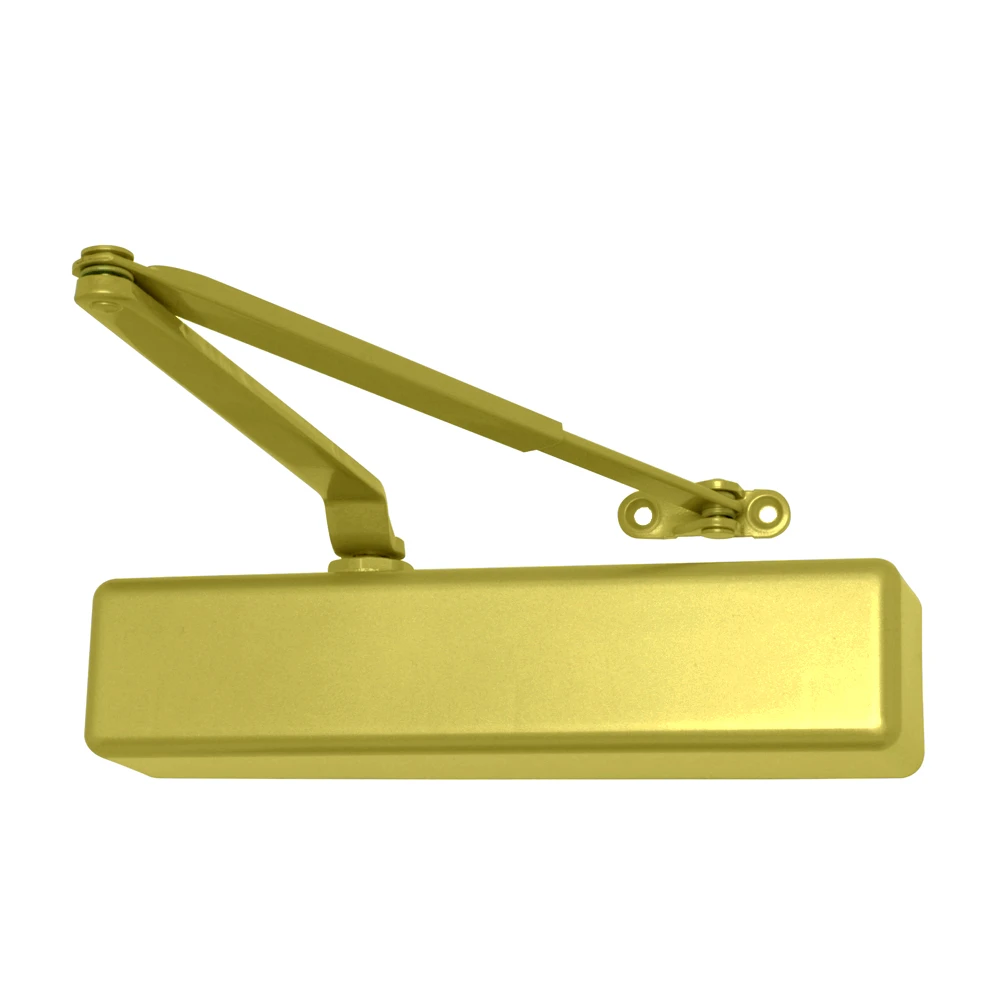
LCN 1461 vs 1261: Pick the Arm Before the Closer
Posted by Kent on 23rd Oct 2026
The arm is the order, not the closer
People order an LCN 1461 or 1261 by the number and then discover there are a dozen arm choices hiding in the part number. We stock both families in a long list of arm styles and finishes. Pick the wrong arm and the closer still bolts up, but it does not do what the door needs: it hits the wall, it will not hold open, or it ends up on the wrong side of the opening. Choose the arm first.
1261 versus 1461 in the catalog text
The catalog describes the 1261 as a light-to-medium-duty cast-iron surface closer from LCN's 1260 family, with an adjustable power spring covering sizes 1 through 5. It describes the 1461 as a medium-duty surface closer offered with multiple cover options, with an adjustable closing spring. Both are surface mounted, both have adjustable closing and latch speeds, and both have a back-check to protect the closer and frame from wind or abuse. That is nearly all the descriptions say. They do not give a door width or weight limit for either, so if your door is wide, heavy or on a windy exterior, ask us for the manufacturer's sizing before you pick the number. The 1460 failure-diagnosis guide is a useful companion: which part failed when it slams or drags.
Regular arm
The 1461-REG-BRASS and the 1261-REG-AL are the regular arm. In the trade the regular arm is the standard top-mount arrangement: the closer sits on the door and the arm reaches to the frame. It is the simplest, the cheapest to get right, and it works when the closer can sit on the pull side of the door.
Regular arm with parallel arm shoe
The 1461-RW/PA-AL is listed as the regular arm with a parallel arm shoe. A parallel arm mounts the closer on the push side of the door, with the arm lying flat along the door face and the frame. It is the arrangement for a door where the closer cannot go on the pull side, such as an outswing exterior door where you do not want the closer exposed.
The same family has the 1461-Rw-62A-AL, titled regular arm with an auxiliary parallel arm shoe. Notice a catalog quirk: elsewhere in the 1461 family, extra-duty and heavy-duty arm listings carry a 62G or 62A tag and are titled "with Thick Hub Shoe." The 62A tag means auxiliary parallel arm shoe in one title and thick hub shoe in another. We are not going to settle that from a part number. Read the title of the exact listing you are buying.
Hold-open arm
The 1461-H-AL and the 1261-H-AL are the hold-open arm. The arm has a stop in it that holds the door open at a set position until someone pulls it shut. It is for a door that gets propped all day. Do not hold open a rated door with a mechanical hold-open arm unless the opening is meant to have one. Fire door hold-opens belong on an electromagnetic release tied to the fire alarm, so the door closes when the alarm drops.
Cush-N-Stop arm
The 1461-CUSH-AL and the 1261-CUSH-AL carry the Cush-N-Stop arm, which the catalog calls a cushion arm. It stops the door at a set point in the swing so it does not slam into a wall, a column or the adjacent door. That is the one to put on a door that opens into something. There is also a hold-open Cush-N-Stop version (the HCUSH part numbers) and a spring Cush-N-Stop on the 1461, listed SCUSH and SHCUSH.
Extra-duty and heavy-duty arms
The 1461-EDA-AL is the extra-duty arm and the 1461-HD-AL is the heavy-duty arm. The catalog gives each one line and no load figure. In the trade these arms are meant for doors that get abused or pushed hard: a school corridor, a loading dock, a restroom door that gets kicked. If the door takes a beating, the arm is what bends first. The parallel-arm abused-door piece is the LCN 4110 guide.
What the finish does and does not do
Each arm style comes in several cover finishes: aluminum, brass, dark bronze, light bronze, black and statuary on the 1461. The finish is the cover, nothing more. It does not change the closer inside or the strength of the arm. Choose the finish to match the door hardware.
One caution on the 1261. There are slim cover versions of the 1261 in the catalog that are not stocked right now, so they are not in the picks above. The standard-cover 1261 listings are the ones to order from.
A quick way to decide
- Pull-side mount, nothing special: regular arm.
- Push-side mount, closer must stay off the pull side: parallel arm.
- Door that gets propped open: hold-open arm.
- Door that opens into a wall or a neighbor: Cush-N-Stop.
- Door that takes abuse: extra-duty or heavy-duty arm.
The full LCN range, from surface closers to concealed ones, is on the LCN door closer page.
Ordering mistakes to avoid
Three come up. First, picking the arm by price: the regular arm is the baseline and every other style is there because a door needs something the regular arm does not do. Second, ignoring the swing: confirm which side of the door the closer is going on before you pick regular or parallel. Third, skipping the power adjustment on a windy door: the catalog says both closers have adjustable closing and latch speeds and a back-check, and the 1261 has an adjustable power spring covering sizes 1 through 5. Set those on the door after it is hung, not at the counter.
Common questions
What is the difference between the LCN 1261 and 1461?
The catalog calls the 1261 a light-to-medium-duty cast-iron closer with a spring covering sizes 1 through 5, and the 1461 a medium-duty closer with multiple cover options. Neither listing gives a door size limit.
Which LCN arm holds the door open?
The hold-open arm, listed with an H in the part number such as 1461-H-AL. The hold-open Cush-N-Stop versions carry HCUSH.
What does a Cush-N-Stop arm do?
The catalog calls it a cushion arm. It stops the door at a set point in the swing so the door does not slam into a wall or a neighbor.
Do the LCN 1461 and 1261 come in different finishes?
Yes. The cover comes in several finishes, including aluminum, brass, dark bronze, light bronze, black and statuary on the 1461. The finish is the cover only.