
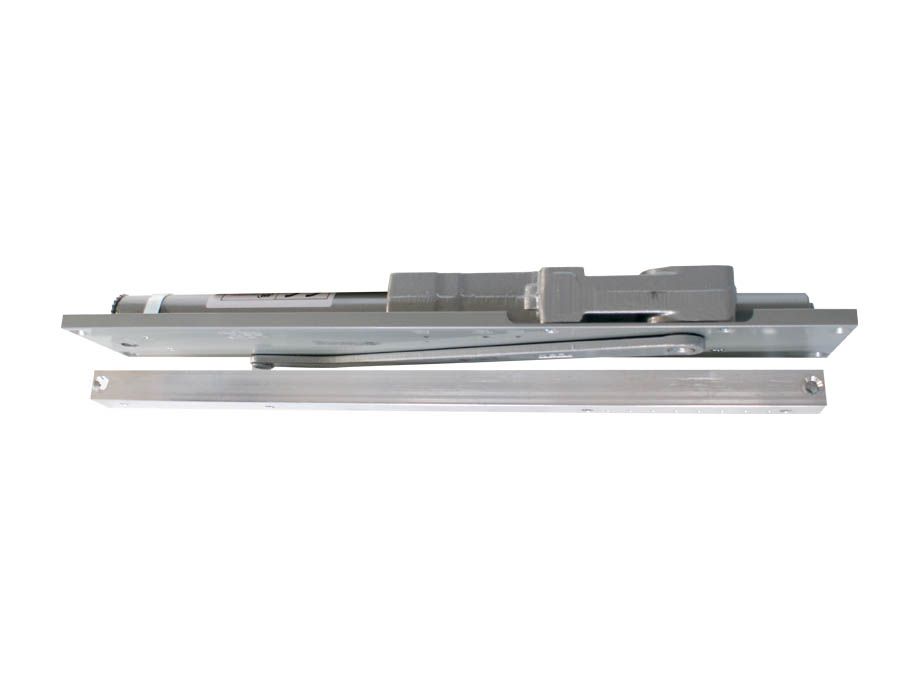
LCN 2033: Standard Arm or Hold-Open Arm Concealed Closer
Posted by Kent on 24th Sep 2026
A closer nobody sees, on a decision that matters
The whole point of a concealed closer is that it disappears. The LCN 2033 mounts inside the door itself, track-arm operation, nothing sitting on the face where a surface closer would hang. Clean look, harder to vandalize, no arm sticking out for someone to grab or kick. Architects like it for exactly that reason on a lobby door or a conference room entrance where a bulky surface closer would wreck the sightline. But "concealed" doesn't mean no decision to make. The 2033 comes with a standard arm or a hold-open arm, and that choice has nothing to do with looks. It has everything to do with what happens to the door forty times a day, every day, for the next decade.
Standard arm: the door closes, every time, no exceptions
The 2033 with standard arm does one job: it shuts the door behind whoever opened it. No hold-open position, no way to prop it short of a wedge someone's not supposed to be using. That's the right call on a stairwell door, a fire-rated opening, anything where the door needs to be closed and latched between uses and there's no legitimate reason for it to sit open. Offices, restrooms, mechanical rooms. Most doors in most buildings, honestly, want the standard arm and nothing fancier.
I default to standard arm unless someone gives me a specific reason not to. It's the arm that fails safe. A hold-open mechanism that jams open is a door that never closes; a standard arm has no failure mode where the door just stays wide open on its own.
Hold-open arm: for a door that earns the right to stay open
The 2033 with hold-open arm lets the door stop and stay at a set position, usually somewhere around 90 degrees, instead of swinging shut every single time. Push it past that point and it holds. This is the arm for a hospital corridor with cart traffic all day, a loading area where hands are full more often than not, or any opening where forcing full closure on every pass just means someone props it with a trash can by the second week. I'd rather spec the hold-open arm than watch facilities improvise a workaround that defeats the door's fire rating entirely.
The tradeoff nobody skips past
A hold-open arm on a fire-rated or smoke-rated opening is a code problem waiting to happen unless it's tied into the building's alarm system so it releases and closes automatically on alarm. A plain mechanical hold-open, the kind that just stops and stays until someone pushes it shut, has no business on a rated door. If this opening is rated, the standard arm is the only mechanical option on the table. Needs to hold open anyway? You're looking at an electrified closer with alarm-tied release, not this arm choice at all.
Same closer body either way
Both configurations share the same heavy-duty concealed-in-door closer body, with adjustable closing and latch speeds and back-check built in to protect the closer and frame from wind or someone shoving the door open too hard. Swapping the arm doesn't downgrade the closer underneath it. You're choosing how the door behaves at the end of its swing, not trading away durability to get a hold-open feature.
Finish is the easy part
Both arm types ship in the same run of finishes, aluminum among them, so match it to the frame and move on. That decision takes thirty seconds. The arm decision is the one that actually changes how the door behaves for the next fifteen years, so give it the attention the finish doesn't need.
What actually goes wrong when the wrong arm gets ordered
Standard arm on a door that needed hold-open means facilities improvises. They wedge it, they zip-tie the latch back, they do whatever gets the cart through without someone standing there holding the door for the next person. Every one of those workarounds defeats the closer entirely and usually the fire rating along with it. Hold-open arm on a door that needed standard is the quieter mistake. The door just doesn't close reliably anymore, and nobody notices until a smoke door didn't do its job the one night it mattered. Neither mistake shows up on a punch list. Both show up on a code inspection or, worse, after an incident.
Reorder cost is the boring reason to get it right the first time. A concealed closer isn't a five-minute surface-closer swap. Getting into the door to change the arm means the same labor as the original install, twice.
If the 2033's track-arm body isn't a fit for a heavier or more abused opening, our LCN 4110 parallel arm guide covers a surface-mounted alternative built for exactly that. And for a closer that releases automatically on an alarm signal instead of a plain mechanical hold-open, see the LCN 3133 guide.
Common questions
What's the difference between the LCN 2033 standard arm and hold-open arm?
The standard arm closes the door fully every time, with no hold-open position. The hold-open arm lets the door stop and stay open at a set position until someone pushes it past that point.
Can I put a hold-open arm on a fire-rated door?
Not a plain mechanical hold-open. A fire or smoke-rated opening needs a closer that releases and closes automatically on alarm, which is an electrified closer, not this arm option.
Does the hold-open arm on the 2033 cost more than the standard arm?
Yes, slightly. It's a physically different arm mechanism inside the closer, not a software or configuration flag on identical parts.
Is the closer body different between the two arm options?
No. Both use the same concealed-in-door closer body with adjustable closing and latch speeds and back-check. Only the arm mechanism changes.
What door types is the LCN 2033 built for?
It's a heavy-duty concealed closer meant for commercial doors where a clean, tamper-resistant look matters and there's no surface-mounted closer visible on the face of the door.