
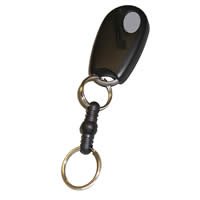
Linear ACT-31B: Add a Gate Remote Without Reprogramming
Posted by Kent on 19th Sep 2026
A gated community adds a tenant, or a facility hands out one more transmitter to a new hire, and the property manager's first fear is having to reprogram the whole system to add it. On some access systems that fear is justified. On a Linear-based gate or barrier system, it usually isn't, and knowing why comes down to how the transmitter itself is coded.
What the ACT-31B actually is
The Linear ACT-31B is a 1-channel key ring transmitter built for Linear's access-control receivers and controllers, including the AE100, AE500, and AE1000 gate and door controllers. It ships with a quick-disconnect key ring so it rides on an actual key ring instead of a separate fob clip, and two type 2016 lithium batteries rated for roughly five years of service, so it's not a device you're expecting to bring back to the counter for a battery swap within the first year or two.
Every transmitter runs at 318 MHz and uses Linear's MegaCode format, factory pre-programmed with one of over one million possible codes. That's the detail that answers the property manager's actual question. You're not setting a dial or a DIP switch bank to some shared code the way older gate remotes worked. Each transmitter arrives with its own unique code baked in at the factory, which is also why code duplication across a large tenant base isn't something you have to worry about managing by hand.
Why adding one doesn't touch the ones already in use
Linear's receivers learn each specific transmitter code rather than checking against one shared system-wide code. Add a new ACT-31B to the controller's memory and every transmitter already programmed into that system keeps working exactly as it did before, nothing about an existing resident's or employee's remote changes when you add someone else's. That's the whole value of block-coded MegaCode hardware over a shared-code system: growth is additive, not disruptive.
These transmitters also ship block coded, meaning a batch arrives as a sequential run of ID codes rather than random singles. On an AE-series controller, that lets you program a whole block into memory at once by entering just the first and last code in the sequence, rather than learning each individual remote one at a time. For a new construction gated community handing out fifty remotes at closing, or an HOA doing a bulk turnover, that's the difference between an afternoon job and a week of one-at-a-time programming. A single replacement or add-on order, like the situation most property managers actually call about, just gets learned in individually, which takes seconds per transmitter.
Facility codes add one more layer of control on top of the block. Because they can be set on the system side, two neighboring properties running Linear hardware can each maintain their own resident code base without a transmitter accidentally opening the wrong property's gate, useful for adjacent HOAs or a multi-building complex under different management.
There's a security angle to the learned-code design worth mentioning to a board or property owner who asks about it. Because the receiver only responds to codes it has specifically learned, someone can't take a transmitter, reprogram it to a different code, and gain access to the system that way. That's a real weakness on some older shared-code or DIP-switch gate systems, where anyone with physical access to a remote and a little know-how could clone or alter it. A MegaCode transmitter that isn't already learned into the controller is just an inert fob as far as that gate is concerned.
What this doesn't solve
None of this helps if the existing controller isn't a Linear AE-series unit, or an older receiver that predates MegaCode support entirely. Confirm the controller model before ordering a batch of these, since a transmitter that's the right frequency but the wrong coding format for the receiver won't learn in no matter how many times you try. If a property's access hardware isn't Linear to begin with, a gate box or a mechanical alternative might be a better fit than trying to force compatibility. Our guide to mounting a lockset on a steel gate covers that mechanical route for gates that don't run electronic access at all.
Ordering more than one
Because each ACT-31B carries its own factory code, ordering ten for a new phase of a community and ordering one to replace a lost remote are the same transaction, not different SKUs or a special bulk-coding request. The only real planning question is whether the batch you're ordering falls in the same sequential block as transmitters already in the system, which matters if you want to use the first-and-last-code shortcut on the controller rather than learning each one in by hand. For a small add-on order, that shortcut doesn't matter much. For a fifty-unit rollout, ask about sequential blocks before you place the order.
Keep a written log of which transmitter ID went to which unit or employee regardless of order size. The hardware doesn't track that for you, the receiver just knows a code is valid, not who's carrying it, and a property that hands out remotes without logging them is the same property that can't answer "whose gate remote is this" when a resident moves out and never turns theirs back in. That's a paperwork problem, not a hardware one, but it's the one that actually costs a property money when someone forgets to deactivate a departing tenant's transmitter.
Common questions
Will adding a new ACT-31B affect transmitters already programmed into the system?
No. Linear's receivers learn each transmitter's individual code rather than checking against one shared code, so adding a new one has no effect on remotes already in use.
Which Linear controllers does the ACT-31B work with?
It's built for Linear's access-control receivers and controllers, including the AE100, AE500, and AE1000 lines. Confirm the controller model before ordering, since an older receiver that predates MegaCode support won't learn a MegaCode transmitter.
How long does the battery last?
The two included type 2016 lithium batteries are rated for roughly five years of service, so it's not hardware you're expecting to service again soon after installing it.
What does "block coded" mean for a bulk order?
A block-coded batch arrives as a sequential run of transmitter ID codes, which lets a Linear AE-series controller have the whole block programmed into memory at once using just the first and last code, instead of learning each remote in individually.