
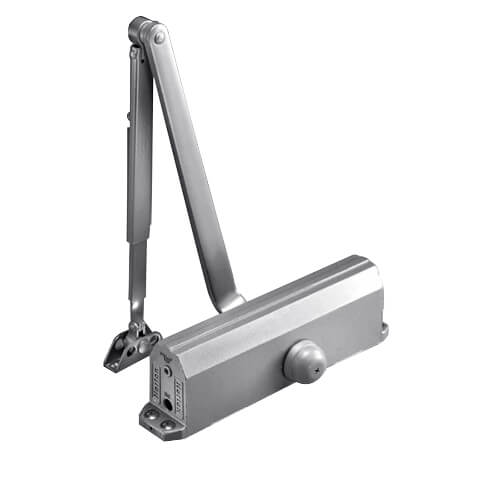
Norton 1600: The Adjustable Closer for a Light Commercial Door
Posted by Kent on 13th Aug 2026
Not every door needs an institutional closer. A small-office entry, a break-room door, an interior door in a tenant suite, these swing a few hundred times a day, not a few thousand, and they do not take the beating a school corridor takes. Spec a heavy 7500 on that door and you have paid for spring power and a cast body you will never use. The Norton 1601 is the closer I reach for on that door: a non-handed, adjustable-spring surface closer that fits most light-to-medium commercial openings, mounts three ways out of one box, and installs in an afternoon. Norton is an ASSA ABLOY brand, the same house as Yale and Corbin Russwin, and the 1600 is their workhorse for the door that just needs to close and latch, every time, without drama.
What the Norton 1600 adjustable closer actually is
The 1600 is a tri-style, non-handed aluminum-body closer with an adjustable spring. Three things in that sentence do the real work, so read them one at a time.
- Non-handed. The same closer works on a left-hand or right-hand door. You do not order a hand, you do not stock two versions, and you cannot put it on backwards. On a multi-door job that is one less thing to get wrong on the packing slip.
- Tri-style mounting. One closer, three mounts: regular arm on the pull side, parallel arm on the push side, or top-jamb. The hardware and the shoe to do all three ship in the carton. You decide at the door which mount clears the frame and the wall, not when you place the order.
- Adjustable spring. The 1600 covers a range of door sizes off one closer instead of forcing you to pick a fixed spring size at order time. You set the closing force at the door to suit the width and the weight, then fine-tune the sweep and the latch with the two valves.
That combination is the whole point. One SKU on the shelf handles a run of ordinary interior and light-exterior doors, and the installer sizes it in place. For a property manager buying for a building, or a contractor closing out a punch list, that is fewer part numbers and fewer callbacks.
When the 1600 is right, and when to step up
The honest line: the 1600 is a light-to-medium-duty closer. It is right for interior office doors, break rooms, conference rooms, light tenant entries, and interior storefront doors that see normal traffic. It is a lot of closer for the money on those openings.
It is not the closer for an abused exterior door, a wind-loaded entrance, or a high-traffic institutional opening. When the door is heavy, catches wind, or takes hundreds of hands an hour, step up to a cast-iron heavy-duty body like the Norton 7500. The tell is simple. If the door is going to get kicked, wind-caught, or pounded, buy the iron. If it is an ordinary commercial door that just needs to shut and latch reliably, the 1600 is the right buy and the cheaper one. Do not over-spec the whole building out of habit, and do not under-spec the one exterior door because the rest of the run was interior.
Regular, parallel, or top-jamb: pick the mount at the door
Because the 1600 is tri-style, the mount is a field decision, and each one has a reason.
Regular arm
Mounts the closer body on the pull side of the door with the arm projecting out to the frame. It gives the most closing power for the least spring, so it is the efficient choice when the swing and the adjacent wall allow the arm to project. On an interior door with clearance, this is the default.
Parallel arm
Mounts on the push side with the arm folded back flat against the door. You use it when the door swings into a corridor and a projecting arm would be a hazard or would hit a wall, or when you simply want the cleaner look with the arm tucked in. It trades a little efficiency for clearance and protection.
Top-jamb
Mounts the body on the frame face above the door rather than on the door itself. It is the answer when the door leaf has no room for the body, a common problem on narrow-rail aluminum and glass doors. Same closer, different real estate.
Hold-open or not
The 1600 comes in a plain closer and a hold-open version. The plain Norton 1601 closes the door every time, no catch. The Norton 1601H hold-open adds a mechanical detent in the arm that holds the door open at a set angle until someone pushes it past, handy on a break-room or a supply door you want to prop while you load in.
One hard rule on that: a mechanical hold-open belongs only on a non-rated door. A fire-rated door must self-close and latch every time, and a mechanical hold-open on a rated opening is a code violation. If you need a rated door to stand open and release on the alarm, that is an electrified hold-open tied to the fire alarm, a different animal entirely. Put the 1601H on the break room, not on the stairwell.
Finish and adjustment
The 1600 ships in the usual commercial finishes, with 689 aluminum the standard and statuary bronze, dark bronze, black, and satin brass available to match the rest of the door hardware. The finish is a painted cover over the aluminum body, so match it to the levers and hinges on the opening and the closer disappears into the door.
Adjustment is two valves: sweep speed for the main travel and latch speed for the last few inches. Set the sweep so the door closes at a controlled pace, then speed the latch just enough to drive the door into the frame and throw the latch. If the door drifts and does not latch, the latch valve is too slow. If it slams the last few inches, it is too fast. Two screwdriver turns, done.
Common questions
Is the Norton 1600 handed?
No. The 1600 is non-handed and tri-style, so one closer fits a left-hand or right-hand door and mounts regular arm, parallel arm, or top-jamb out of the same box. You size the spring and pick the mount at the door.
Can I use the Norton 1600 on an exterior door?
On a light exterior door with normal traffic and no serious wind load, yes. On a heavy, wind-loaded, or high-abuse exterior door, step up to a heavy-duty cast body like the Norton 7500. The 1600 is a light-to-medium-duty closer.
Can I put the hold-open version on a fire door?
No. A mechanical hold-open is only for non-rated doors. A fire-rated door must self-close and latch every time. If a rated door needs to hold open, use an electrified hold-open tied to the fire alarm.
What is the difference between the 1601 and the 1601H?
The 1601 is a standard closer that shuts the door every time. The 1601H adds a mechanical hold-open detent in the arm that keeps the door open at a set angle until you push it closed. Same body, different arm.
Lock Depot stocks the Norton 1600 Series in the standard closer and the hold-open version, in the full commercial finish range. Start at the Norton door closer hub, or if your door is heavier than the 1600 is built for, read Norton 7500: Which Closer for a Heavy Institutional Door. Or call 877-365-5625 with the door width, the swing, and whether it is exterior, and we will get you the right closer and mount.