
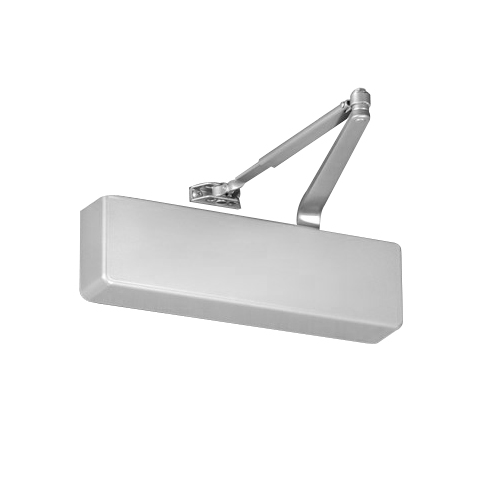
Norton 7500: Which Closer for a Heavy Institutional Door
Posted by Kent on 27th Jul 2026
An institutional door in a school, a hospital, or a government building takes abuse a retail door never sees. It runs all day, it gets propped and yanked, and it has to close every single time or it fails a fire inspection. A residential-grade closer laughs for a month and then leaks oil down the door. The Norton 7500 is built for that door: a heavy-duty institutional closer sized for constant use.
What "institutional" buys you over a standard closer
The 7500 is a cast-iron body with a bigger piston and a heavier spring than a light commercial closer. That is not spec-sheet bragging. It means the closer has the muscle to shut a heavy door against wind or stack pressure in a tall building, and the guts to do it a few hundred times a day for years. On a door that gets used this hard, the cheaper closer is not cheaper. You replace it twice while the 7500 keeps working.
It is an adjustable-spring closer, so one model covers a range of door sizes. You set the spring power to the door instead of ordering a fixed size and hoping. On a heavy institutional door you will usually run it near the top of its range, which is exactly where a lighter closer would already be maxed out and losing.
Mounting: regular, parallel, or top jamb
The three ways a closer mounts decide whether it fits your door and how it looks. The 7500 handles all three, but you order the arm for the one you need.
Regular arm mounts on the pull side and gives the most closing power, but the arm sticks out into the opening. Parallel arm mounts on the push side and tucks up against the door, which is what most institutions want because it stays out of the way and out of reach of people who like to hang on things. Top jamb is for when there is no room on the door face. The S7500 is the regular-arm-only version if you know that is your mount. Figure out which side and which arm before you order, because the wrong arm turns a fifteen-minute swap into a callback.
Hold-open, and the fire-door trap
The 7500-689 is the non-hold-open version. It closes every time, no exceptions. That is what a fire-rated door legally requires. Do not put a mechanical hold-open closer on a labeled fire door, because a door propped open with a hold-open arm fails the fire inspection and defeats the whole reason the door is rated. If you need a door to stay open and still be code-legal, you want an electrified hold-open tied to the alarm, which drops the door shut when the alarm sounds. That is a different animal and a different order. For a standard institutional door that must self-close, the non-hold-open 7500 is the correct spec.
Common questions
What mount for a school corridor?
Parallel arm. It tucks against the door, out of reach and out of the way. Regular arm sticks into the opening and takes more abuse.
Can I use a hold-open on a fire door?
Not a mechanical one. A labeled fire door must self-close. If it has to stay open, use an electrified hold-open tied to the alarm.
Do I need to order a specific door size?
No. The 7500 is adjustable-spring, so one closer covers a size range. Set the power to the door on install.
Lock Depot stocks the Norton 7500 in the standard finishes, regular and parallel arm, in stock. Start at the Norton hub, or read the companion piece on sizing a closer for a heavy door: Which LCN Closer for a Heavy Commercial Door That Slams. Or call 877-365-5625 and tell us the mount and whether the door is fire-rated.