
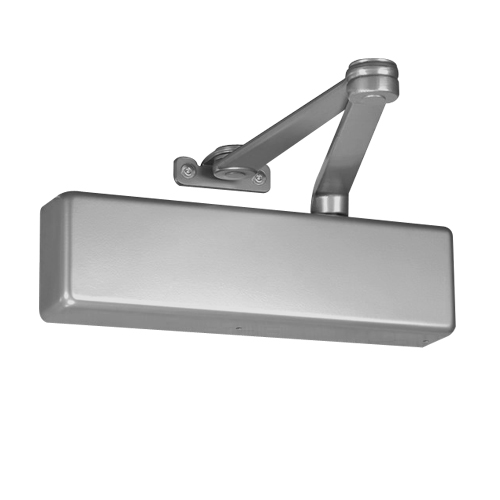
Norton 7570: Security Closer for a Detention or Behavioral-Health Door
Posted by Kent on 12th Aug 2026
A standard door closer is built to be seen and serviced. The arm folds out where you can reach it, the cover pops off with two screws, and the adjustment valves sit right on the face. That is fine on an office corridor. It is a problem on a holding cell, an intake door, a psychiatric or behavioral-health unit, or any door where the person on the other side has time, motive, and nothing better to do than take the hardware apart. For those doors you want a security closer, and the Norton 7570 Series is the one built for it.
What makes a closer a security closer
Three things separate the 7570 from a regular Norton. First, the arm is a rigid one-piece arm, not the jointed forearm-and-main-arm you see on a normal closer. A folding arm gives you a lever and a pinch point. A rigid arm does not fold, so there is far less to grab, pry, or use as a purchase point. Second, the fasteners are tamper-resistant, so the cover and arm do not come off with a screwdriver from the pocket. Third, the whole assembly is heavier and tighter to the door and frame, with less exposed hardware for someone to work at. Norton is an ASSA ABLOY door-control line, the same family as the Rixson floor closers, and the 7570 is their security-grade surface closer.
My take from the field: on a detention or behavioral-health door, the failure you are designing against is not wear, it is intent. A person who wants the hardware off the door will find every screw head and every gap a standard closer leaves exposed. The 7570 removes those. It costs more than an institutional closer like the 7500, and it should, because it is solving a different problem. Do not put a standard closer on a secure door and expect it to survive. It will be on the floor in a week.
Regular rigid arm or parallel rigid arm
The 7570 comes two ways, and the mounting decides which:
- Regular rigid arm. The 7570 with the regular arm mounts on the pull side of the door with the arm reaching to the frame face. It gives strong control and is the standard mount where the pull side is the secure side.
- Parallel rigid arm. The PR7570 mounts on the push side with the arm running parallel and tucked back against the door. Parallel mount keeps the arm out of the swing path and closer to the door, which is usually what you want on a secure opening so there is less arm hanging out to attack.
Where it belongs, and where it does not
Spec the 7570 on holding cells, sally-port and intake doors, secure corridors, evidence and property rooms, and behavioral-health patient areas where hardware gets attacked. That is its job. Where it does not belong is the ordinary office, classroom, or lobby door. A rigid arm and tamper hardware buy you nothing on a door nobody is trying to defeat, and you give up the easy field adjustment a standard closer gives you. If the door is just heavy and abused rather than secured against a person, the institutional 7500 is the closer to read up on instead. Match the closer to the threat, not to the biggest number in the catalog.
Finish
The 7570 lists in the standard closer finishes: 689 aluminum is the common commercial spray, with statuary bronze (690), light bronze (691), and black (693) available where the design calls for a darker cover. On most secure openings the cover is the least of your concerns, so 689 aluminum is the default unless the specifier wants a specific color.
Common questions
What is different about a security closer?
A rigid one-piece arm instead of a folding arm, tamper-resistant fasteners, and a heavier assembly with less exposed hardware. It is built to survive deliberate attack, not just heavy use.
Regular arm or parallel arm?
It depends on which side of the door is secure. Regular arm mounts pull side; parallel arm mounts push side and tucks the arm back against the door. On most secure openings parallel keeps the least arm exposed.
Is the 7570 the same as the institutional 7500?
No. The 7500 is a heavy-duty institutional closer for abuse and traffic. The 7570 adds the security features (rigid arm, tamper hardware) for doors where a person is actively trying to defeat the hardware. Different problems.
What do you need to order one?
The door's hand, which side is the secure side, and the door and frame type. Those set the arm configuration and the mounting hardware.
Lock Depot stocks the Norton 7570 security closer in regular and parallel rigid-arm configurations. Start at the Norton hub, or if your door is heavy and high-traffic rather than a secured opening, read Norton 7500: Which Closer for a Heavy Institutional Door. Or call 877-365-5625 with the hand, the secure side, and the door type, and we will send the right security closer and the tamper hardware to hang it.