
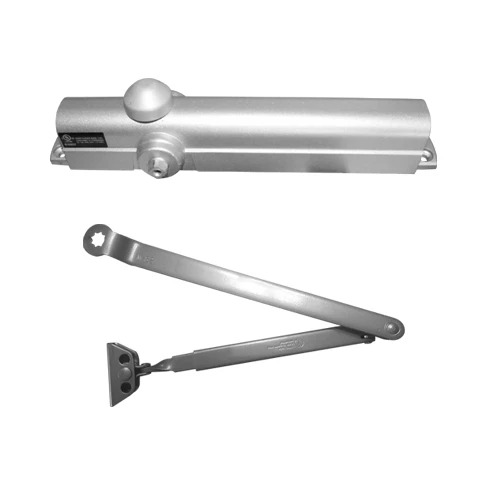
Norton 8000 Series: Regular, Parallel, or Top Jamb Arm
Posted by Kent on 19th Sep 2026
A door closer looks like a simple part until you get to the jobsite and find out the wall behind the hinge side won't clear a regular arm, or the frame has a deep reveal that a standard bracket can't reach. That's the moment you find out whether the closer in your hand can actually mount three ways, or whether you guessed wrong and you're driving back to the shop.
The Norton 8101 (8000 Series) is built for exactly that uncertainty. One closer body. Three legitimate mounting arms. You pick the one the door actually needs, at install, not at order time.
One body, three arms: what "Tri-Style" means
Norton calls the 8000 Series "Tri-Style" because the same closer accepts a regular arm, a parallel arm, or a top jamb mount to a 3-inch reveal. It's a medium-duty, non-handed closer, certified ANSI/BHMA A156.4, Grade 1, rated past 15 million cycles. Cast aluminum body. Rack-and-pinion internals, not a cam. A 1-1/4" diameter piston and 5/8" pinion journals that don't wallow out after a few thousand doors. Spring size is field-adjustable 1 through 6, so the same unit closes a light office door or a heavier exterior slab depending on how you set it.
None of that matters if you order the wrong arm kit. Here's how the three break down.
Regular arm: the default, if nothing's in the way
Regular arm mounts on the pull side, closer body on the door, arm running back to the frame. It's the strongest of the three geometrically and the one to default to. Use it unless something specific rules it out: a wall that dead-ends right past the hinge, a corridor too narrow for the arm to swing clear, or a push-side-only install.
Parallel arm: when the swing needs to hug the door
Parallel arm mounts the arm alongside the door face instead of projecting out toward the frame. It's the one to spec when there's a wall, a piece of casework, or another door close enough that a regular arm's swing radius would hit it. Costs you a little mechanical advantage. Buys you clearance. I've put these on vestibule doors where the second door was twenty inches away, and a regular arm would've clipped it on every open.
Top jamb, to a 3" reveal: when the frame is set back
Top jamb mount puts the closer on the frame head instead of the door, arm dropping down to the door face. This is the one that saves the call when the frame has a deep reveal, up to 3 inches, and a door-mounted arm geometry won't reach or work at the right angle. Recessed storefront returns and some retrofit metal frames run this deep. Measure the reveal before you order. Guessing here is how a closer ships back.
The gotcha nobody reads until they're standing at the door
The cover is not included. That's stated plainly in Norton's own spec sheet and it still catches people, because most closers in this price range ship with one. If the job needs a finished look, order the cover separately or confirm it's already on hand. Also: door thickness range is 1-3/4" to 2-1/4". Outside that, this isn't your closer regardless of arm style.
Finish-wise, the 8101 comes in aluminum, statuary bronze, dull bronze, and black, so matching storefront metal or a painted hollow metal frame isn't a problem. Pick the finish, then pick the arm, not the other way around.
When the 8000 isn't enough closer
Medium duty means exactly that. If the door in question is an institutional entrance that gets kicked open forty times a shift, or a detention-grade opening that needs to survive genuine abuse, don't stretch the 8000 to cover it. Step up to something built for that load. Our Norton 7500 piece covers the sizing question for an abused door in more detail. Save the 8101 for the doors it's actually rated for: standard office, retail, and light commercial traffic, where 15 million cycles is more than the building will ever ask of it.
Skip guessing on arm style from a catalog photo. Pull the reveal measurement and check for wall clearance before you order. It's five minutes at the door and it's the difference between a closer that goes on today and one that goes back in a box.
Lock Depot stocks the Norton 8101 in aluminum and the other finish options, ready to ship. Full Norton closer lineup is on the hub if the 8000 turns out to be the wrong step.
Common questions
Can I change the arm style after the closer is installed?
Not without removing it and remounting with the new arm kit and template. The mounting holes and arm geometry differ between regular, parallel, and top jamb. Decide before you drill.
Is the Norton 8000 Series handed?
No. It's non-handed, which means one stocked unit works on a left-hand or right-hand door regardless of swing. That's one less thing to get wrong on the order.
What spring size should I set it to?
Depends on the door — weight, width, and how much wind or stack pressure it fights. The 8101 adjusts across sizes 1 through 6 in the field, so start in the middle of the manufacturer's recommended range for the door size and tune from there once it's hung.
Does the 8000 Series come with a cover?
No. The cover ships separately. If the install needs a finished appearance, order it with the closer — don't find out at the punch-list walk that it's missing.
What's the difference between the 8000 Series and the 7500 Series?
Duty rating. The 8000 is medium duty for standard commercial doors. The 7500 is built for institutional and heavy-abuse openings — see the 7500 article for where that line sits.