
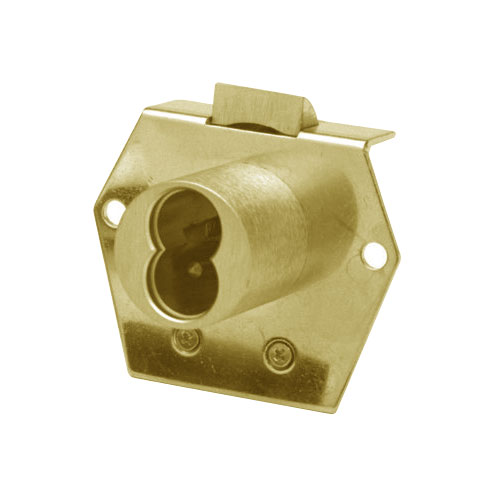
Olympus 725: An SFIC Cabinet Lock That Matches Your Cores
Posted by Kent on 21st Sep 2026
Olympus 725: An SFIC Cabinet Lock That Matches Your Building's Cores
Every door in the building runs on interchangeable cores, best or arrow keyway, and the master key system took months to set up correctly. Then facilities orders a file cabinet lock or a supply closet drawer lock from a hardware store, and it shows up with its own dedicated key that has nothing to do with the building's system. Now there's a second key ring, a second key nobody can find in six months, and a lock the master key doesn't open. The Olympus 725 Series exists so that never has to happen again: it's a cabinet and drawer lock built around Small Format Interchangeable Core (SFIC), the same core format running the rest of the building.
What SFIC actually buys you here
The 725 accepts best, arrow, or equivalent IC cores, in 6 or 7 pin configurations, the same core format a locksmith pulls and swaps on a mortise lock or a cylindrical lockset without disassembling the hardware. Pull the core from a 725 cabinet lock with the control key, drop in a new one keyed to the building's current system, and the cabinet lock is back in the master key system in under a minute. No drilling, no replacing the whole lock body, no separate key for facilities to track. The lock ships without a core included, because the entire point is that you're keying it to match what's already in the building, not starting a new keyway from scratch.
Both variants use a 1-1/8" barrel diameter and a 1-1/16" barrel length, and both are built for a vertical-handed drawer installation. Each comes with a 725-1 spacer to fit either a 6-pin or 7-pin core, so the same lock body works across a mixed core inventory without ordering a different spacer part number for each.
Surface latch or rim deadbolt
The 725RL is a surface-mount latch mechanism, the simpler of the two: the latch bolt engages automatically when the drawer closes, no separate lock step required. It ships with a 725-SP-RL solid lipped strike and a plastic thumbturn for quick manual retraction from inside if needed.
Step up to the 725RD and you get a rim-mount deadbolt instead. It requires a deliberate turn of the key or thumbturn to throw the bolt, which is the right call for a drawer or cabinet you actually want to confirm locked, not just closed. It ships with a 725-SP-RD solid rectangular strike, and the key is removable in either the locked or unlocked position, so staff aren't stuck pulling a key out mid-turn.
Picking between them
If the contents are low-value and the goal is mainly keeping a drawer from sliding open on its own, the 725RL latch is enough, and it's faster to use because there's no separate lock action. If you're storing anything you need a real, confirmable locked state for (petty cash box, a supply cabinet with controlled medical stock, a records drawer), spend the extra step and order the 725RD deadbolt. A latch that "usually" stays shut is not the same commitment as a deadbolt someone deliberately threw and can verify by trying the drawer.
Either way, order the core separately from your usual key-control vendor or through us if you already buy BEST or Arrow cores from Lock Depot, and specify the keyway and pinning before the cabinet lock ships so the two arrive ready to combine rather than sitting in a drawer waiting on a second shipment.
Where this actually gets installed
The 725 shows up most on the jobs that never make it onto a hardware schedule: a nurses' station supply drawer, a records room file cabinet in a school district office, a maintenance shop parts cabinet where three different shifts need the same key. Nobody writes a spec for a cabinet lock the way they write one for a storefront door, and that's exactly how a building ends up with forty mismatched cabinet keys rattling around a facilities office drawer of their own. Standardizing on SFIC for cabinet hardware the same way you standardized on it for doors closes that gap quietly, one drawer at a time, instead of leaving it as a problem nobody owns.
If you're rekeying a building or bringing a newly acquired property onto your existing master key system, don't forget to audit the cabinets and drawers along with the doors. A facility that's fully rekeyed on the door side but still running the original hardware-store keys on every file cabinet hasn't actually finished the job. It just moved the loose-key problem from the doors to the furniture.
Common questions
Does the core come with the lock?
No. The 725 ships without a core so you can key it to match your building's existing system. Order the core separately in your keyway and pinning.
Can I use a Schlage keyway core in this lock?
The 725 is built for best, arrow, or equivalent SFIC cores in 6 or 7 pin configurations. If your building runs a different core format, confirm compatibility with us before ordering rather than assuming it fits.
What's the real difference between the RL and RD versions?
The RL is a surface-mount latch that engages automatically when the drawer closes. The RD is a rim-mount deadbolt that requires a deliberate key or thumbturn action to lock, giving you a confirmable locked state instead of a latch that's simply closed.
Will one spacer work for both 6-pin and 7-pin cores?
Yes. The included 725-1 spacer fits either configuration, so the same lock body accepts a 6-pin or 7-pin core without a separate part number.
Is this a horizontal or vertical drawer lock?
Vertical-handed. Confirm your drawer orientation before ordering, since a vertical-handed lock will not install correctly on a horizontally-oriented drawer front.
Both configurations are in stock in multiple finishes. Browse the rest of the SFIC-compatible cabinet hardware on the Olympus hub, and see our write-up on the Olympus 800LCM for a cabinet deadbolt built the same way, keyed to your building instead of a hardware-store blank.