
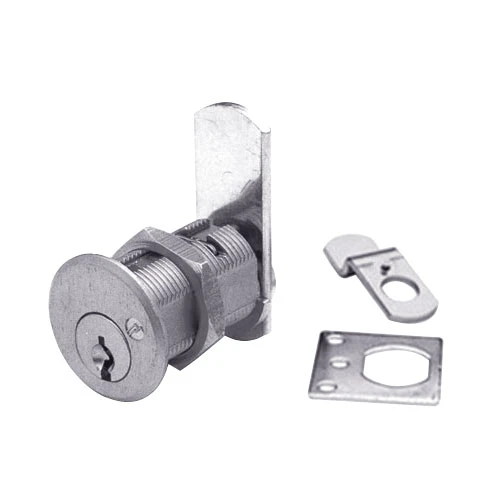
Olympus DCR4 vs DCN4: Keying a Row of File Cabinets Alike
Posted by Kent on 12th Sep 2026
A row of file cabinets that all take a different key is how an office ends up with a drawer full of loose keys nobody can identify, or a lock that gets drilled out because the one person who had the key left the company. The fix is cheap and mechanical: replace the cam locks with a set keyed alike, so one key opens every cabinet in the row. The two candidates on the shelf are the Olympus DCR4 and DCN4 reversible cam locks, and the difference between them is the one spec that decides whether your new locks integrate with existing hardware or start a second, incompatible keying system.
R Series or N Series: the pin count is the whole decision
The DCR4 is Olympus's R Series, a pin tumbler cylinder drilled for 5 pins. The DCN4 is the N Series, a National-pattern cabinet lock built to a 4-pin standard. Both are reversible cam locks with a 1-3/4" cylinder length, both ship with two keys per lock, and both let the cam be repositioned to work in any locking orientation once installed. The pin count isn't a security tier so much as a compatibility question: if the building already has R Series or N Series cabinet locks anywhere, matching that series is what lets a new bank of cabinets share a master key or at least a common keying vendor relationship with what's already installed, rather than starting a parallel key system nobody can cross-reference.
If there's no existing cabinet lock standard to match, either series does the job on a new order. The practical difference at that point comes down to what's already stocked, since a facility standardized on one pin count keeps spares, key blanks, and re-key kits simpler to manage than running both in the same building.
Keyed alike versus keyed different, and why it matters more than the series
Both the R and N Series ship in keyed different and keyed alike versions, and this is the choice that actually solves the "which key opens this drawer" problem. A keyed-different order gives every lock its own unique key, which is correct for a row of employee lockers where each person should only open their own. A keyed-alike order, like the DCR4-KA4T2 or DCN4-KA101 variants, cuts every lock in that batch to the same key, which is what a facilities manager wants on a bank of shared file cabinets, storage drawers, or supply cabinets where one key holder needs access to all of them.
The keyed-alike code on the SKU (KA4T2, KA101, and similar) identifies the specific key cut shared across that batch. Order every cabinet in the row under the same keyed-alike code, not just the same series, or you'll end up with locks that look identical and still take different keys.
Installing into an existing cutout
Both series install into the same standard cam lock cutout common to metal file cabinets and casework, and the cylinder is rekeyable in the field via the cylinder retainer clip rather than requiring a full lock swap if the keying needs change later. That matters on a facility that expects staff turnover: rekeying a retainer-clip cylinder is a five-minute job per lock, while replacing the whole cam lock assembly is not. Confirm the cylinder length against the cabinet's panel thickness before ordering; a 1-3/4" cylinder that's too long or too short for the drawer front is the most common return on a cam lock order, and it has nothing to do with which series you picked.
Finish is a cosmetic choice, not a security one
Each series ships in multiple finishes, Satin Chrome and Bright Brass among them, and the finish has no bearing on the pin count, the keying, or the cam's holding strength. Pick the finish that matches the cabinet hardware already on the drawer front so the replacement doesn't stand out, and don't let a finish preference drive the series decision; that gets the compatibility question backwards. If the existing cabinets mix finishes already, a cam lock replacement is a reasonable point to standardize the finish across the row at the same time, since you're already ordering and installing new hardware.
Order a spare cylinder or two beyond what the current cabinet count needs. A facility that expands its filing or storage footprint later, or loses a key and needs a same-day rekey, will use those spares faster than expected, and matching a keyed-alike code months after the original order means tracking down the exact code again rather than pulling a spare off the shelf.
Common questions
Can I mix R Series and N Series locks in the same bank of cabinets?
Mechanically yes, since each lock is independent, but they won't share a key or a master key system with each other. If the goal is one key for the whole row, standardize on one series and one keyed-alike code across every cabinet in that row.
How do I know which series is already installed in my building?
Pull one existing cylinder and count the pin chambers, or check the lock face for an "R" or an "N" series marking if one is present. When in doubt, bring the old cylinder or a clear photo of it when ordering replacements rather than guessing.
What does the keyed-alike code on the SKU actually control?
It identifies the specific key cut shared by every lock ordered under that code. Two locks with the same keyed-alike code take the same key; two locks with different codes, even in the same series, do not.
Can these cam locks be rekeyed later without replacing the whole lock?
Yes. Both series use a cylinder retainer clip that lets the cylinder be pulled and rekeyed in the field, which is faster and cheaper than replacing the full cam lock assembly when a keying change is needed.
Do these locks come with a master key option for a building with many keyed-alike groups?
Master keying is available through Olympus's broader cam lock program beyond a single keyed-alike batch; for a multi-group building, work out the full keying schedule before ordering rather than adding groups one cabinet at a time.
For a different Olympus cabinet-hardware decision, matching a deadbolt to your building's existing keyway, see Olympus 800LCM: Cabinet Deadbolt on Your Building's Keyway. The full cam lock and cabinet lock line is on the Olympus hub.