
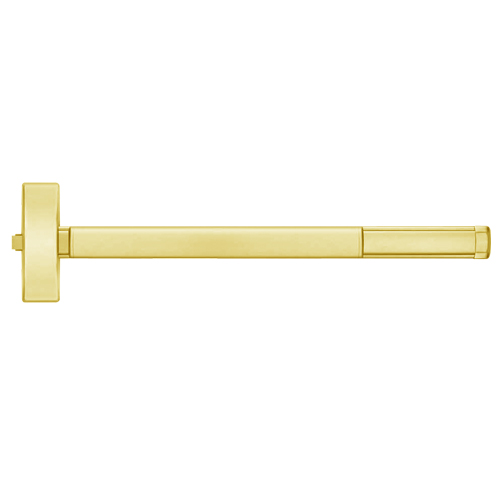
PHI 2100 Fire-Rated Electric Exit Devices: ELRFL to TSFL
Posted by Kent on 26th Nov 2026
A fire door that also has to talk to access control
Stairwell doors, corridor doors and many exits sit in rated openings, and a lot of those same doors now need a card reader, a delay or a monitor on them. The PHI Apex 2100 comes in a fire-rated version of each electric option, with an FL added to the prefix: ELRFL, MLRFL, DEFL and TSFL. This guide goes through what the listings say about those four, and what changes when the device is fire rated. It uses the 36 inch bright brass version of each.
For the base device and its prep numbers, see our PHI 2100 function prep guide. For why anyone looks at PHI against the big-name rim device, see our Apex 2100 comparison.
The big change: no dogging
Every one of the four listings says "Dogging feature is not available." The non-fire-rated 2100 has a 1/4 inch turn hex key dogging as standard. On a fire-rated device, that is gone.
That is not a defect. Dogging holds the latch retracted so a door can sit unlatched, and a rated door has to latch every time it closes. If a building manager asks you to dog a rated door during business hours, the answer is no, and the electric options below are the legitimate way to get the same convenience. A door that releases on a card read and then latches behind the person is a fire door that still works for a busy lobby.
What stays the same
Per the listings, the four share the body of the standard 2100:
- UL listed and certified to ANSI A156.3 Grade 1.
- Door size 36 inch (2 foot 7 inches to 3 feet).
- Non handed, wide stile.
- Stainless steel deadlocking latchbolt, 3/4 inch throw.
- S300 investment cast stainless steel strike, black powder coated, furnished standard.
- Touchbar height of 39-15/16 inches from the floor.
- Exit only, prepped for a cover plate. Cylinder and trim are not included.
The listings say "fire rated device" and nothing about the rating period or the door and frame it was tested on. That is a gap, and I will not fill it with a number. The label on the device and the listing on the frame tell you what the opening is good for. Check both before you write it into a schedule.
ELRFL: electric latch retraction, fire rated
ELRFL2101-605-36. The listing says electric latch retraction and that it requires an ELR150 series power supply. Use this when a credential should retract the latch on a rated door so someone can walk through without pressing the bar. The listing does not say how long the latch stays back or what happens on loss of power. For a rated opening, those answers matter, because the door has to latch and, on a power failure, has to behave the way the fire marshal expects. Get the answers in writing before you order.
MLRFL: motorized latch retraction, fire rated
MLRFL2101-605-36. The listing says motorized latch retraction and gives no power supply. It also gives no voltage or current. Like the ELRFL, it fits a door where a credential does the pulling. Do not assume the ELR150 supply serves it. Ask us for the electrical data first.
DEFL: delayed egress, fire rated
DEFL2101-605-36. The listing gives a 15 second delay and calls for a PS161-6 power supply. Delayed egress on a rated door is the combination that most often gets turned down by the authority having jurisdiction, because you are asking a door to hold people for 15 seconds while also being a fire door. Many jurisdictions allow it only under strict conditions, such as tying the delay to the fire alarm so the door releases when the alarm sounds. I do not know your jurisdiction. Call the fire marshal before you buy this device, not after you install it.
TSFL: touchbar monitoring switch, fire rated
TSFL2101-605-36. This one includes a touchbar monitoring switch. It does not change how the door opens. It reports that the bar was pushed. On a rated door, it is the simplest electric option and the one least likely to raise a code question, since the door works as an ordinary fire exit and the switch only watches. The listing gives no contact rating or wiring details, so get the spec sheet before you connect it to a panel.
Check the opening, not only the device
A fire-rated exit device does not make a door rated. The door leaf, the frame, the hinges and the closer each carry their own label, and the device has to be one the door's listing allows. Before you order, read the label on the edge of the door and the frame. If the opening is a pair of doors with a mullion, the mullion needs to be right as well. When a rated door fails an inspection, it is usually a missing closer or a painted-over label, not the panic hardware. Walk the opening first and the exit device choice gets easier.
Pick by the problem
- People with credentials should walk through a rated door: ELRFL or MLRFL.
- A pause is wanted before release: DEFL, only with the fire marshal's agreement.
- You only want to know the exit was used: TSFL.
If the door is not rated, the non-fire-rated versions are a separate list and they keep the dogging feature. We cover those in a separate guide. The full range is on the PHI exit device page.
What the listings do not say
No fire rating period, no voltage, no current draw, no wiring and no retraction time appear on any of the four. Whether a version is approved for a given door and frame depends on the labels and the local authority, neither of which a catalog listing can settle. Send us the door, the frame label, the access control and what the fire marshal said, and we will match the right letters.