
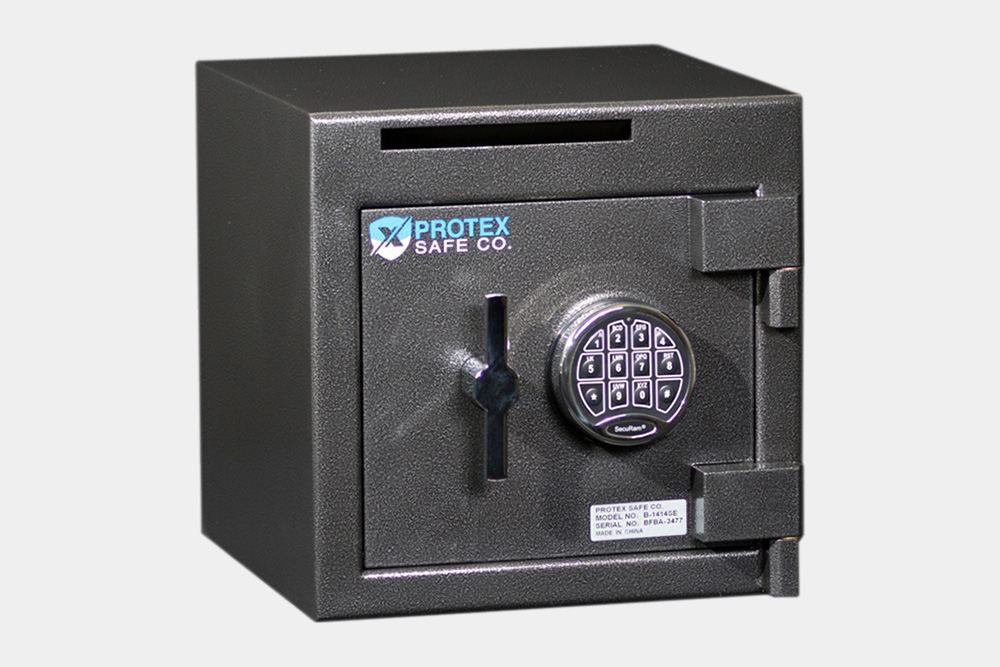
Protex B-1414SE or HD-53: Depository Safe vs Burglary Safe
Posted by Kent on 30th Oct 2026
Two safes, two different problems
The Protex B-1414SE and the Protex HD-53 get compared because both are electronic-keypad steel safes you can bolt to a floor and both are about a foot and a half on a side. They are built for opposite jobs. One is a depository: money goes in through a slot and the person who dropped it cannot get it back. The other is a burglary safe: it holds what you put in by opening the door. If you buy the wrong one, you will feel it every closing.
Start with the question: who handles the cash?
A depository safe exists to take the cashier out of the loop. The cashier drops the till overage through a slot. The manager opens the safe at close. An employee with a keypad code to a regular safe can open it, and so can anyone who learns the code. A depository separates "can put money in" from "can take money out."
The register cash guide covers getting money out of an open drawer. This one covers what to buy once you have decided a lockable place is needed.
The numbers
| B-1414SE | HD-53 | |
|---|---|---|
| Type | Top-loading depository safe | Electronic burglary safe |
| Outside (H x W x D) | 14" x 14" x 14" | 20-7/8" x 14-7/8" x 14-1/4" |
| Inside (H x W x D) | 12" x 13-3/4" x 11" | 19" x 13-1/4" x 10-3/8" |
| Weight | 63 lb | about 106 lb (the listing shows 105 in one place and 106 in another) |
| Lock | Securam electronic keypad, backup key | Electronic keypad, backup key |
| Bolts | 3 chrome bolts, 1" diameter | Chrome locking bolts, 1" diameter |
| Anchoring | Four bolt-down holes | Bolt-down anchor holes |
| Deposit slot | 7" x 1/2", anti-fish baffle | None listed |
What the B-1414SE does
The B-1414SE has a 7-inch by half-inch drop slot, and behind it an anti-fish baffle plate so nobody can reach back in or fish a deposit out with a hooked tool. Folded bills and deposit slips go through. A half-inch slot will not take a zippered bank bag, so plan on loose cash and slips, or pick a different model with a longer chute; the listing points to the Protex FD-2014 LS II for that.
The construction is stated plainly: 0.100-inch solid steel body, fully welded; a half-inch solid steel door plate; three 1-inch chrome bolts; a drill-resistant hard plate; a spring-loaded relocker; and four anchor holes. A relocker is the backup that throws extra bolts if someone attacks the lock, so a punched-out lock still does not open the door. At 14 inches square it fits under a standard counter.
A word about rating. The listing says B-Rate construction, and that describes steel thickness, not a UL certification. Nobody tested this safe against a UL attack protocol. That is not a flaw, it is a fact to know before your insurance carrier asks. If your carrier requires a specific rating for cash on premises, ask them first and read us the line.
What the HD-53 does
The HD-53 is the step up from a nightstand safe. It weighs around 106 pounds, with heavy 1-inch chrome bolts and an electronic keypad with backup key, and it has bolt-down anchor holes. The listing says it holds cash, documents, firearms or jewelry, and that people buy it when a smaller one feels too light. The interior is 19 inches high, which gives you vertical space the B-1414SE does not have.
What it does not have, on the listing, is a drop slot. That is the whole difference. Every deposit means opening the door, so anyone who holds the code can take out what is inside. For a back office where one or two trusted people handle the money, that is fine. For a counter with five cashiers, it is exactly the problem a depository solves.
I do not have a stated burglary rating for the HD-53 in the text I worked from. If a rating matters for your insurance, ask before you order.
How I would choose
- Cashiers dropping money all day, manager opens at close. B-1414SE.
- Owner or office manager storing cash, checks, deeds and a firearm in one place. HD-53.
- Both problems. Buy both. A depository under the counter, and the burglary safe in the back office for the manager's morning bank run.
If volume is higher than a 14-inch box handles, look at a wider body such as the one in the AMSEC BWB3020 guide.
The habit that makes either safe work
A safe does nothing for a business that does not use it. The habit I push on every owner is simple: make a drop at a set point, not at the end of the shift. When the till passes a limit you pick, say the second large bill that goes in, the cashier drops the excess through the slot and writes the time on the drop sheet. Then the drawer never holds much, and the thing a robber sees when the drawer opens is not worth the trouble. A depository only pays off if people actually feed it during the day.
The HD-53 works the same way in a back office, with one difference: the manager opens the door to deposit, so the deposit log lives on paper beside it. Keep the log, keep the code to as few people as you can, and change it on a schedule.
Install notes that matter
- Bolt it down. At 63 pounds the B-1414SE is liftable by two people. Both safes have anchor holes for a reason. Anchor to a slab or a structural member, not just a shelf.
- Program your own code. The B-1414SE listing says you set the code yourself. Change it when a key employee leaves.
- Keep the backup key off-site. A backup key in the register drawer defeats the safe.
- Freight. Both ship by freight carrier and do not qualify for free shipping; call (877) 365-5625 for a quote.
Questions we get
Can the manager see what was deposited without opening it?
No. The listings do not describe a log or a window. Count at close.
Is B-Rate the same as a UL rating?
No. It describes steel thickness. UL rates by attack testing.
Does the HD-53 come in a fingerprint version?
The listing points to the HZ-53 for fingerprint access at this size, and the HD-73 for a bigger body.