
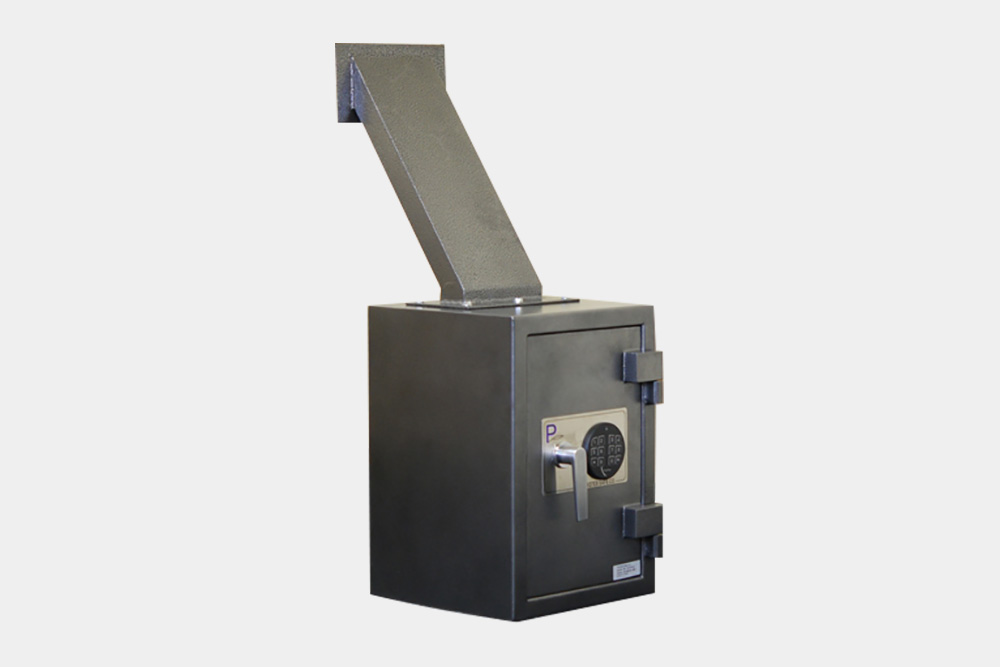
Protex FD-2014 LS II vs FD-2714 vs FD-3020 II vs RD-1612
Posted by Kent on 23rd Nov 2026
Depository safes are bought by volume and by bag size
Most people shopping for a depository safe start with price and end up regretting the chute. Here is the order I use instead. First, how many deposits go in between openings. Second, what the deposit looks like: a folded bill and a slip, or a zippered bank bag. Third, where the person emptying it will stand. The four Protex models below answer those three questions differently, so a few minutes with a tape measure and the drop sheet saves a return.
All four are depository designs. Money goes in through a slot, an anti-fish baffle keeps it from coming back out, and the person who made the drop cannot take it back. If you want the difference between a depository and a plain burglary safe first, the B-1414SE versus HD-53 guide covers it.
The numbers from the listings
| FD-2014 LS II | FD-2714 | FD-3020 II | RD-1612 | |
|---|---|---|---|---|
| Outside (H x W x D) | 20" x 14" x 14" | 27" x 14" x 14" | 30" x 20" x 20" | 16" x 12-1/2" x 14" |
| Inside (H x W x D) | 19-3/4" x 13-3/4" x 11" | 15" x 13-3/4" x 11" | 18" x 19-3/4" x 17-1/2" | 8-1/2" x 12-1/4" x 11" |
| Weight | 103 lb | 116 lb | 175 lb | 70 lb |
| Lock | Electronic keypad | Keypad with backup key | Keypad with backup key | Electronic keypad |
| Loading | Front, long chute | Front | Front | Rear retrieval, front slot |
The first three list five active bolts at 1-1/8 inch diameter and a 1/4-inch drill-resistant hard plate over the lock. The RD-1612 listing does not give a bolt count or a plate thickness, so I will not tell you it matches.
FD-2014 LS II: the long chute is the point
The listing calls out the extended chute for a reason. A short slot jams on a thick envelope, and a cashier who fights a slot at 10 p.m. starts leaving cash in the drawer. The long chute is meant to take full-size deposit bags and thick envelopes without a struggle. That is why it suits convenience stores and quick-service counters, where the drop is a bag, not a bill.
It is also the smallest of the three front-loaders, 14 inches square, so it fits under a counter or in a tight back room. The interior is 11 inches deep, which limits how many stuffed bags it holds before the manager has to empty it.
FD-2714: same footprint, more room to stack
The FD-2714 shares the 14-inch footprint and goes up to 27 inches. The listing says it holds a full week of deposit bags for a business doing a few thousand dollars in daily cash. I will leave that business-size claim as the maker's. What the numbers show is that the interior height is 15 inches inside a 27-inch body, so a good share of that height is not storage. The listing does not say what fills it. If you stack tall envelopes on edge, measure against the 15 inches, not the outside.
The listing also does not describe a long chute for this model. If your drops are bags and you want a 14-inch footprint, the LS II is the one to look at.
FD-3020 II: the back-office safe for a busy room
This is the big one at 30 inches tall and 20 square, and 175 pounds. The listing aims it at a restaurant doing a couple hundred covers a night, with servers and bartenders dropping all shift. The interior, 19-3/4 inches wide and 17-1/2 deep, is the roomiest of the group. The listing mentions an audit trail on the keypad. It does not say how many entries the lock stores or how you read them, so ask us before you promise your owner a printable report.
Because it weighs 175 pounds it ships by freight, and once it is on the slab with four bolts through the anchor holes it is not leaving with anybody who does not have a truck.
RD-1612: the counter model that opens from behind
The RD-1612 is the odd one. You deposit through a front slot and retrieve from the rear. The listing describes a check cashing counter or a pharmacy drop-off: the clerk sits behind a partition, the customer feeds paperwork in through the slot, and nothing on the customer side can open it. At 70 pounds and 16 inches high it sits on a counter or shelf. It is a depository for paper, not for stacks of bank bags: the interior is only 8-1/2 inches tall.
How I would choose
- Bagged deposits, tight space. FD-2014 LS II.
- Tall stacks of envelopes, same footprint. FD-2714.
- High volume, a dedicated back-office spot. FD-3020 II.
- Customers or clerks on opposite sides of a partition. RD-1612.
If you need two separate doors, one to deposit and one to retrieve, none of these four does that. Ask about the dual-door models from the same maker.
Read the rating line before you tell your insurance carrier
The listings say B-Rate construction and state plainly that B-Rate describes steel thickness, not a UL certification. Nobody has attack-tested these against a UL protocol on this page. If your policy requires a certified rating for cash on the premises, ask your carrier what they accept before you order.
Install notes
- Anchor it. The three front-loaders list four bolt-down anchor holes. Use them into a slab or structural member.
- Change the code when a key employee leaves. The keypad lock is easy to reset, and that is the advantage over a key.
- Keep the backup key away from the safe. A backup key in the register drawer defeats the whole idea.
- Freight. These ship by freight carrier. Call (877) 365-5625 for a quote and the best delivery window.
Questions we get
Will a zippered bank bag fit?
The FD-2014 LS II is the one the listing describes as taking full-size deposit bags. For the others, measure your bag against the slot before you order.
Can the cashier get a deposit back out?
The listings describe anti-fish protection on all four. That is the purpose of a depository.
Is there a smaller option that needs no floor space?
See the register cash guide for wall drop boxes, which hold less but need no floor space.