
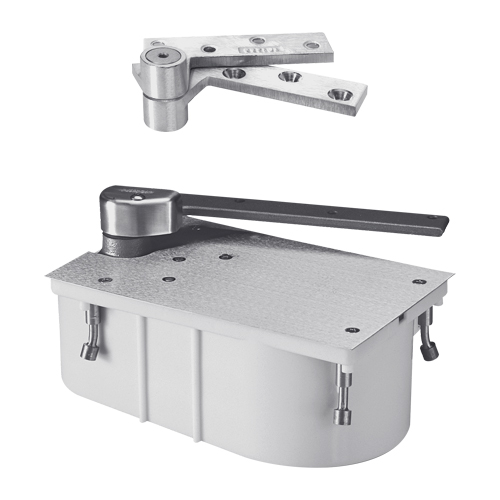
Rixson 27-180N vs 27-180A: Hold-Open or Not
Posted by Kent on 18th Sep 2026
Same floor closer, one letter that changes how the door behaves
If you have already priced a Rixson 27 Series floor closer for a heavy pivoted or glass door, you have run into the second decision the part number hides: N or A. Same body, same offset-hung mounting, same 450-pound weight capacity, same 4-foot door width rating. The letter tells the closer whether it lets go of the door at the top of the swing or fights to bring it shut every time.
The 27-180N is non hold-open. The 27-180A is automatic hold-open. Order the wrong one and you either have a door that will not stay open for a hand truck, or a door that will not close behind a delivery crew that just walked past it.
27-180N: the door always wants to close
The 27-180N closes the door on every cycle no matter how far someone pushes it open. There is no mechanism holding the door at 90 or 180 degrees; the hydraulic closer body just meters the swing back to latched. This is the right closer for any opening where an open door is a problem you cannot allow even temporarily: a fire-rated pair, a stairwell door, an exterior entrance where an open door means climate control and security both walk out at once.
It is built to ANSI/BHMA A156.4 standards, rated for a door up to 450 lbs. and 4 feet wide, with a maximum opening of 180 degrees. Rixson also notes it is non fire rated on its own; a fire door assembly needs the closer paired with the correct rated frame, pivots, and hardware set as a whole, not the closer certifying the door by itself.
27-180A: the door stays open until something tells it to close
The 27-180A is mechanically identical, same weight and width ratings, same adjustable hydraulic backcheck, same offset-hung mount, but it adds automatic hold-open. Push the door past a set point and it stays there on its own instead of drifting back shut. This is the closer for a loading dock door that gets propped for an hour of deliveries, a mechanical room a technician is in and out of all day, or any pivoted glass entrance where you genuinely want it to stay open during business hours and only close itself after that set point is released.
One trade-off applies here: an automatic hold-open closer on a door that is supposed to always self-close, like a fire-rated stairwell, is a code problem waiting to happen. Hold-open only belongs on a door where staying open is a normal, intended state, and it should never sit on a rated fire door unless it is tied into the building's fire alarm system so it releases and closes on alarm, which the plain 27-180A is not built to do on its own.
What does not change between them
Both versions share the same 3/4-inch offset-hung mounting style, the same adjustable hydraulic backcheck to slow the door before it slams into a wall or stop at the end of its swing, and the same handing options: order left-hand or right-hand to match the door, and both are available across the same finish range. Neither includes the top pivot as a separate consideration; Rixson notes a standard 180-degree top pivot is included, but you still need the correct cement case set into the floor to receive the closer body, same as on any floor closer installation.
Getting the handing right
Floor closers are handed, and getting it wrong means a closer that fights the door instead of controlling it. Stand on the outside of the opening, looking at the door. If the hinges (or pivots) are on your left and the door swings away from you, it is left-hand. If the pivots are on your right, it is right-hand. Both the 27-180N and 27-180A ship in LH and RH versions; confirm handing before ordering, because a floor closer set into concrete is not a same-day fix if it arrives wrong.
Which one to order
Default to the 27-180N unless you have a specific, ongoing reason the door needs to stay open on its own. A door that only occasionally needs to be propped is better served by a door-mounted hold-open arm a person sets manually, not a closer that decides to hold the door open every single time it swings past a certain point. Reserve the 27-180A for doors where staying open is the normal daytime state: dock doors, shop doors, mechanical spaces with constant foot and cart traffic. See the full line on the Rixson hub.
Common questions
Can I order the 27-180N now and add hold-open later?
No. Hold-open is built into the closer's internal mechanism, not a field-installed accessory, so switching from non hold-open to hold-open means ordering the other model, not adding a part to the one you already have.
Is either version rated for a fire door?
Neither is fire rated on its own. A fire-rated opening needs a complete listed assembly, door, frame, pivots, and closer, and if hold-open is required on a rated door it must be electrified and tied to the fire alarm so it releases on alarm activation. Call us before speccing a floor closer on any rated opening.
What is the difference between offset-hung and center-hung mounting?
Offset-hung, which is what both the 27-180N and 27-180A use, mounts the pivot point away from the door's centerline, which is the standard approach for most single-acting doors. Center-hung is a different mounting geometry used mainly on double-acting doors that swing both directions. Confirm which your opening needs before ordering, since the two are not interchangeable.
Does the hold-open closer let go if someone pushes the door harder?
The automatic hold-open engages at a set point in the swing. Rixson's listing does not document a manual release-by-force feature on the 27-180A, so treat the hold-open as staying engaged until the door is manually swung back past that point, not something that disengages under a hard push.
Does the weight rating change between the N and A version?
No. Both the 27-180N and 27-180A carry the same 450-lb, up to 4-foot-wide door rating. The hold-open feature does not change how much door weight the closer body can control.
Hold-open or not, handing, fire-rated openings: no automated phone trees. Call 877-365-5625.