
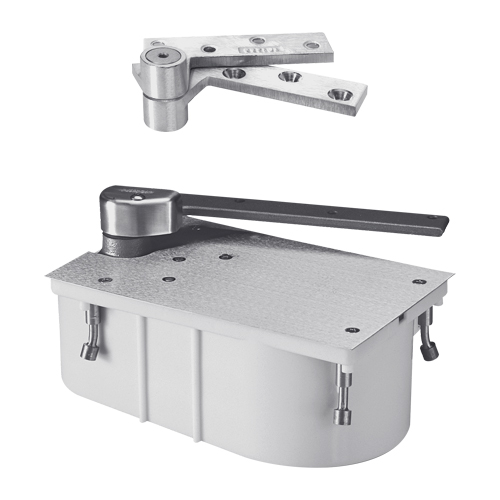
Rixson 27 Floor Closer for a Heavy Pivoted or Glass Door
Posted by Kent on 7th Aug 2026
Some doors won't take a surface closer. A heavy center-hung entrance, an all-glass door, a monumental aluminum-and-glass storefront where nobody wants an overhead arm hanging in the sightline — those pivot on the floor, and they need a closer buried in the floor to match. The Rixson 27 floor closer is the heavy-duty answer for that kind of opening. It's a different animal from a surface closer, and ordering it wrong is expensive, so let's get it right.
Why a floor closer at all
A floor closer sits in a cement case under the threshold and does the same job an overhead closer does, controls the swing, brings the door back, sets the speed, but from below, out of sight. On a glass entrance it's the only clean option; there's no top rail to bolt a surface closer to, and even where there is, an overhead arm on a monumental door looks wrong. The 27 is the heavy-duty Rixson, built for the big, frequently-used entrance that a lighter closer would wear out. When the door is heavy and the look matters, this is the closer.
Offset-hung vs center-hung, get this right first
The 27 in this configuration is a 3/4" offset-hung closer. Offset-hung means the pivot point sits back 3/4" from the door edge, and the door has a butt-hinge-like swing on one side. Center-hung means the pivot is on the door's centerline and it can swing both ways, revolving-door style. These are not interchangeable. The closer, the pivots, and the door prep all have to match one geometry. Figure out which one your door is, or which one the architect drew, before anything gets ordered. Buying an offset closer for a center-hung door means the whole package is wrong.
Handing and degree of hold-open
Floor closers are handed. The LH/RH in 27-180N-LH is the door's hand, and it has to be right, a floor closer set for the wrong hand won't close the door correctly. The 180 refers to the swing range. Some models offer a hold-open at a set degree (90, 105) so the door stays parked open; others are non-hold-open so it always closes. Decide whether this door should ever stay open on its own. On a fire-rated or smoke-barrier opening, you generally can't have a mechanical hold-open at all, same rule as any closer, it has to close and latch.
Finish shows on the cover plate
Most of the closer is hidden, but the top cover plate at the threshold is visible and takes foot traffic. Match it: 626 satin chrome is the common commercial pick, or 613 oil-rubbed bronze for a darker entrance. Pick the finish that matches the door rail and pulls.
Common questions
When do I need a floor closer instead of an overhead one?
On center-hung or offset-hung pivoted doors, heavy glass or monumental entrances, where there's no top rail for a surface closer or you don't want a visible overhead arm.
What's the difference between offset-hung and center-hung?
Offset-hung pivots 3/4" back from the edge and swings like a hinged door; center-hung pivots on the centerline and can swing both directions. The closer and pivots must match one or the other, they're not interchangeable.
Do I need to order pivots and a case too?
Usually yes. A pivoted door needs the top/intermediate pivot and often a cement case and threshold. On a replacement we can often match your existing case so you swap just the closer body.
Is it handed?
Yes. Give us the door's hand (left or right). A floor closer set for the wrong hand won't control the door properly.
Lock Depot stocks the Rixson 27 heavy-duty floor closer with the matching pivots, cases, and cover finishes. Start at the Rixson hub, or if your door takes a surface closer instead, read LCN 4040XP: Stop a Heavy Commercial Door From Slamming. Or call 877-365-5625 and tell us center-hung or offset-hung, the door's hand, new install or replacement, and we'll build the whole package so nothing's missing on install day.