
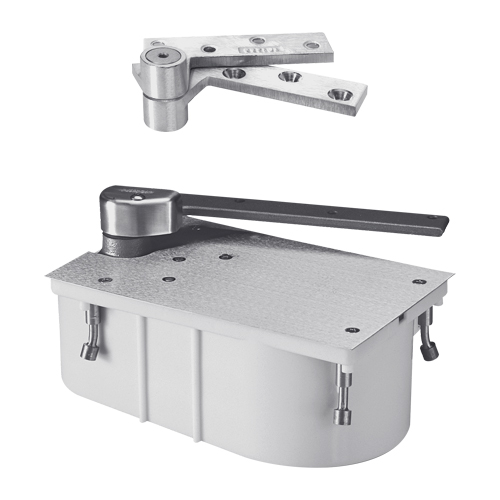
Rixson 27 vs F27: Fire-Rated or Standard Offset Hung Floor Closer
Posted by Kent on 29th Sep 2026
The top pivot is where a fire-rated floor closer job goes wrong. Order the standard Rixson 27 for an opening that turns out to be on a rated corridor or stairwell, and the closer arrives with a top pivot that was never tested and listed for a fire door assembly. Order the fire-rated Rixson F27 for an opening that was never rated in the first place, and you've paid more for a listing the door doesn't need and doesn't use. The body, the hydraulics, and the door-size capacity are identical between the two. The only thing that changes is the top pivot, and that one part is what determines whether the assembly can go on a rated opening at all.
Same closer body, one listed part apart
Both the 27 and F27 are heavy-duty, 3/4" offset hung floor closers certified to ANSI/BHMA A156.4, built for single-acting exterior or interior doors where the door's weight is carried by the bottom arm and the floor rather than by hinges alone. Both handle doors up to 450 lbs and up to 4'0" (1219mm) wide, both use an adjustable hydraulic backcheck to slow the door before it reaches full swing, and both are built non hold-open with a maximum 180-degree opening, at which point an auxiliary floor or wall stop is recommended to protect the closer itself. Everything about how the closer controls the door is the same. Where they split is the top pivot: the standard 27 ships with a standard top pivot, listed 180, while the F27 ships with an F180 top pivot that carries the fire listing the standard part does not.
Rixson 27: for a non-rated opening
The 27-180N is marked non fire rated on the spec sheet, and that's not a limitation, it's the correct, lower-cost part for the great majority of heavy pivoted or glass entrance doors that never carry a fire rating in the first place. Storefront entries, interior glass doors, lobby doors on a non-rated wall: this is the closer to spec, and there's no reason to pay for a fire listing the opening will never use or need inspected.
Rixson F27: for a rated opening
The F27-180N carries the same body and hydraulic performance but ships with the F180 fire-rated top pivot, which is what a fire door inspector is actually looking for on a rated stairwell, corridor, or smoke-barrier opening. If the door schedule calls the opening rated at all, whether it's a 20-minute smoke door or a 90-minute stair enclosure, the closer's top pivot has to be part of a listed assembly, and that's what the F27 configuration provides. Guessing "it's probably fine" on a rated door is the kind of shortcut a fire marshal catches during final inspection, and reworking a closer after the door is hung and glazed costs a lot more than ordering the correct part the first time.
Check the door schedule before you order either one
The door schedule or the architect's hardware set will state the fire rating for every opening on the job, and that's the document to check, not a guess based on how the building looks. If the schedule is silent or the opening was added after the original design, treat it as a question for the architect or the local AHJ before ordering, since installing the wrong top pivot on a rated wall is a life-safety compliance issue, not a cosmetic one. Both closers are also handed: order LH or RH to match the door's swing, since the offset-hung mounting is handing-specific on this series.
Why the offset-hung mount matters for a pivoted glass door
An offset hung floor closer like the 27 Series is the standard choice for a heavy pivoted or wide glass entrance door precisely because the pivot point sits offset from the door's leading edge rather than centered on it, which is what lets the closer body sit in the floor and the door swing clear without a visible surface-mounted arm across the glass. That's the look storefront and lobby entries are usually specified for, and it's also why the closer has to be ordered to the correct handing. A closer built for a left-hand door mounted on a right-hand opening won't engage the pivot correctly regardless of whether the fire rating is right, so confirm handing and fire rating together before the order goes in, not as two separate checks.
Common questions
Can I retrofit an F180 top pivot onto an existing standard 27 closer body?
Rixson sells the F27 as a complete fire-rated assembly, and the closer body and top pivot are matched as a listed set. Swapping just the top pivot onto a non-rated body doesn't recreate a tested and listed fire door assembly, so if the opening needs the rating, order the complete F27 configuration rather than mixing parts.
How do I know if my opening actually needs the fire-rated version?
Check the architect's door and hardware schedule for the opening's fire rating. If it lists a rating of any duration, 20 minutes, 45, 60, or 90, the closer needs the F27's fire-rated top pivot. An unrated opening on the same schedule can use the standard 27.
Do the 27 and F27 handle the same door weight and width?
Yes. Both are rated to 450 lbs and up to 4 feet of door width, so weight and width capacity never factor into which one to pick. The fire rating of the opening is the only deciding factor.
What happens past 180 degrees of opening?
Neither closer is built to control the door past its 180-degree maximum. Rixson recommends an auxiliary floor or wall stop on both configurations to protect the closer mechanism from over-travel, especially on a door that gets propped hard against a wall regularly.
Not sure whether the opening on your job is rated, or which handing you need? Call 877-365-5625 with the door schedule in hand and we'll confirm the exact configuration before you order. See the rest of the line on the Rixson hub, and if the real question is hold-open versus stop-only rather than fire rating, read Rixson 27-180N vs 27-180A: Hold-Open or Not.