
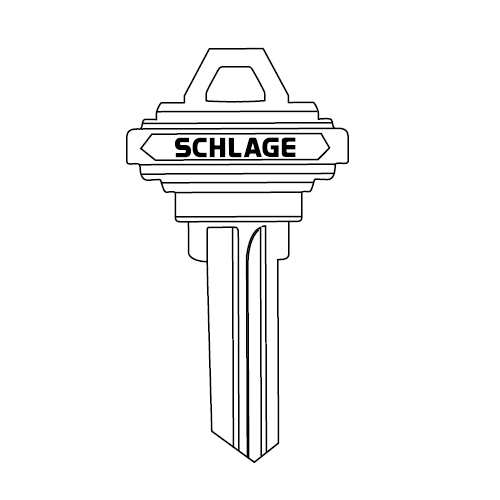
Schlage 35-100, 35-101, 35-056 Blanks: 5 Pin, 6 Pin, Control
Posted by Kent on 20th Nov 2026
Schlage 35-100 vs 35-101 vs 35-056 classic key blanks: five pin, six pin, or control key
Schlage's classic key blanks look alike in a drawer and they are not interchangeable. Three numbers matter: the 35-100 is a five pin blank, the 35-101 is a six pin blank, and the 35-056 is a control key blank. All three are standard bow, embossed both sides, nickel silver, in the same lettered keyways. Pick by the number of pins and by what the key has to do.
These are the classic lettered keyways: F, C, E and so on. They are not the Everest C family with its three-digit numbers; that is a different set of blanks, and the 20-057 guide explains why a plain C and a C123 are not the same keyway. The brand overview is in the Schlage hub.
What the listings say
All three families describe the key the same way: standard bow, embossed both sides, nickel silver, classic conventional key blank. The listings differ in two places. The 35-100 says 5 pin. The 35-101 and the 35-056 say pin length 6. The 35-056 adds one more line: it is a classic conventional control key blank, and the control key is used to insert and remove a Schlage Interchangeable Core.
That last line is the reason the 35-056 exists. A control key does not open the door. It pulls and seats a removable core. If you run a core system, the control key is the most important key in the building, and it needs its own blank.
Five pin or six pin
The pin count has to match the cylinder. A key cut for six pins on a five pin cylinder will not behave, and a five pin key in a six pin lock leaves a pin position uncut. The listing gives the pin count and the keyway, and the cylinder dictates both. I cannot tell you from the catalog which of your locks are five pin. The way to find out is to count the bitting cuts on a key that works, or to look at the cylinder paperwork from the keying.
The catalog lists 11 keyways for the 35-100 and 12 for the 35-101. The one letter that is on the 35-101 and not on the 35-100 is S, the 35-101-S. Everything else lines up: F, FG, C, G, L, CE, EF, E, H, J and K.
| Keyway | 5 pin (35-100) | 6 pin (35-101) | Control key (35-056) |
|---|---|---|---|
| F | 35-100-F | 35-101-F | 35-056-F |
| C | 35-100-C | 35-101-C | 35-056-C |
| E | 35-100-E | 35-101-E | 35-056-E |
| K | 35-100-K | 35-101-K | not listed |
| S | not listed | 35-101-S | not listed |
The other keyways, FG, G, L, CE, EF, H and J, are on all three families.
The control key blank
The 35-056 comes in ten keyways: F, FG, C, G, L, CE, EF, E, H and J. There is no K and no S on the control key line. If your core system is in one of those two keyways, ask us before you plan around a control key blank, because it is not in this catalog under that number.
A control key blank is not a convenience. It exists because the person who changes cores should not be using a regular user key to do it. In a building with a core system and a rotating crew, there should be two control keys at most, one on the facility manager and one in a safe, and the blanks for them should be bought, counted and cut as a set. The control keys are the ones I would never cut at a hardware store counter. Core rekey work goes the same way: the control key and the keying chart are the two things a facility has to protect.
The listing does not say which of the Schlage interchangeable cores, full size or small format, each keyway control blank is meant for. It says only that the control key inserts and removes a Schlage Interchangeable Core. If you need a specific core, call us with the cylinder or the core number.
Choosing for a job
- Identify the keyway. The letters on the bow of a working key.
- Count the pins. Five pin means the 35-100. Six pin means the 35-101.
- Is it a control key? If the key is going to operate a core system, order the 35-056 line.
- Check the keyway is listed for that family. K and S are the two that do not run through all three.
- Order spares. A blank miscut on the machine costs less than a second trip.
If you cut the keys yourself, you also need a machine and cutter that handle the keyway. The GMS blank guide covers the same problem on the Best side of the world.
What is not in the catalog
The listings do not say how a 35-100 differs from a 35-101 beyond the pin count and the keyways offered, they do not give blade dimensions, and they do not map keyways to lock models. I will not fill that in from memory. If a spec matters for your lock, we confirm it against the part number before you buy.
Common questions
What is the difference between the 35-100 and 35-101?
The listings call the 35-100 a 5 pin blank and the 35-101 a pin length 6 blank. The 35-101 also carries an S keyway that the 35-100 does not.
What is the 35-056 for?
It is a control key blank. The listing says a control key is used to insert and remove a Schlage Interchangeable Core.
Which keyways do you stock?
The 35-100 comes in F, FG, C, G, L, CE, EF, E, H, J and K. The 35-101 adds S. The 35-056 comes in F, FG, C, G, L, CE, EF, E, H and J.
Is a classic C the same as an Everest C?
No. They are separate keyway families and separate blank numbers. Check the blank against the cylinder.
Are these blanks cut?
No. A blank has to be cut to the lock's bitting on a key machine.
Give us the keyway and the pin count and we will pick the right Schlage blank for you.