
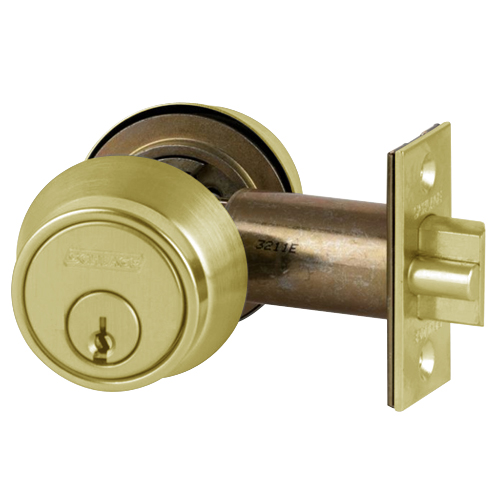
Schlage B250PD vs B252PD: Single or Double Cylinder Deadlatch
Posted by Kent on 1st Nov 2026
A deadlatch is not a deadbolt, and the difference matters on a gate
Schlage's B250 and B252 are tubular deadlatches. They look like deadbolts on the shelf, and the catalog files them next to the B600 deadbolts, which is why they get ordered by mistake. A deadbolt stays where you leave it. A deadlatch is a spring latch with a guard that locks it in place once the door closes, so the door relocks itself every time it shuts. For a pool gate, an apartment common door or a utility panel, that automatic relock is the whole reason to buy one.
If you want a plain bolt you throw by hand, you want the B660 and its relatives, not these.
The two numbers
| B250PD | B252PD | |
|---|---|---|
| Cylinders | Single: key outside, thumbturn inside | Double: key on both faces |
| Type | Tubular deadlatch | Tubular deadlatch (night latch) |
| Keyway | Schlage C | S123, 6-pin |
| Backset | 2-3/8 inch or 2-3/4 inch | 2-3/8 inch standard |
| Door thickness | 1-3/8 inch to 1-3/4 inch | 1-1/2 inch to 1-3/4 inch |
| Grade | Not stated in the listing | Grade 2 auxiliary lock |
The two listings are written differently. The B250PD text reads like a deadbolt listing, and the B252PD text is the older one with ANSI numbers and strike sizes. Where they disagree, we say so below rather than smooth it over.
B250PD: key out, thumbturn in
The single-cylinder function is the one most people want. A key operates it from the outside, and a thumbturn throws and retracts it from the inside, so anyone inside can get out without a key. The listing calls it the standard choice for an entry door with no glass nearby. It comes in six finishes, 605, 606, 609, 613, 625 and 626, and each is a separate part number.
B252PD: key on both sides, relocks on close
The double-cylinder version has a cylinder on each face, and the deadlocking latchbolt is retracted by key from either side. The listing says it is suited to pool, apartment and condominium gates, utility panels and pipe chases, and that it is tough enough for the heaviest gate. It adds that you install it above the bottom lock, where a deadbolt usually goes, and that because it is a latch rather than a deadbolt, the door re-locks automatically when it closes. There is no hold-back feature, so you cannot pin the latch open. That is a feature on a pool gate and a nuisance on a delivery door.
Because anyone leaving needs a key, this is a lock for doors that are not primary exits. A pool gate with a chain-link fence around it is a different problem from a corridor door in an apartment building. Check the egress requirements for the specific door before ordering a lock with a key on the inside.
The throw question
The two listings give different figures for how far the latch reaches. The B250PD listing mentions a one-inch throw seating deep into the strike and an anti-saw insert in the bolt. The B252PD listing gives the latch as a 9/16 inch throw deadlatch. We are not going to reconcile that for you. A latch that is called a deadlatch and a bolt that is called a one-inch throw are different animals, and the catalog does not say which numbers belong to which hardware. If throw depth matters to your application, call us with the door and frame details before you order.
Strike and frame
The B252PD listing gives the strike as a 1-1/8 inch by 2-3/4 inch square corner T-strike. The B250PD listing does not give a strike size. If you are replacing an existing latch, measure the existing strike and frame prep and tell us what you have. Do not assume the strike from an old lock will line up with a new one.
Keying
The B252PD ships with a 6-pin solid brass cylinder on the S123 keyway and two nickel silver keys per lock, per the listing. The B250PD listing says it keys to the Schlage C keyway so it fits an existing Schlage system. If your property is on a master key system, give us the key code before you order, because one cylinder on a common key is worth more than a bag of loose ones.
Why the deadlatch guard earns its place
A plain spring latch can be pushed back with a card or a thin tool when the gap between door and frame is loose. That is how most "locked" gates and utility doors get opened by someone who should not be in there. The deadlatch adds a small guard plunger beside the latch. When the door is closed and the strike holds the plunger in, the latch cannot be pushed back. When the door is open, the plunger is free and the latch works like any other. You get the convenience of a lock that engages on every close, and you keep most of the resistance of a bolt.
The guard only works if the strike lines up. A door that sags, a gate that swings loose on its hinges, or a strike mounted a quarter inch off will leave the plunger unsupported and the lock acts like an ordinary latch. Check the fit with the door closed before you call the job done. Where a gate drifts out of alignment as the season changes, fix the gate first, then the lock.
Finishes
The B250PD comes in 605 bright brass, 606 satin brass, 609 antique brass, 613 oil rubbed bronze, 625 bright chrome and 626 satin chrome. The B252PD is listed in 605, 606, 609, 625 and 626. Outdoor gates take weather, so choose a finish you can live with after a few seasons.
How to choose
- Entry door, no glass, people inside need to leave freely: B250PD.
- Gate or utility door that must relock itself and is not a primary exit: B252PD.
- A bolt you throw by hand: look at the B600 deadbolts instead.
- Replacing an old lock: measure backset, door thickness and strike before ordering.
The rest of the Schlage line is on the site. For another way to control a pool or utility opening without a key on the inside, see our Schlage CO-100 keypad piece.
Common questions
What is the difference between the Schlage B250PD and B252PD?
The B250PD has a key cylinder outside and a thumbturn inside. The B252PD has a key cylinder on both faces.
Does the B252PD lock by itself?
The listing says it re-locks automatically when the door closes, because it is a deadlatch rather than a deadbolt.
Can I hold the B252PD latch open?
No. The listing states there is no hold-back feature.
What backset does the B252PD use?
The listing gives 2-3/8 inch as standard.
Will the B250PD work on a pool gate?
The listings point to the B252PD for pool gates. Call us with the gate details if you want to use the single-cylinder version.