
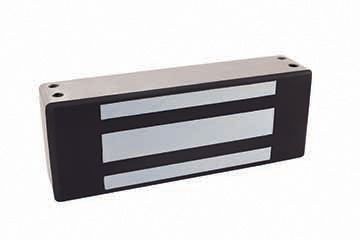
Securitron M62, M32, or M34R: Match Holding Force
Posted by Kent on 25th Sep 2026
1200, 600, or 500 pounds: the maglock question is really a threat question
Every Securitron MagnaLock in the line does the same basic job, an electromagnet on the frame holds a plate on the door until power drops or a request-to-exit releases it. What changes between models is how hard someone would have to work to defeat it, and that's not a spec you guess at. Oversizing wastes money and adds mounting depth you may not have. Undersizing on the wrong door is a liability problem. Here's how to read the three most common models against the opening you're actually protecting.
Exterior and perimeter doors: M62
The Securitron M62 holds 1200 lbs, the top of Securitron's standard line, and Securitron's own listing recommends it for exterior and perimeter doors, anywhere someone could force their way in and do real damage or gain access to something worth protecting. It needs 2.5" of flat mounting space, more than the lighter models, so confirm the header or frame has the depth before you spec it. It runs automatic dual voltage with no field adjustment, ships with 10 feet of jacketed conductor, and carries Securitron's MagnaCare lifetime replacement warranty. This is the size for a door where a determined person on the wrong side is a real scenario, not a hypothetical.
Interior secured areas: M32
Step down to 600 lbs with the Securitron M32, built for areas where physical assault on the door isn't the expected threat, a secured interior space that's monitored, or any interior opening you want closed off from casual entry rather than a break-in attempt. It's fire rated Grade 1 hardware, which matters if the opening is on a rated corridor and the maglock needs to release on an alarm signal without holding the door against code. Same automatic dual voltage, same instant-release circuit with no residual magnetism, same 10-foot conductor cable included. This is the right size for the door between a lobby and a back-of-house area, not the loading dock.
Because the M32 is fire rated, it's also the model most likely to sit on a corridor that's tied into the building's fire alarm system, where the maglock has to drop power and release the instant the alarm trips, no manual override, no delay. Confirm that release path is wired and tested as part of the install, a maglock that holds through a fire alarm signal is a code violation regardless of how well it's mounted.
Sliding doors, recessed mount: M34R
The Securitron M34R holds 500 lbs and is purpose-built for mounting in a sliding door application, where a surface-mounted maglock body would sit proud of the track and look like an afterthought. The recessed body gives a finished appearance appropriate for a lobby or a lightly-secured interior room. Same threat profile as the M32, an area you want closed to casual entry rather than defended against forced attack, just packaged for a door type the surface-mount M62 and M32 weren't built to mount on.
Matching the model to the door
Start with the threat, not the door hardware catalog. A perimeter door facing the parking lot or an alley gets the M62's 1200 lbs. An interior door between departments, or a secured room inside a building that's already access-controlled at the perimeter, gets the M32's 600 lbs, less holding force but a fire rating you'll need on most interior rated corridors. A sliding door anywhere in that same interior-security category gets the M34R for the mounting, not because it's weaker or stronger than the M32, it's built for a different door geometry at a comparable holding force.
What all three share
Every model here uses Securitron's instant release circuit with virtually no residual magnetism, so the door actually releases clean instead of sticking from leftover magnetism after power drops, a known failure mode on cheaper maglocks. All three ship with 10 feet of jacketed, stranded conductor, run automatic dual voltage with zero field configuration, and are backed by the MagnaCare lifetime no-fault replacement warranty. None of them are handed, and none need a separate power supply spec beyond matching the building's access control voltage.
None of the three ship with a request-to-exit sensor or door position switch built in on the base model covered here. If the access control design calls for bond sensing or REX monitoring at the lock itself rather than through a separate contact, confirm which variant of that model number carries it before ordering, Securitron sells sensor-equipped versions of several of these bodies under a different part suffix.
All three are in stock and ship from the Securitron hub. If the door in question can't take a maglock's flat mounting surface at all, the maglock-for-a-door-you-can't-mortise piece covers when a maglock is the right call versus a mortise electric lock, and if the release side of the system, the keyswitch, still needs specifying, MK vs MKA covers momentary versus maintained contact.
Common questions
Do I need the M62's full 1200 lbs on every exterior door?
Not automatically, but Securitron specifically recommends the M62 for exterior and perimeter doors where forced entry is a real risk. An interior door in the same building can usually run the lighter M32 instead.
Can the M32 or M34R go on a fire-rated corridor door?
Both are rated Grade 1 fire-rated hardware, which the surface-mount M62 listing doesn't specify. Confirm the exact rating needed against your local AHJ before ordering on a rated opening.
Why does the M62 need more mounting depth than the others?
It's rated for 1200 lbs of holding force, which requires a larger magnet and armature than the 600 lb M32 or 500 lb M34R, so Securitron specs 2.5" of flat mounting space for it.
Is the M34R weaker than the M32?
Slightly, 500 lbs versus 600 lbs, but the real reason to choose it isn't holding force, it's the recessed body built specifically for mounting on a sliding door.
Do these maglocks need a separate power supply?
Yes, a compatible access control power supply sized to the maglock's current draw. All three here run automatic dual voltage, so the supply just needs to match the building's access control voltage, no field adjustment on the lock side.