
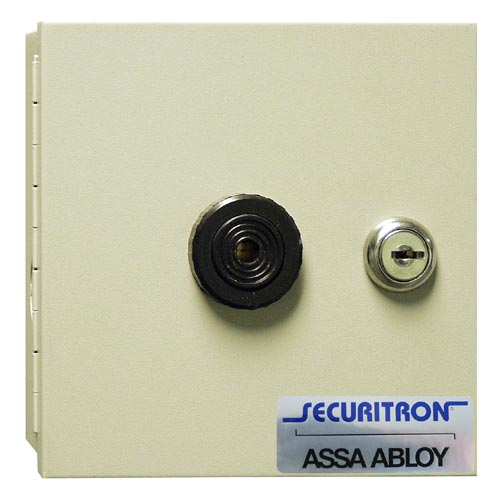
Securitron XDT vs BA-XDT vs FA-XDT Exit Delay Timer
Posted by Kent on 7th Oct 2026
Slowing down a door on purpose
Most of the time I help people open doors faster. Once in a while the customer wants the opposite. A retail store has a back door that employees prop open and that customers use to walk out with merchandise. A memory care unit has a door that residents should not be able to wander through unnoticed. In both cases the owner does not want to lock the door for good, because that would be an egress problem. The answer is a short, controlled delay: someone pushes, an alarm sounds, and the door releases after a set time.
Securitron makes a family of timers for this called the XDT. We stock three versions, and the difference is in the housing, not the brains. Pick the wrong housing and you spend the install fighting the box.
What the catalog says an XDT does
The listing describes the XDT series as a door prop alarm timer and exit delay. Here is what it claims:
- It is widely used in dementia wards to prevent patient wandering, and in retail to prevent grab-and-dash theft.
- The delay is configurable and suits fail-safe environments that need different settings through the day.
- Its function works with entry control, door and lock monitoring, and authorized immediate exit.
- The listing says it possibly meets all code requirements including the BOCA 30 second relock function. I will come back to the word "possibly".
- The nuisance delay and release times are set with DIP switches.
- It includes three 5 amp SPDT relays for interfacing with other equipment.
- External switches, like a time clock, can put the unit into a different mode when you do not want delayed exit at all.
- It is UL listed, with the MagnaCare lifetime replacement warranty.
Three housings, one timer
- The XDT-12 is board only. No box, no cover. It is for the installer who is building it into an enclosure or panel that already exists. The same board comes in 24 volt as the XDT-24.
- The FA-XDT-12 is a flush mount plate. That is the one that sits in the wall with a finished face. Think of a nurses' station or a front desk, where it should look like part of the building.
- The BA-XDT-12 is a surface mount enclosure with a piezo sounder and a door label. The "BA" in the part number is the boxed alarm. It makes the noise and tells the person at the door why.
The voltage is the same story as any lock accessory. Match it to the lock supply on the door. Look at the label on the lock, not at what someone remembers.
My own rule is simple. If the board is going into a panel you already own, buy the board. If it has to sit in a wall in view of the public, buy the flush plate. If the whole reason for the timer is to make a noise and stop the person pushing, buy the boxed alarm with the label. A door label that says an alarm will sound is half of the deterrent. Most people stop when they read it.
Why the word "possibly" matters
I do not skip over the "possibly meets all code requirements" line, and you should not either. Delayed egress is one of the most tightly regulated things in the building code. Where it is allowed, in what kinds of buildings, how long the delay can be, and what has to happen when the fire alarm trips all depend on the occupancy and the jurisdiction. A timer does not give you permission. A fire marshal does.
Before you order, ask the code official three plain questions: is delayed egress allowed on this door, what is the longest delay they accept, and what do they want tied into the fire alarm. Write down the answers. Then set the DIP switches to match, not the other way around. The listing mentions the BOCA 30 second relock function as something the unit can be set to. That is the maker's description of what the timer can do. It is not a ruling on your door.
The time clock trick
The mode switching in the listing is a feature I like. A clinic or store may want the delay during the hours when the building is open and a door is unwatched, and no delay when staff is on the floor. An outside switch, such as a time clock, flips the timer between modes. One door can then behave two ways without a person having to remember anything. If you want it, say so when you ask us for help so we can look at how you plan to control it.
Check the lock first
The listing says this timer is for fail-safe environments, which means the lock releases when power is removed. A magnetic lock is the usual example. If the door has a fail-secure strike or a mortise lock, this may not be the right product, and you should come to us before you buy. The three relays are there so you can tie the timer into other equipment such as access control panels. We have a guide on matching a Securitron lock to the door and a note on a door you cannot mortise in maglock for a door you cannot mortise.
Common questions
What is the difference between XDT, FA-XDT and BA-XDT?
The housing. XDT is board only, FA-XDT is a flush mount plate, and BA-XDT is a surface mount enclosure with a piezo sounder and door label.
How do I set the delay time?
The catalog says the nuisance delay and release times are set digitally with DIP switches.
Can I turn the delay off at certain times of day?
Yes. The listing says external switches such as time clocks can put the unit into different modes when delayed exit is not wanted.
Does it meet code?
The listing says it possibly meets all code requirements, including the BOCA 30 second relock function. Confirm with your local code official before you install it on an egress door.
Which voltages are available?
The board is sold in 12 volt and 24 volt. Match it to the lock supply on your door.
The rest of the line is on our Securitron page. Send us the door, the lock and the code answers and we will tell you which XDT fits.