
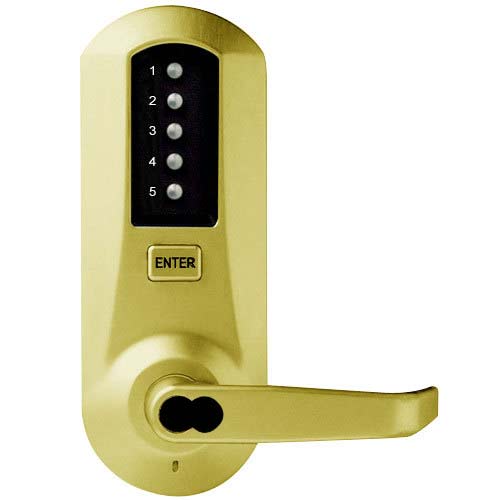
Simplex Pushbutton vs Alarm Lock Trilogy: Mechanical or Battery
Posted by Kent on 17th Nov 2026
Two ways to take the key out of a door, and they fail differently
A customer calls and says "I want a keypad on the back office door." That sentence covers two very different locks. One is a mechanical pushbutton lock with no electronics at all. The other is a battery-powered digital lock with a keypad, a user list and an audit trail. Both are standalone, neither needs wiring, and both accept a key override. The choice comes down to what you want to happen when something goes wrong, and who needs to know who came through the door.
Here are four locks we stock that show the split: the Simplex 5051MWL-03-41 and 5042MWK-026-41 on the mechanical side, and the Alarm Lock Trilogy DL2700IC-C-US26D and DL4100IC-C-US26D on the digital side.
Side by side, from the listings
| Simplex 5000 Series | Alarm Lock Trilogy | |
|---|---|---|
| Power | None. All mechanical. | AA batteries |
| Codes | One access combination, changed at the keypad | 100 to 2000 users listed |
| Audit trail | None | Up to 40,000 events |
| Key override | Medeco LFIC core, sold separately | Corbin Russwin interchangeable core, core and keys ordered separately |
| Fire rating | 3-hour UL/ULC | Not stated in the listing |
| Example | 5051MWL-03-41 | DL2700IC-C-US26D |
The Simplex: nothing to die, nothing to track
The Simplex 5000 Series is the push-the-buttons lock you have seen on maintenance rooms and stairwell doors for decades. The listings describe it as all-mechanical, no batteries to replace, no wiring required. There is one combination. You change it at the keypad without taking the lock off the door.
That last point is the whole tradeoff. One combination means everybody who knows the code is the same person as far as the lock is concerned. If the night cleaner leaves, you change the code for everyone and tell everyone. For a six-person shop that is fine. For a building with forty people, it gets old fast.
What you get in return is a lock that cannot be bricked by a dead battery. The listings call out Grade 1, a 3-hour UL/ULC fire rating, a 1/2 inch latch throw and a field-reversible lever. The key override takes a Medeco LFIC core, and the core is not included. If your building already runs Medeco cores, this is the one that fits your keying.
The two models differ in backset and trim. The 5051MWL lists a 2-3/4 inch backset with a lever. The 5042MWK lists a 2-3/8 inch backset. One thing to check before you order: the 5042MWK is titled a knob lock, but the feature list on the page says ADA-compliant lever design. Those two statements cannot both be right, so confirm the trim with us before you order. Measure your existing backset first either way. The two numbers are not interchangeable and a wrong backset means a new lock.
Both Simplex models list passage mode through an interior thumbturn. Engage it and people walk in without a code. That is handy for a reception door during the day, and it is also the thing people forget to turn off at night.
The Trilogy: a user list and a record
The Trilogy locks are the opposite design. The listings describe PIN-only access: enter a code on the keypad and the lock opens. No wiring, no panel, no network, battery powered, with a built-in audit trail. Users run from 100 to 2000 depending on the model, and the trail holds up to 40,000 events.
That changes the conversation. A terminated employee gets one code deleted instead of a whole building notified. A missing inventory item turns into "who opened the storeroom between six and nine on Thursday." For pharmacies, evidence rooms and any door where somebody will eventually ask who was in there, the trail is the reason to buy.
The cost is that it runs on batteries. A digital lock with dead batteries is a locked door, and your override key is the only way in. This is exactly why the IC prep matters. Both models here are prepped for Corbin Russwin interchangeable core, so your override key is the same one your Corbin Russwin core doors already use. The listing is clear that the core and keys are ordered separately, so budget for them.
The DL2700 is described as the workhorse that fits a standard 161 cylindrical prep. The DL4100 listing reads nearly the same and does not tell us how it differs from the DL2700 in function, so we are not going to guess. If that difference matters on your job, call before you order.
How I decide
- Few people, rare turnover, no need for a record: the Simplex. Nothing in it needs power, so nothing in it runs out.
- More than a dozen people, or any reason to ask who went in: the Trilogy. Pay once for the lock and keep the batteries on a calendar.
- Your keying is Medeco: the Simplex with the Medeco override. If your keying is Corbin Russwin, go with the Trilogy IC-C.
- It must live on a fire-rated door: the Simplex lists the 3-hour rating. Check the Trilogy listing for the rating on your exact model before you commit.
What goes wrong in the field
With the Simplex, the problem is an old code that nobody changes. Staff leave, the code stays. We have walked into buildings where the code was written on the frame in pencil. Put a calendar reminder on the code change.
With the Trilogy, the problem is batteries nobody watches. Put a date on the inside of the door when you swap them. When a door is a life-safety egress path, remember the inside lever is always free, which is how both designs are meant to work, but test it after every service.
On either lock, the override key is not an afterthought. You will use it more than you expect, and the core you choose decides whether a locksmith can rekey it in five minutes or has to special order. Pick the core to match your building first, then the lock.
One more thing about the code
Avoid obvious codes. A four-digit code that matches the street number is the first thing anyone tries. Whichever lock you buy, set a code that is not your birthday, and write down the programming procedure where the facilities manager can find it. The Simplex combination changes at the keypad. The Trilogy takes a programming code at the door.
Questions on which of these fits your door, or what your existing core is? Call us. We will pull the hardware schedule and match it before you spend anything. Related reading: Simplex 5010MWL vs 5010XKWL: Medeco or Kaba key override and Alarm Lock DL2700: standalone keyless lock, no wiring.