
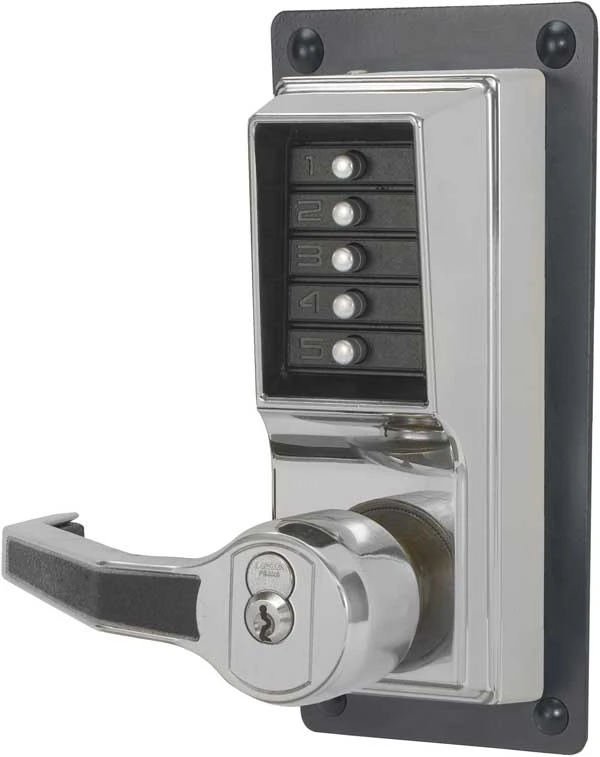
Simplex LLP1020 vs LRP1020: Hand and Key Override Core
Posted by Kent on 5th Oct 2026
A pushbutton lock for the outside of an exit device
An exit device lets people out. It does not keep strangers from walking in, and a lot of doors with panic hardware still need a way to get in from the outside without handing a key to everybody on staff. The Simplex LP1000 series exit trim solves that with a mechanical pushbutton lever on the outside of the door. It has no batteries and no wiring. Punch the code, turn the lever, and the exit device retracts.
The part numbers look like a mess until you break them apart. The two we are covering are the LLP1020 and the LRP1020. Three things vary: the hand, the key override core and the finish. Get the first two wrong and the lock does not fit, or the key does not work.
What the catalog says it does
- All-mechanical operation. Nothing to charge, nothing to wire.
- Single access combination with thousands of possible codes.
- You change the combination at the keypad, without taking the lock off the door.
- ADA-compliant lever design.
- Vandal-resistant solid metal pushbuttons.
- Weather-resistant, for indoor or outdoor installation.
- ANSI/BHMA Grade 1, 3-hour UL/ULC fire rated, 3-year warranty.
It mounts to most rim and vertical rod exit devices, and the catalog says the template and mounting hardware are included. Check the exit device maker's trim chart before you order, as always. If you are not sure the trim will fit your device, send us the exit device model.
LLP or LRP: it is the hand of the door
The catalog lists the LLP1020 for a left hand door and the LRP1020 for a right hand door. Handing a door is simple in principle: stand outside, on the side where the lock trim will go, and see which side the hinges are on. Hinges on the left is a left hand door. The catch is a reverse bevel or an out-swinging door, where people argue about it. If there is any doubt, send a photo of the door from outside, hinges visible, and we will confirm before you order. A wrong-hand trim on an exit device is a return, not an adjustment.
The letter before the finish: whose core goes in the override
This is the part that trips up buyers. The pushbutton lever gives you code access, but the same trim carries a key override, so a person with a key can bypass the code. The override is a removable core. The catalog lists it by the brand of core, and it ships without the core. The core is sold separately.
- B: Best SFIC override. LLP1020B-026
- C: Corbin Russwin LFIC override. LLP1020C-026
- M: Medeco LFIC override. LLP1020M-026 and LRP1020M-026
- R: Sargent LFIC override. LLP1020R-026 and LRP1020R-026
- S: Schlage SFIC override. LLP1020S-026 and LRP1020S-026
Pick the one that matches the keying system the building already uses. A building with a Schlage SFIC key system wants the S. A campus on Medeco wants the M. Notice that the catalog calls two of them SFIC (small format) and three of them LFIC (large format). Those are different physical core sizes, so the system you already own decides the letter. If the building has no key system at all, you are choosing one, and that is a conversation to have before you buy.
We have more on interchangeable cores in our Simplex mechanical pushbutton guide.
The finish suffix
After the letter comes the finish code. From the listings: 026 is bright chrome (US26/625), 03 is bright brass, 05 is antique brass and 26D is satin chrome. Match it to the exit device trim and the other hardware on the door. The part numbers I linked above are all the 026 chrome. Each finish is its own listing in our catalog, so tell us the finish you need and we will point you to the right one.
Who this suits, and who it does not
The catalog says Simplex locks of this type are used in government facilities, hospitals and commercial buildings. That is the right fit: stockrooms, back-of-house doors, equipment rooms, a gym entrance with panic hardware. A mechanical code lock is a good answer where you want to avoid chasing lost keys and dead batteries.
It is not an audit trail. There is one combination for the door, and everyone who knows it uses the same one. Where you need to know who came in and when, you want electronic access control. For simple keyless entry on a door that already has an exit device, this trim does the job. For a knob or lever lock that is not an exit trim, our write-up on Simplex 1011 versus LR1011 covers that side.
Common questions
What does the L in LLP1020 and LRP1020 mean?
The catalog lists the LLP for a left hand door and the LRP for a right hand door.
Does the Simplex exit trim come with a key core?
No. It is prepped for the override core you choose, and the core is sold separately.
Which core brands are available?
Best SFIC, Corbin Russwin LFIC, Medeco LFIC, Sargent LFIC and Schlage SFIC, shown by the letter B, C, M, R or S.
Do I need batteries or wiring?
No. It is all mechanical, and you change the combination at the keypad.
Is it fire rated?
The catalog lists it as 3-hour UL/ULC fire rated. The exit device it mounts to has its own rating, so check that as well.
The full line is on our Simplex page. Send us the exit device model, the hand of the door and the key system you use and we will line up the right part number.