
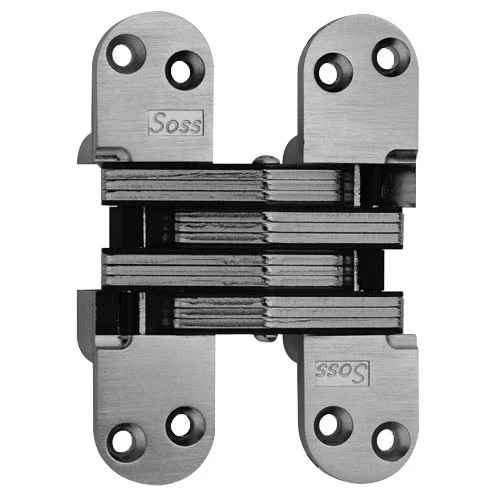
Soss 218 vs 220: Sizing an Invisible Hinge for a Flush Door
Posted by Kent on 20th Aug 2026
A butt hinge will not let a door disappear. Hang it dead plumb, cut every mortise clean, and you still have knuckles standing proud of the door edge telling the room where the door is. On a flush jib door or a hidden closet off an executive office, that is the whole job lost at the last step.
An invisible hinge fixes it by living inside the opening. We stock the Soss line, and the two people ask for by name are the 218 and the 220. Here is how to pick, and how not to scrap a door leaf cutting the pocket.
Why nothing shows when the door is closed
A Soss invisible hinge is not a plate you screw to a surface. The body routes into a pocket cut in the door edge and a matching pocket cut in the jamb. Close the door and there is no knuckle, no barrel, no pin, nothing but the reveal. Open it and the leaves scissor out of both pockets and carry the door clear. You buy appearance and you pay for it in joinery.
When an invisible hinge is the wrong hinge
Concealment does nothing for load. If the hinge is allowed to show and the door is heavy or on a closer, a ball-bearing butt hinge is the honest answer, and the Hager BB1191 covers that sagging commercial door. If the door is tearing its hinges out of the frame, hiding them fixes nothing; load spreading does, and a continuous hinge carries the weight down the full height of the edge. Go invisible where the door must not read as a door.
Sizing an invisible hinge for a flush door
Three sizes cover most of what we ship. The number in each product name is the size of the hinge.
Start with the door, not the catalog page
The 303C is the 11/16" invisible hinge, the small one, for light work: a cabinet door, a millwork panel, a casework access door. We stock it in satin brass as the 303C-US4. The 218-US26D is the 1-3/4" hinge. The 220-US26D is the 2" hinge, the largest, and where to look as the leaf gets taller, wider, or heavier.
Bigger hinge, heavier door. That is as far as I will take it from a part number. Note what the size is not: 218 does not mean the hinge is for a 1-3/4" thick door. It is the hinge's nominal size. I have watched people order off that assumption and get the wrong hinge for the leaf.
So do not size this off a blog post, mine included. Send us the door's height, width, thickness, and material and we will confirm the size and the hinge count. The 218 and the 220 both cover wood or metal applications.
Spring closer, or not
The 220IC-US26D is the spring closer version of the 2" hinge. A spring inside the hinge pulls the panel shut on its own.
That earns its keep on a concealed door that must not sit open. A jib door drifting an inch off the paneling gives away a door built to be invisible, and a panel swinging into a corridor is worse than a giveaway.
It is the wrong choice where the door should stay put, like a hidden panel in front of shelving somebody works out of with both hands full. Know what it is: a spring in a hinge, not a closer.
Finish
Finish is the decision people skip here, for the obvious reason. Closed, you never see it. Then the door opens and there it sits at eye level, and satin chrome against satin brass is the only metal anyone is looking at. We stock the 2" hinge in both, the 220-US26D in satin chrome and the 220-US4 in satin brass.
The trap: the mortise scraps doors, not the hinge
This is the part that costs money. An invisible hinge is a routed pocket in a finished door leaf and a routed pocket in a finished jamb. Route it in the wrong place, or too wide, and you have not made a mistake you can shim out. You have a scrapped leaf, maybe a scrapped jamb, on a millwork door with a lead time.
Buy the router guide template with the hinges
That is what the templates are for. The 220-IT router guide template guides the 2" hinge and the 218-IT guides the 1-3/4". Buying the matching template alongside the hinges is the cheapest insurance on the job, by a wide margin against one ruined door. Get the template that matches the hinge you ordered, and set it off Soss's own instructions rather than a shop memory of how the last one went.
Retrofitting a door that was hung on butt hinges
Plan invisible hinges at the door order stage, not after the door is hung. Two things go wrong on a retrofit.
- The old butt hinge cutouts do not go away. They are flat mortises sitting roughly where the new pockets want to be, and filling them so nothing reads on a finished edge usually shows.
- The door edge may not have the meat for the pocket. A hollow-core leaf, a thin leaf, or one with its lock prep already cut can leave you short of material right where the hinge goes.
If the door is already hung, call us before anyone touches a router. Sometimes the answer is a new leaf.
What to have in hand before you order
Door height, width, and thickness. Material, wood or metal, solid or hollow. Whether the panel has to self-close. What finish the rest of the hardware carries. Whether the door exists yet or is still on order. That answers size, the 220IC question, and finish in one call, and tells us which template goes in the box. Start at the Soss hinge hub.
Common questions
Soss 218 vs 220, what is the actual difference?
Size. The 218 is the 1-3/4" invisible hinge and the 220 is the 2", so the 220 is the larger hinge and where to look as the door gets heavier. They take different router guide templates, so the size also decides which template you buy. Send us the door's dimensions and material and we will confirm which one.
Do I really need the Soss router guide template?
Yes, buy it with the hinges. An invisible hinge is a routed pocket in a finished door and jamb, and freehanding that is how a leaf gets scrapped. The 220-IT matches the 2" hinge and the 218-IT matches the 1-3/4". Against one ruined door, the template is the cheapest line on the order.
How many invisible hinges does my door need?
Call us with the door before you buy, because the count follows the leaf's height, width, thickness, weight, and material, and I will not guess it off a part number. Give us those five and we will confirm count and size together.
Will the 220IC spring closer hold a concealed door shut by itself?
It pulls the panel closed on its own, which is what you want on a jib door that must never sit ajar. It is a spring inside a hinge, not a door closer, so it has none of a closer's adjustable sweep and latch control. If the opening needs true controlled closing, tell us the application.
Can I put invisible hinges on a door already hung on butt hinges?
Usually not cleanly, which is why this gets decided at the door order stage. The old butt hinge mortises stay in the edge and the jamb and rarely fill invisibly, and the leaf may not have material left for the pocket once the hinge and lock preps are in it. Send a photo before anyone routes anything.