
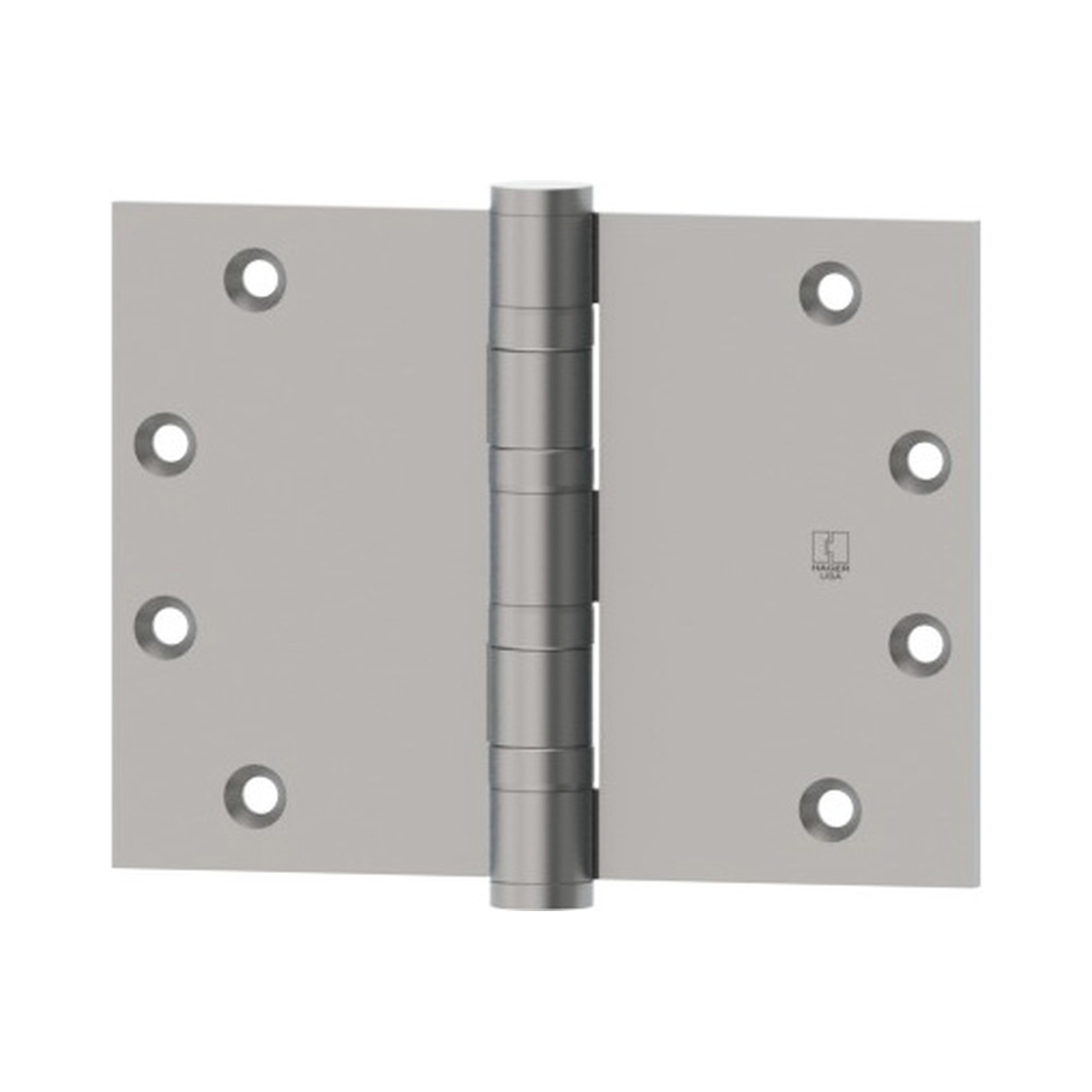
Hager BB1199: The Heavy-Weight Ball-Bearing Hinge for a Sagging Commercial Door
Posted by Kent on 9th Aug 2026
A commercial door that sags, drags the floor, or won't latch anymore usually isn't a lock problem. It's the hinges. Cheap plain-bearing hinges wear out under a heavy door and let it droop, and once the top corner drops the whole opening fights you. The fix is a proper heavy-weight ball-bearing hinge, and for a genuinely heavy door that's the Hager BB1199. Here's how to pick the right one so the door hangs straight and stays that way.
Ball bearing is not optional on a real commercial door
Plain-bearing hinges are metal turning on metal. On a light interior door that's fine. On a heavy exterior door with a closer pulling it shut thousands of times, that metal-on-metal wears, the door settles, and the top hinge takes the beating. A ball-bearing hinge packs bearings between the knuckles so the door swings on rolling steel instead of grinding. It carries weight without wearing, and it's what any closer-equipped door should have. If a door with a closer is on plain hinges, that's usually why it's sagging. Put ball bearings on it, and if the door is already heavy or high-frequency, put a heavy-weight build on it, not a standard one.
Heavy weight, and the two ways to buy it
For a genuinely heavy or high-frequency door — a solid-core exterior door, a high-traffic entrance — Hager rates two of its full-mortise ball-bearing hinges Heavy Weight: the BB1199 and the BB1168. Both carry the heavier gauge Hager builds for the same job; the BB1168 is the lower-cost of the two, the BB1199 is the step up. If you're not sure which to spec, the BB1168 covers most heavy commercial doors at a lower price, and the BB1199 is worth the upcharge when the opening or the environment calls for it. Call and describe the door if you want us to make that call with you. Either way, don't reach for a "standard weight" hinge on a door that's already sagging under normal use. That's usually how it got there in the first place.
This trips people up because "heavy weight" and "standard weight" sound like marketing labels, and on some product pages they get typed carelessly. They're not marketing labels. They describe the gauge of steel or brass Hager bends into the knuckle, and a thicker gauge holds up longer under a heavy slab and a hard-working closer. When you're comparing hinges from a spec sheet or a listing, don't take the label at face value if the door is already a problem child — cross-check the model number against the manufacturer's own certification, because a mislabeled listing puts the wrong hinge on a door that's already failing.
Size, and why 4.5 x 4.5 is the default
The 4.5 x 4.5 in the part number is the hinge dimensions, 4-1/2 inches tall by 4-1/2 inches wide (open). That's the standard size for a typical 1-3/4" thick commercial door. Thicker doors or wider ones may want a 5-inch hinge for the extra throw and load. When you replace a sagging door's hinges, measure the old ones and match the size, or the new hinge won't fill the existing mortise cut in the door and frame. Wrong size means chiseling, and nobody budgeted for that on a Tuesday afternoon service call.
NRP for security, and finish
On an outswing exterior door, the hinge pins are on the outside, which means someone could knock the pins out and lift the door off. Order the hinge NRP, non-removable pin, so the pin can't be driven out with the door closed. It's a small upcharge and it closes an obvious hole on any outswing exterior opening. Finish: 26D satin chrome (US26D) is the commercial workhorse and matches most other hardware. Match the hinge finish to the lever and closer so the opening looks like one job, not three mismatched vendors.
Common questions
Why is my commercial door sagging?
Almost always worn hinges, usually plain-bearing hinges under a heavy or closer-equipped door. A heavy-weight ball-bearing hinge carries the weight without wearing and stops the droop.
BB1199 or BB1168?
Both are Hager heavy-weight ball-bearing hinges built for the same kind of door. The BB1168 is the lower-cost option; the BB1199 is the step up. Call with the door's weight and use if you're not sure which fits your budget.
How many hinges do I need?
Three for a standard door, four for a door over 90 inches tall. Replace the full set, not just the worn top hinge.
What does NRP mean and do I need it?
Non-removable pin. On an outswing exterior door the pins are exposed; NRP stops someone knocking them out to lift the door off. Order NRP on any outswing exterior opening.
Will a heavy-weight hinge fit where my old hinge was?
Yes, if the size matches. 4.5 x 4.5 is the standard footprint for a 1-3/4" commercial door, and a heavy-weight hinge in that size drops into the same mortise cut as the standard-weight version it's replacing. Measure before you order; don't assume.
Lock Depot stocks Hager heavy-weight ball-bearing hinges in standard sizes and finishes, with NRP options. Start at the Hager hub, or if the sagging door also has a closer that needs sorting, read LCN 4040XP: Stop a Heavy Commercial Door From Slamming. Or call 877-365-5625 with the door's weight, height, and whether it swings out, and we'll spec the hinge and the count.