
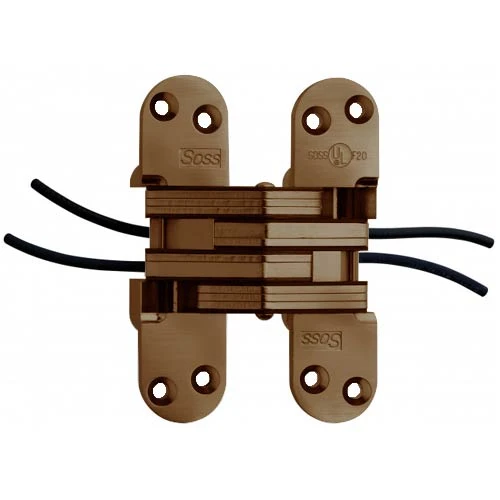
Soss 218PT: Power Transfer Through an Invisible Hinge
Posted by Kent on 1st Oct 2026
Wiring an electrified lock without a visible power transfer at the hinge
An architect specs Soss invisible hinges for exactly one reason: nothing shows when the door is closed. That preference runs straight into a problem the moment the door needs an electrified strike, a maglock, or a card reader, because the standard way to get power across the hinge line, a surface-mounted power transfer, is visible hardware bolted right where the invisible hinge was supposed to keep things clean. Soss builds a version of its invisible hinge that solves this without breaking the concealed look: the 218PT.
What the 218PT actually is
The Soss 218PT is a 2.5 amp power transfer hinge with a UL rating, built into the same concealed body as Soss's standard invisible hinge line. It mortises fully into the door and frame edge, opens a full 180 degrees, and disappears completely when the door is shut, the same as any other Soss invisible hinge. The difference is internal: it carries wire through the hinge barrel itself, so power gets from the frame to the door without a separate transfer unit mounted anywhere on the face of the door or frame.
Where it fits and where it doesn't
The 218PT needs a minimum door and frame material thickness of 1-3/4 inch, and it's rated for use on hollow metal, sheet metal, tin-clad, steel composite, or wood-core swinging fire doors carrying a 20-minute rating. That fire rating matters on the same jobs where a standard power transfer would get flagged: a rated door assembly can only carry hardware on its certification list, and a 218PT rated to 20 minutes covers a meaningful slice of the light commercial fire door market without needing a separate transfer unit added to the assembly. It's a light-duty hinge by design, built for the wiring path rather than raw structural load, so it's not the pick for a heavy exterior door carrying the full weight of a maglock and closer on its own.
One power hinge, plus standard hinges to carry the door
This product page is for a single individual hinge, and that's a detail worth flagging before ordering: a door typically hangs on two or three hinges total, and the 218PT is meant to replace just the one hinge the wiring needs to pass through, not every hinge on the door. The others can stay standard Soss hinges sized to the door, which is the same sizing decision covered for the standard 218 and 220 invisible hinges. Mixing one 218PT with standard invisible hinges on the same door is the normal install, not a workaround.
Installation notes that save a return trip
Like any Soss invisible hinge, the 218PT needs a deep, full mortise cut into both the door and frame edge, precise router or hinge-jig work, not a surface template. Confirm the door and frame both meet the 1-3/4 inch minimum material thickness before cutting; a door that's too thin for a standard 218 is also too thin for the 218PT, and there's no adjusting the mortise depth after the fact. Because the unit is UL rated and carries a fire-door application, keep the cutout dimensions and installation to the manufacturer's template exactly. A fire-rated hinge installed outside its listed parameters can invalidate the door's rating even if the hinge itself is the correct part.
Where the 218PT falls on the hinge, top, middle, or bottom, is worth deciding before the mortise gets cut. Running wire through the top hinge keeps the run shortest if the powered hardware is mounted high on the door, like a card reader at typical reach height, while a middle-position hinge splits the difference for a strike mounted mid-height in the frame. Whichever position gets picked, keep it consistent with where the wire actually needs to land on the door face, since fishing wire an extra foot or two inside a mortised door leaf is harder than planning the hinge position correctly from the start.
For the sizing question on the non-powered hinges going on the same door, matching leaf size, gauge, and load rating to the door's actual weight and width, the same logic covered in the Soss 218 vs 220 sizing guide applies whether or not one of those hinges happens to carry a power transfer. The PT designation changes what's inside the hinge barrel, not how the rest of the door gets sized around it.
Template accuracy matters more on this install than on almost any other hinge job, because there's no adjusting a Soss mortise after the router has already cut it. Use the manufacturer's jig, not a hand-marked layout, and dry-fit the hinge in the mortise before final assembly. A mortise cut a sixteenth of an inch off center on a standard invisible hinge is an annoyance; the same error on the 218PT can pinch or expose the internal wiring where it passes through the hinge barrel, which turns a hardware mistake into an electrical one.
Ask about the finish before cutting, too. Soss invisible hinges come in a handful of standard finishes, and the 218PT is no exception, but because the hinge body is fully concealed once the door is hung, some customers are surprised to learn the finish only shows during a service call, when the door's open and the hinge is exposed for adjustment. It's worth confirming with the customer whether finish match actually matters on a hinge nobody will see day to day, since it can be a place to save a little on the order without anyone noticing the difference.
Common questions
Does the 218PT replace all the hinges on the door?
No. It replaces just the one hinge the wiring needs to run through. The remaining hinges on the door can be standard Soss invisible hinges sized to the door as usual.
How much current can the 218PT carry?
2.5 amps, with a UL rating. That covers most standalone electric strikes, single maglocks, and card readers; a job pulling more current than that needs a different power transfer approach.
Can the 218PT go on a fire-rated door?
Yes, on hollow metal, sheet metal, tin-clad, steel composite, or wood-core swinging fire doors with a 20-minute rating, provided the installation follows the manufacturer's template exactly.
What's the minimum door thickness for the 218PT?
1-3/4 inch minimum material thickness on both the door and frame. A thinner door doesn't have enough material for the mortise depth the hinge needs.
Is the 218PT visible when the door is closed?
No. Like the standard Soss invisible hinge line, it's fully concealed within the door and frame edge when the door is shut.