
Stanley QCL230 vs QCL235 vs QCL240: Which Function
Posted by Kent on 6th Oct 2026
Three Stanley QCL200 locks that look the same and behave differently
Pull the QCL230, QCL235 and QCL240 out of their boxes and you have the same chassis, the same latch, the same trim styles. The number after QCL is the function, and the function decides who can get through the door and when. Order the wrong one and you find out at the install: a bathroom that will not lock, or a supply room anyone can walk into.
All three belong to the Stanley QCL200 series, which the catalog describes as a standard-duty cylindrical lock for light commercial work. It is certified to ANSI/BHMA A156.2 Grade 2, built for quick installation and easy retrofit, and made with vandal resistance in mind. None of these three functions takes a key from the outside, so there is no keyway to match and nothing to rekey. You are picking behavior, not building up a keyed lock.
QCL230: the passage lock
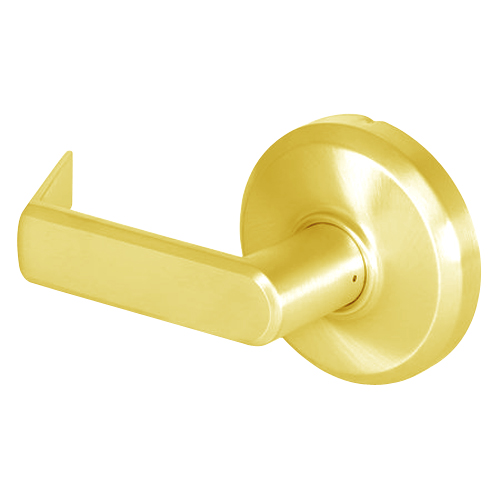
The QCL230 is the simplest of the group, and it is what most people mean when they say "just a latch with a handle." Both levers are always unlocked and always free. Nobody can lock the door and nobody needs a key. The QCL230 with the Sierra lever in bright brass is the listing we use as the reference.
Use a passage lock where you want the door to close and stay closed but never be secured: a corridor door between two open areas, a closet that holds nothing valuable, a vestibule, a break room. If someone asks "does this door need to lock?" and the honest answer is no, the QCL230 is the right lock and the cheapest way to be right.
QCL235: the communicating lock
"Communicating" is not a word most people use outside the trade. It describes a door between two spaces where one side is never locked out. The catalog puts it plainly: blank plate outside, inside lever always unlocked and always free. From the inside you open the door. From the outside there is no lever to turn at all.
That makes the QCL235 a fit for a door you want to open from one direction only. A supply room that people walk out of but are not supposed to wander into is a typical use. The QCL235 in bright brass with the Sierra lever shows the layout. Check which side carries the lever before you install it, because the lock is non-handed and the plate goes on the side you decide.
One thing to settle before you order: if staff ever need to get in from the blank-plate side, this is the wrong lock. Nothing on that side turns. If anyone needs to enter from both directions, step up to an entry, office or corridor function, which in this series means the QCL250, QCL251 or QCL254.
QCL240: the privacy lock
The QCL240 is for the door a person closes behind them. The catalog describes it as push-button locking. Push the button on the inside and the outside lever stops working. Turn the inside lever, or close the door again after it has been opened, and the button releases. The inside lever is always free, so nobody gets trapped behind it.
Two details matter in the field. First, the catalog says it can be opened from outside with a small screwdriver. That is intentional. A privacy lock is not a security lock, and in a restroom or a changing room you want staff to be able to get in if someone is unwell. Second, there is a clutch that disengages the outside lever from the latch while the door is locked. That is the vandal-resistance feature: somebody hanging on the outside lever cannot force the mechanism. The QCL240 with the Sierra lever is the listing to start from.
Privacy locks go on restrooms, single-user bathrooms, fitting rooms, consultation rooms and staff changing areas. They do not go on anything that has to resist a determined entry, and they are not a substitute for a keyed lock on an office.
What they share: the door prep
All three use the same preparation, which is the practical advantage of staying inside one series. From the catalog specs:
- Door thickness: 1-3/8" to 2" (35 to 51 mm).
- Backset: 2-3/4" (70 mm) square standard.
- Cross bore: 2-1/8" (54 mm) diameter.
- Latch: listed as a radius latch with a 3/4" throw.
- Strike: ANSI 4-7/8" x 1-1/4".
- Handing: non-handed, so there is no left or right to get wrong.
That is the standard cylindrical prep on most commercial doors, which is why a QCL200 is often a straight swap for an older cylindrical lock. Measure the backset and the bore on the door you are replacing before you order. If either is off, send us a photo of the existing lock and the edge of the door and we will tell you what fits.
The catalog describes the packaging as compartmentalized, with each part in its own section. That helps when a crew is installing a dozen at once: nobody has to hunt for the strike or the screws.
Lever style and finish
The QCL200 listings come with the Sierra lever and the Summit lever. In the Sierra style our catalog carries bright brass, oil rubbed bronze, satin nickel, bright chrome and satin chrome. Match the finish to whatever is already on the building. Mixed finishes along one corridor look like a mistake. If you are matching hinges or exit devices, get the finish names from the existing hardware first, since different makers name the same finish differently. We would rather check than guess.
How to pick in thirty seconds
- Door never needs to lock, from either side: QCL230 passage.
- Door opens freely from the inside and the outside should be a blank plate: QCL235 communicating.
- Door needs to be lockable from the inside by the occupant, with an emergency way in: QCL240 privacy.
- Door needs to lock with a key from the outside: none of these. Look at the entry functions instead.
Common questions
What is the difference between a passage lock and a privacy lock?
A passage lock never locks. A privacy lock has an inside push button that locks the outside lever until you turn the inside lever or close the door again.
Can I open a QCL240 privacy lock from the outside?
Yes. The catalog says it can be opened from the outside with a small screwdriver, which is the emergency release on a privacy function.
Does the QCL235 communicating lock have an outside lever?
No. The catalog lists a blank plate on the outside. The inside lever is always unlocked and always free.
Do these locks come handed?
No. The QCL200 locks are listed as non-handed, so one part number covers a left or a right door.
What grade are the QCL200 locks?
The catalog lists them as certified to ANSI/BHMA A156.2 Grade 2, a standard-duty rating for light commercial use.
The full Stanley line is on our Stanley hardware page. If you are matching a lock to a door you cannot see from here, send us the door thickness, the backset and a photo of the current lock, and we will line up the part number. For another look at Stanley hardware, see our note on the Stanley CEFBB179 electrified hinge. For the same function logic on another maker's cylindrical line, see Sargent 10 Line: storeroom versus office.