
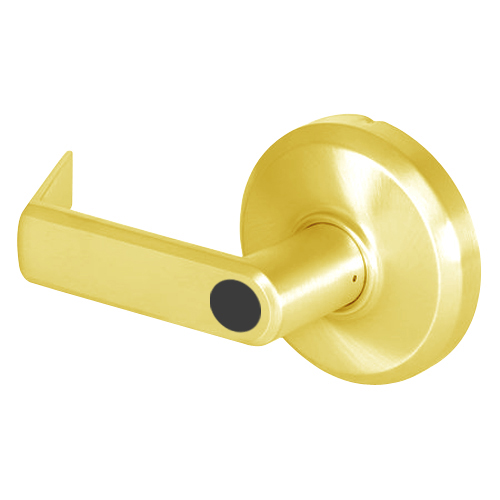
Stanley QCL250, QCL251, QCL254: Entry, SFIC or Corridor
Posted by Kent on 6th Oct 2026
The Stanley QCL200 locks that take a key
The passage and privacy functions in Stanley's QCL200 line are easy: nobody needs a key. The functions in this article are the ones that do. The QCL250, QCL251 and QCL254 are all sold less cylinder, and that is the first thing to understand before you order. The catalog says it for each one: cylinder is not included. You are buying the lock body, the levers and the latch, and you supply the keying.
That is not a defect. A building that already has a key system wants its own cylinders, and a lock that arrives with a random one is a problem to solve. The three models differ in what the lock does and in what kind of cylinder it expects. All are certified to ANSI/BHMA A156.2 Grade 2 as standard-duty cylindrical locks for light commercial use.
QCL250: the entry lock
The QCL250 is the one most light commercial doors want. The catalog describes two ways to lock it from the inside. Turn/push-button locking: pushing and turning the button locks the outside lever, and it stays locked until you use the key or manually unlock the button. Push-button locking: pushing the button locks the outside lever until it is unlocked by key or by depressing the inside lever. In both cases the inside lever is always free for immediate egress.
Which mode you get is in the part you buy, so read the listing. The QCL250 with the Sierra lever in bright brass is the one we use as the reference entry lock. A small office, a studio, a back-room door where the person inside should be able to lock out the hallway, and the manager can still get in with a key: this is the lock for it.
The clutch feature deserves a note. When the outside lever is locked, the clutch disengages it from the latch, so someone yanking on a locked lever cannot damage the mechanism. That is the part of the vandal-resistance claim that matters on a door that faces a public hallway.
QCL251: the same lock, prepped for an interchangeable core
The QCL251 is listed as an entrance/office lock prepped for SFIC, which stands for small format interchangeable core. Functionally it behaves like the QCL250. The difference is the cylinder it expects: instead of a conventional mortise or cylindrical cylinder, the outside lever takes a removable core. The catalog again says the cylinder is not included.
The reason to pick an interchangeable core is control. A core can be pulled with a control key and replaced in seconds, with no tools on the lever and no disassembly of the lock. If a key goes missing, you pull the core and drop in a new one, and the old key is dead. On a campus, a property with turnover, or any building where keys walk, that matters. The QCL251 with the Sierra lever in bright brass is the listing to look at.
If you already run interchangeable cores, the QCL251 is the right choice because it matches what you own. Our guides on rekeying with BEST SFIC cores, Arrow 6-pin versus 7-pin cores and the KSP core cover how those systems work. If you do not run interchangeable cores, the QCL250 and a standard cylinder will cost you less and give up nothing you need.
Whichever core you plan to use, send us the brand and keyway before you order. The lock is only half of the match.
QCL254: the corridor lock
The QCL254 solves a different problem. A corridor door, such as a classroom or hallway office, usually needs two things at once. People inside must be able to leave without a key. A key holder in the corridor must be able to lock the door from outside. The catalog describes it as a deadlocking latch bolt operated by the lever from either side, except when the outside lever is locked by key or by the push button on the inside.
The details, as listed: the key in the outside lever locks or unlocks the outside lever. Operating the inside lever releases the push button. Closing the door also releases the push button. And the inside lever always operates the latch bolt. In plain terms, someone can lock themselves in for privacy, but a closed door resets itself, and nobody is ever trapped. The QCL254 corridor lock in bright brass with the Sierra lever is the reference listing.
A deadlocking latch bolt means the latch itself resists being pushed back with a shim or a thin tool once the door is closed. For a door that opens onto a public corridor, that is a useful bit of extra resistance to have on a light commercial lock.
How the three compare
- QCL250: entry. Standard cylinder (not included). The everyday office lock.
- QCL251: entrance/office, prepped for SFIC (core not included). Same behavior, interchangeable-core control.
- QCL254: corridor. Deadlocking latch bolt, push button inside that releases when you close the door or move the lever.
All three share the door prep. From the catalog specs: door thickness 1-3/8" to 2", 2-3/4" backset, 2-1/8" cross bore, a 3/4" latch throw and an ANSI 4-7/8" x 1-1/4" strike. They are non-handed. If you are replacing an older cylindrical lock, measure the backset and the bore first. The standard prep matches most commercial doors, which is what makes the QCL200 a practical retrofit.
Lever, finish and what to confirm before you order
The QCL200 comes with the Sierra lever and the Summit lever. The Sierra lever is in bright brass, oil rubbed bronze, satin nickel, bright chrome and satin chrome in our catalog. Pick the finish to match the other hardware on the door and in the corridor.
Three things to settle first:
- What function the door needs. If you are not sure whether it is an entry or a corridor door, tell us what the room is used for.
- What cylinder you will fit. A standard cylinder, or a removable core and which brand.
- The door thickness and backset, so the prep matches.
Common questions
Does the Stanley QCL250 come with a cylinder?
No. The catalog lists it as less cylinder, so the cylinder is not included. You supply it.
What does SFIC mean on the QCL251?
It stands for small format interchangeable core. The QCL251 is prepped for that kind of removable core, and the core is not included.
What is the difference between the QCL250 and the QCL254?
The QCL250 is an entry lock. The QCL254 is a corridor lock with a deadlocking latch bolt, where the inside push button releases when you operate the inside lever or close the door.
Can the inside lever always open the door?
Yes. On all three functions the inside lever is listed as always free for egress.
Are these locks left-hand or right-hand?
Neither. They are listed as non-handed.
See the full range on our Stanley hardware page. Send us the door thickness, backset and the cylinder you intend to use, and we will line up the part number before you order. For another Stanley product that solves a door problem, see our guide to the Stanley QED100 electrified exit device options.