
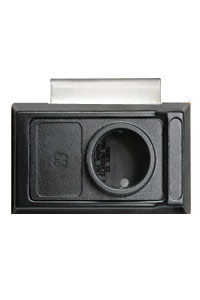
Supra 00624 vs 001773: Over-the-Door or Wall-Mount Lockbox
Posted by Kent on 18th Sep 2026
A property manager calls asking for "a lockbox," and half the time the door they're describing won't take one. Most combination lockboxes hang from a lever handle or a doorknob. A lot of the doors that actually need one, narrow-stile aluminum storefronts, a rear door fitted with a panic bar instead of a lever, a shed or gate with no handle at all, don't have anything to hang from. Supra makes two very different answers to that problem, and picking the wrong one gets you a box you can't actually mount on the property you're standing in front of.
Supra 00624: mounts over the top of the door, not on the handle
The Supra 00624 is an over-the-door mortise lock box. Instead of clamping onto a lever or knob, it hooks over the top rail of the door itself, the same way an over-the-door towel bar hooks over a bathroom door. No drilling, no exterior hardware, no dependence on the door having a lever at all. This is the box I point a real estate agent to on a narrow aluminum storefront where a standard shackle-style box won't clear the stile, or on any commercial door where the exterior trim is a push bar, a paddle, or bare glass. It's a GE Security product, the same parent line behind Supra's key cabinets, so the fit and finish match the rest of the family. The tradeoff is exactly what it sounds like: it needs a door with a top edge it can hook over and clear on the swing, so measure the door thickness and check for a closer arm or head-mounted hardware that might block it before you order one for a specific opening.
I've also used the 00624 on doors where the agent didn't want a permanent mark left on good hardware, a glass storefront door with a polished pull that the listing office didn't want scratched by a clamp-style box. Hooking over the top rail leaves the door hardware untouched, which matters more than people expect on a commercial listing where the buyer is inspecting the finish along with the space.
Supra 001773: a slimline keysafe that doesn't need a door at all
The Supra 001773 solves a different problem entirely. It's a Slimline push-button keysafe that mounts to any flat surface with the included hardware, a wall, a fence post, a shed, a gate frame, anywhere you can drive two screws. It holds two keys behind an interlocking, tamper-resistant faceplate, and because it doesn't hook onto anything, it works in situations the 00624 can't touch: a vacation rental with a keyless side gate, a utility closet with no door swing to hook onto, a detached shed with nothing but a hasp. It's a much smaller footprint too, sized for one or two spare keys rather than a full lockbox card, which makes it the cheaper and less conspicuous option when a full-size box would be overkill.
The push-button entry also matters for anyone managing a rotating list of contractors. Reset the combination between tenants or trades and the box functions like a mini key exchange, without touching the property's actual locks.
Which one actually fits your situation
Picking between them isn't about which box is "better," it's about what you're mounting it to. If there's an actual door edge and the box just needs to survive weather and public handling without a lever to hang from, the 00624 is built for exactly that. If there's no door to hook onto at all, or you just need to stash a spare key somewhere that isn't a doorknob, the 001773 does that job in a smaller, cheaper package. I've watched both get bought for the wrong reason: an agent ordering an over-the-door box for a listing where the real need was a spare key hidden near a detached garage with no door edge to hook onto, and a facilities manager buying a slimline keysafe for a storefront that kept getting knocked loose because the door's own swing needed the sturdier mortise mount instead. Match the box to the mounting surface first, worry about key capacity second.
Coastal and high-humidity properties are worth a separate note. Both boxes are steel, and a vacant listing sitting through a full season near salt air will show it on the hardware faster than an occupied one. If a box has to survive months on an empty property, budget for an earlier swap rather than assuming either unit is a install-and-forget fixture.
If what you actually need is bulk key storage for a staff of several people rather than a single spare key for a listing or a gate, that's a different product family. Our guide to sizing a Supra key cabinet covers that decision instead.
Common questions
Does the 00624 require any drilling or exterior hardware on the door?
No. It hooks over the top rail of the door, so there's nothing to drill and nothing mounted to the face of the door itself. Confirm the door's swing clearance at the top, and check for a closer arm or head hardware that might interfere, before ordering one for a specific opening.
How many keys does the 001773 hold?
Two. It's built for a spare key or two, not a full lockbox card or a large ring, which is why it's a noticeably smaller unit than a standard combination lockbox.
Can I use the 00624 on a door with a panic bar instead of a lever?
Yes, that's one of the main reasons to pick it. Because it hangs from the top of the door rather than clamping onto handle hardware, it works on doors where the exterior trim is a push bar, a paddle, or nothing at all.
Is either of these the right choice for storing several staff keys?
No. Both are single-listing or single-gate spare-key boxes. A facility keying several people into a building needs a full key cabinet, like the Supra 001801 or 001803, not a lockbox.
Will a vacant property's weather exposure damage either box?
Both are steel and hold up to normal outdoor use, but salt air and long unattended vacancies are harder on any exposed lock hardware. On a property sitting empty for a season, plan on checking or swapping the box sooner than you would on an occupied listing.