
Supra 001801 vs 001803: Sizing Your Key Cabinet
Posted by Kent on 10th Sep 2026
The Drawer Full of Keys Nobody Can Account For
Walk into most maintenance offices and you'll find the same thing: a metal drawer, a pegboard, or an old cigar box full of loose keys. Some have masking tape labels that wore off years ago. Some don't have labels at all. When a resident calls at 7am locked out of a unit, somebody spends ten minutes digging through a drawer hoping the right key is still in there, and hoping nobody walked off with it last spring.
A steel key cabinet fixes that. But the question that actually matters is size. Buy too small and you're back to keys hanging on a nail outside the cabinet within a year. Buy the right one and every key in the building has one place to live.
Two Cabinets, Two Different Jobs
Supra makes two versions of this cabinet, built for different scales of property. Neither one is electronic. There's no software, no audit trail, no app checking keys in and out. What you get is a locked steel box, a set of numbered tags, and a chart you fill in by hand. That's the whole system, and for a lot of maintenance shops, that's exactly enough.
Supra 001801: 30-Key Cabinet
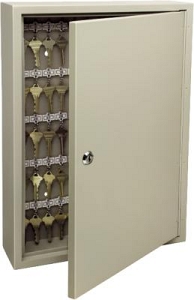
The 001801 is a 30-Key Cabinet, a compact steel box measuring 12.04" x 8.11" x 3.19", finished in Clay, secured with a keyed cam lock and two keys. It ships with numbered key tags, key rings, and a lock-location chart so you can log which numbered hook matches which door. It's built for a single small property: a garden-style apartment building, a strip of retail units, a small church campus. If you're managing 25 to 30 keys total, this is sized correctly. If you're already close to 30 and adding units, don't buy this one, you'll outgrow it fast. Full details are on the 001801 30-key cabinet product page.
Supra 001803: 120-Key Cabinet
The 001803 is the Stor-a-Key heavy-duty 120-Key cabinet, a larger steel unit at 19.25" x 13.325" x 4". Same lock type, a keyed cam lock with two keys, same Clay finish, same included tags and chart, just built to hold four times the keys. It costs more up front, but per-key it beats buying three small cabinets and bolting them side by side. This is the one for a mid-size apartment community, a multi-building complex, or a school district maintenance shop juggling keys for classrooms, gyms, offices, and outbuildings across several sites. See the specs on the 001803 120-key cabinet product page.
How to Actually Size This
Count first. Walk your property or your district roster and count every key you're currently responsible for, not just unit doors, but mechanical rooms, electrical closets, laundry rooms, gates, storage sheds, and any master keys floating around. Add ten or fifteen percent for keys you'll add this year. That's your real number.
Under 25, the 001801 works and you'll have room to spare. Between 25 and 30, it's tight, pick the 120 if you're growing at all. Above 40 keys, don't bother with the small cabinet. You'll be back ordering a second one within a year, and now you've got two cabinets, two keys to track, and the same mess you started with, just split in half. One cabinet sized right beats two cabinets sized wrong.
What's Actually in the Box
Both cabinets come with the same basic kit: two keys for the cam lock, a full set of numbered tags and rings, and a lock-location chart. The chart is a sheet where you write the number next to the door or unit it belongs to. That's the entire tracking mechanism. There's no barcode, no login, no history log if a key goes missing. If your operation needs to know exactly who checked out which key and when, that's a different category of product entirely, and neither of these cabinets claims to do it. What they do is put every key behind one lock instead of forty loose ones on a pegboard, which for most maintenance offices is the actual problem that needed solving.
Rounding Out the Maintenance Shop
A locked key cabinet is one piece of getting a facilities shop under control, not the whole job. If your property has service gates or utility yards, a gate box for mounting a lockset on a steel gate solves the same kind of loose-hardware problem outdoors. And if you've got exterior doors that see pry attempts, storage buildings, laundry rooms, back-of-house entries, a latch protector for outswing doors is a cheap fix for a door that's otherwise an easy target. Same buyer, same shop, same logic: lock down the physical gaps one at a time. You can browse the full lineup of cabinets and accessories on the Supra hub page.
Common questions
How many keys does a Supra key cabinet actually hold?
It depends on the model. The 001801 holds 30 keys, and the 001803 holds 120. There isn't a middle option, pick based on your actual key count, counted room by room, not a guess.
Can I add capacity later by connecting a second cabinet to the first?
No. Each cabinet is a standalone steel box with its own lock and its own numbered tag set. If you outgrow the 001801, you buy a second cabinet. There's no way to merge or expand one unit into another, which is exactly why sizing correctly up front saves you a purchase.
Do these cabinets track who took a key and when?
No. Both are mechanical steel cabinets with a keyed cam lock, there's no electronics, no software, and no automatic record of who opened the cabinet or which key left it. The lock-location chart is a manual reference for which numbered hook holds which key, not a check-out log. If you need that, keep your own sign-out sheet next to the cabinet.
What's included when I order either cabinet?
Both the 001801 and the 001803 ship with the steel cabinet itself, two keys for the cam lock, numbered key tags with rings, and a lock-location chart. Nothing else to buy separately to get it running on day one.