
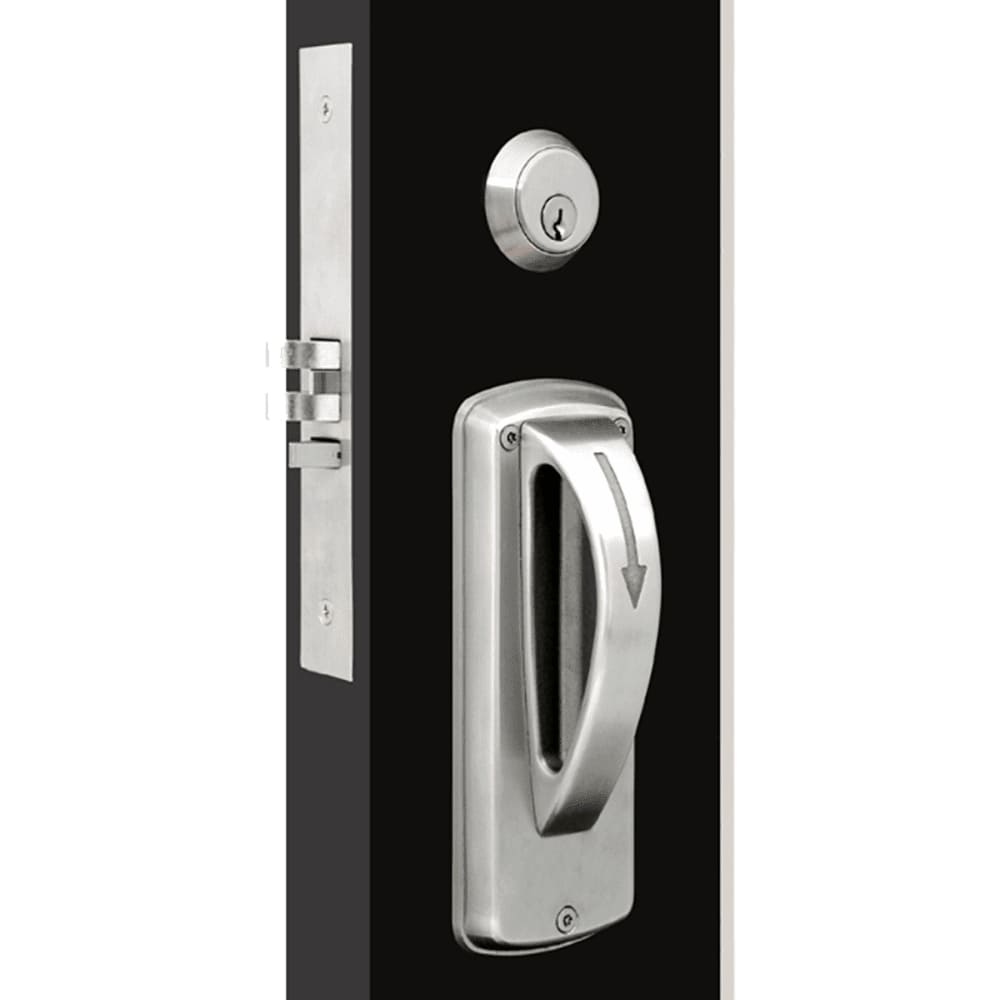
TownSteel MRX: Anti-Ligature Mortise Locks for a Patient Room
Posted by Kent on 17th Aug 2026
A conventional lever on a patient room door is an anchor point. That is why it comes off during a behavioral health renovation or after an inspection writes it up. The replacement is a mortise lock with sloped, continuous trim. We stock two TownSteel lines in 630 satin stainless: the MRX-A arch-trim ligature-resistant line and the MRX-S-K heavy-duty anti-ligature line with sectional trim and knobs.
This hardware is one layer of a facility's safety program. It is not a safety program. The lock removes a place to tie to and keeps working after ten years of hard use. The rest of the unit is somebody else's job. Write the spec that way.
Why an anti-ligature mortise lock for a behavioral health door is shaped the way it is
A normal commercial lever projects from the rose, runs horizontally, then returns toward the door face. That gap between lever and door is a loop, and a loop holds a cord under load. An open-end lever with a raised ridge does the same.
Anti-ligature trim removes the loop by removing the discontinuity. The arch trim on the MRX-A line is a continuous sloped form. No shelf, no return, no gap that captures. Anything draped over it slides off. The rest of the lock is a conventional mortise body.
A knob has no long axis to hang from. That is the argument for MRX-S-K-01-630 and the rest of the knob line.
The trade-off nobody puts in writing
A knob is harder to operate than a lever. A lever works with a forearm, an elbow, a fist, or a wrist. A knob requires grip and rotation. For a resident with limited hand strength, arthritis, or a cast, that difference is real, and accessibility review may have an opinion.
So the decision is not "anti-ligature or not." It is how far toward the knob you go, room by room, and whose sign-off you need. Arch trim on resident-accessible doors, knobs where the risk justifies the operating penalty. Your clinical staff and accessibility reviewer decide that, not the catalog.
Function selection is the part people get wrong
A wrong function is a life-safety problem. I have seen a privacy set land on a patient room door with no way in from the corridor. What we stock:
- 01: Passage, non-keyed. Latch only.
- 02: Privacy / Bathroom with deadbolt, non-keyed.
- 19: Privacy / Bathroom with deadbolt and thumb turn, non-keyed.
- 22: Privacy / Bathroom, thumb turn, no deadbolt, non-keyed.
- 04: Entry / Office, single cylinder. The only keyed function here.
Function by room
| Opening | Typical function | Why |
|---|---|---|
| Patient room door | 01 Passage | Latches, never locks. Staff access is never in question. Corridor control, if any, lives elsewhere on the opening. |
| Patient bathroom, occupancy indication needed | 22 or 19 | Thumb turn gives the resident privacy. Confirm the staff-side override arrangement for the opening before you order. |
| Patient bathroom, deadbolt required by the facility | 02 or 19 | Deadbolt versions where the facility's own policy calls for one. Same override question applies. |
| Staff office, med room, clean supply | 04 Entry / Office | Keyed. Joins the master key system. Residents on the outside, staff on the inside of the credential. |
| Corridor and cross-corridor doors | 01 or 04 | Passage where the door is free, keyed where it separates a controlled area. |
The rule that matters on any patient-accessible door: staff have to be able to get in. A privacy function that cannot be released from the corridor side is a mistake in this environment. What that override looks like, whether it is an emergency release on the trim, a key, a tool, or a policy that the door is never privacy-locked at all, is set by your clinical and safety staff. It is a facility policy decision, not a hardware default, and it changes between a group home and a locked psychiatric unit. Get the answer per opening, in writing, before the order goes in. We will confirm which stocked function matches the arrangement you describe.
Handing is not optional on the MRX-A line
We stock the arch-trim line as discrete parts by hand. Not field-reversible in the box. MRX-A-01-630-LH and MRX-A-01-630-RH are two different part numbers, and so are MRX-A-02-630-LH and MRX-A-19-630-LHR.
Stand outside the door, on the side the public approaches from. Hinges left, swings away: left hand, LH. Hinges right, swings away: right hand, RH. Swinging toward you makes it a reverse: LHR with hinges left, RHR with hinges right. Write down which side you called "outside," because two people can disagree on an interior door.
Confirm the hand at the opening, not from a schedule someone typed last month. A wrong-handed mortise lock is a return and a reorder.
Finish, cylinder prep, and the rest of the order
630 satin stainless steel across both lines, on the merits. Stainless takes abuse without showing it and survives repeated cleaning and disinfection. A plated finish in a room wiped down several times a day looks bad in a year.
The MRX-S-K entry/office function comes in a standard version, MRX-S-K-04-630, plus several interchangeable-core prep variants so the lock joins an existing master key system. The suffixes designate different core families. Tell us which family the facility keys to and we will confirm the part string. Do not guess from the part number.
For bathroom and privacy openings on the knob line, we stock MRX-S-K-02-630 with deadbolt and MRX-S-K-22-630 without. More of the TownSteel line is on the hub page.
The trap: specifying the lock and leaving the rest of the opening alone
New anti-ligature trim goes on. Above it, a closer with a projecting arm. Below it, a floor or wall stop. On the hinge side, exposed barrels and knuckles. Every one is an anchor the new lock did not address.
The opening is the unit of safety, not the lock. Walk the whole door: closer, hinges, stop, grab bar, coat hook, vision light frame, sprinkler head. For the closer half of the job, read our piece on the Norton 7570 security closer for detention and behavioral health doors. Then hand the list to the facility's safety committee.
Confirm before you order
- Door hand and swing, verified at the opening, with an agreed "outside" side.
- Door thickness. Measure it.
- Function per room, per the table and your clinical staff's answer on privacy.
- Cylinder and core family for every 04 opening.
- Whether the opening is fire rated.
- The facility's override policy in writing, per opening.
Common questions
What is the difference between MRX-A and MRX-S-K?
Trim style. MRX-A is arch trim, continuous and sloped. MRX-S-K is sectional trim with knobs. The knob offers less to anchor to, the arch trim is easier to operate. Both stocked in 630.
Can I use a privacy function on a patient room door?
Only if staff can release it from the corridor side, and only if your clinical and safety staff say so. Confirm the override arrangement per opening before ordering.
Do I have to specify handing?
On the MRX-A line, yes. We stock separate LH, RH, LHR, and RHR parts. A wrong-hand lock is a return, not a field adjustment. The MRX-S-K knob line in our stock is not listed by hand.
Which interchangeable-core prep do I order for the MRX-S-K entry function?
Tell us the core family the facility already uses and we will confirm the part string. Reading the suffix off a similar part number is how buildings end up with cores that will not fit.
Does anti-ligature hardware make the room safe?
No. It removes one category of anchor point from one part of one opening. The closer, the hinges, the stop, and the room itself are a separate survey, and the clinical program is doing the real work.