
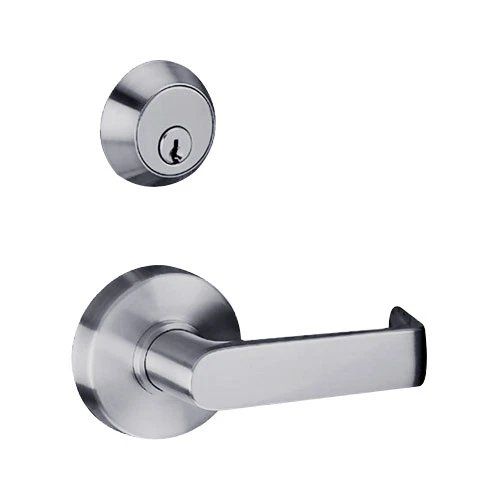
TownSteel MSS: Office or Classroom Function for a School Door
Posted by Kent on 12th Sep 2026
A school facilities order for a hallway of classroom doors is where this mistake shows up most. The purchase order says "TownSteel MSS mortise lock," the SKU list has two functions sitting right next to each other, and somebody picks whichever one is cheaper that week. Then a teacher can't lock her door from the hallway during a drill, or a corridor door that's supposed to stay locked from outside doesn't. The fix isn't a different manufacturer. It's picking the right function code before the order goes out, and on the TownSteel MSS line that means choosing between Entry/Office and Classroom.
What the two functions actually do at the door
Both functions sit on the same heavy-duty sectional mortise case, both are ANSI/BHMA A156.13-2012 Grade 1 certified and UL 10C 3-hour fire rated, and both use the same Sentinel lever and Schlage C keyway on the SKUs referenced here. The difference is entirely in how the outside lever behaves.
The MSS-L-S-04-626 is Function 04, Entry or Office: a key locks and unlocks the outside lever, and once it's locked the outside lever stays dead until someone unlocks it again with a key or a thumbturn from inside, depending on the trim. This is the office door function: the last person out locks it, and it stays locked until someone with a key comes back.
By contrast, the MSS-L-S-05-626 runs Classroom function: the outside lever is locked or unlocked by key from the corridor side, but the inside lever is always free. Nobody inside the room is ever locked in, no matter what the outside key has done. That's the function code that lets a teacher lock the door against the hallway during a lockdown drill while every kid in the room can still walk out if they have to.
Why this isn't interchangeable on a real order
Put an Entry/Office function lock on a classroom and you've built a door that can trap the room's own occupants if someone locks it from the corridor side without checking who's inside first. Put Classroom function on an office that actually needs to stay secured from both directions and you've built a door that never locks the inside lever, which defeats the reason someone specified a keyed mortise lock in the first place. The case, the lever, the finish and the keyway can be identical on the shelf. The function code is the part of the order that has to match the room.
Both functions here ship non-handed, standard 1-3/4" door thickness, 2-3/4" backset, in Satin Chrome (626) with a mortise cylinder for the Schlage C keyway shown. The "L" in the SKU marks TownSteel's Low Sectional case; the same functions are also available in the standard Sectional case under the "R" prefix if the door prep calls for it. Match the case style to what's already cut into the door, not the other way around.
What a mixed-function hallway costs you later
Districts running a keying program that re-keys every summer feel the function mistake worst. If half a hallway is Entry/Office and half is Classroom, the locksmith doing the annual re-key has to carry two different service procedures for what looks, from the corridor, like one identical row of levers and escutcheons. Cylinders get pulled, function tags on the work order get transposed, and the wrong function ends up back on the wrong door. A single, deliberate function standard per room type, offices on 04, classrooms on 05, turns that annual re-key from a guessing exercise into a checklist.
It also matters for substitute staff and campus security walking the halls during a drill. A consistent function code means every classroom door in the building behaves the same way under the same key turn. Mixed functions mean training staff on which doors do what, which is exactly the kind of detail that gets forgotten under an actual lockdown rather than a drill.
Ordering it right the first time
Before the PO goes out on a corridor of doors, confirm three things per opening: the function each room actually needs (office lockdown-from-outside versus classroom always-free-inside), the case style the existing prep was cut for (Low Sectional or standard Sectional), and the keyway the district's existing key system runs on. A batch order with one function code and one keyway is cheap to key and cheap to stock spares for. A mixed batch guessed room by room is the order that comes back three months later as a service call.
Common questions
Can I convert an Entry/Office lock to Classroom function later?
No, not on this line without swapping the lock body. Function is built into the mortise case at the factory, not a field-adjustable setting, so pick the function the room needs before the lock ships.
Which function do most schools actually spec for classrooms?
Classroom function, specifically because it guarantees free egress from inside no matter what's happened at the outside lever. Fire and life-safety review on a school building will generally flag any classroom door that can lock occupants in from either side.
Do Entry/Office and Classroom function use the same key?
They can, if both are cut to the same keyway and keyed into the same system, which is exactly why matching the keyway across a mixed-function order matters. The function code changes how the lock operates; it doesn't change what key fits the cylinder.
What's the difference between the Low Sectional and standard Sectional case?
It's a case-size distinction tied to the door prep dimensions already cut for the lock, not a function or security difference. Measure the existing mortise pocket before ordering rather than assuming which case style is already installed.
Is the MSS line rated for a fire door?
Yes, both functions referenced here carry a UL 10C 3-hour fire rating alongside the Grade 1 mechanical certification, so either one is appropriate for a rated corridor or classroom door provided the rest of the opening's hardware is rated to match.
If the value pitch on this line is what you're weighing first, the case for TownSteel against the bigger three brands is laid out in TownSteel MSS: A Heavy-Duty Mortise Lock That Isn't a Big Three Price. For the rest of the line, including the anti-ligature and electrified options, see the TownSteel hub.