
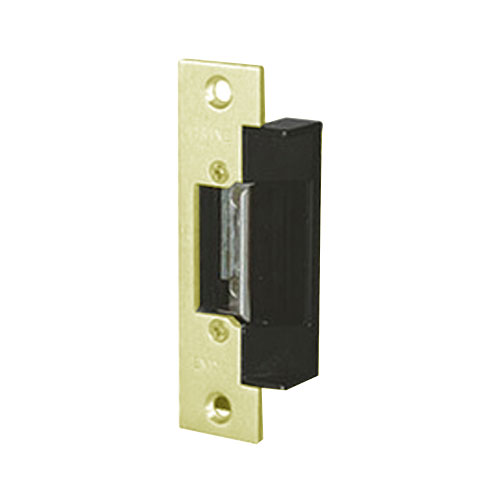
Trine 2012 vs 2012C: A Strike Before You Know the Voltage
Posted by Kent on 15th Sep 2026
The power question nobody has answered yet
I get the call the same way every time. The general contractor wants a strike ordered so the door can close in the schedule, and the access control panel is still three submittals away from being picked. Nobody on site can tell me if the wire coming out of the header is going to carry 12 volts DC, 24 volts DC, or something off an AC transformer left over from an old buzzer system. That's the moment you find out whether you bought the right electric strike or the wrong one.
Two strikes, one frame prep
Trine's 2000 Series covers this problem well, because the whole line is built around the same light commercial body and the same adjustable jaw, just wired differently inside. You can look at the full Trine line and see the pattern: same footprint, different guts. That matters on a retrofit, because I'm not re-cutting a frame twice. If the panel spec changes after rough-in, I want the second strike to drop into the same prep without a hacksaw.
The 2012-RS: DC only, Fail Safe
The 2012-RS-12DC and the 2012-RS-24DC are the same strike built two ways. Both are named Fail Safe right in the catalog listing, both come in Brass Powder finish, and the only difference between them is the DC voltage they're wired for: 12 volts on one, 24 volts on the other. Neither one takes AC. If your panel is a straight DC output and you already know the voltage, this is the cleaner buy. Fail Safe means the keeper releases when power drops, which is what a fire marshal wants to see on a stairwell door or anywhere egress trumps security. I've had inspectors walk a jobsite and ask point blank whether the strike unlocks or locks on power loss, and if you guessed wrong at order time, you're pulling wire and swapping hardware a second time.
The 2012C: AC or DC, wider range
The 2012C-6-14AC/DC and the 2012C-16-24AC/DC are the flexible option, finished in Satin Chrome instead of brass powder. The 6-14 model covers 6 to 14 volts on either AC or DC, and the 16-24 model covers 16 to 24 volts on either AC or DC. That range is the whole selling point: you don't have to know in advance whether the head end is going to hand you AC or DC, only roughly what voltage band you're in. I want to be clear on one thing, because the name trips people up: the 2012C does not carry a Fail Safe designation. Don't tell a customer it fails safe or fails secure based on the "C" name alone. It's an adjustable AC/DC strike, full stop, and if the door needs a defined fail mode for code, that's a separate conversation with the panel and the strike function together.
Where I've seen this bite people
I wired a strike years ago on a side door for a school, went with a 24-volt DC unit because that's what the old panel used. The district swapped vendors mid-project and the new panel put out a lower DC voltage than I'd planned for. The strike barely buzzed, the keeper wouldn't retract clean, and the door dragged against it until the frame took cosmetic damage. That's the failure mode nobody warns you about: a strike that's weak instead of dead, buzzing along and wearing out the prep instead of just refusing to work. Since then I don't guess. If a customer can't confirm voltage and type, I steer them toward the 2012C so the range does the forgiving instead of me re-ordering hardware.
I also worked an intercom entry on a small apartment building where fail-safe operation mattered because of the egress path off the lobby, similar to what I laid out in an intercom entry retrofit I wrote up separately. That job had a known DC panel from day one, so the RS series was the obvious call. Knowing your power source ahead of time is what lets you buy the tighter, purpose-built strike instead of the flexible one.
How I actually choose on the job
My rule is simple: if the panel and voltage are locked in and the door needs a defined fail mode, buy the 2012-RS in the matching voltage and stop there. If the panel spec is still moving, or you're stocking one strike to cover several jobs with different power sources, buy the 2012C in the voltage band that fits and keep the fail-mode conversation separate. I lean toward the 2012C more often than people expect, even on jobs where I think I know the voltage, because I've been burned by a "final" panel spec changing after the strike was already in the wall. The adjustable jaw on both series saves you on frame prep either way, but the voltage flexibility is what saves you on a callback.
Common questions
Can I use a 2012-RS strike on an AC-powered panel?
No. The 2012-RS-12DC and 2012-RS-24DC are wired for DC only. Running AC to a DC-only strike is not a swap you can make in the field; you need the 2012C for AC power.
Does the 2012C fail safe or fail secure?
Neither is stated for it. The 2012C is sold as an adjustable AC/DC strike without a Fail Safe designation, so don't promise a fail mode on that model. If the door requires one, spec a strike where that function is named, like the 2012-RS.
What's the actual difference between the two 2012C voltage options?
The voltage band. The 2012C-6-14AC/DC covers 6 to 14 volts, and the 2012C-16-24AC/DC covers 16 to 24 volts, both accepting AC or DC within that range. Pick the one that brackets your known or expected supply.
Do the RS and C series use the same door prep?
Both belong to Trine's 2000 Series light commercial adjustable line, built around the same adjustable strike body, so they're meant to serve the same class of opening. Always confirm frame prep against the current spec sheet before you commit to a finish or model. I won't hand you a number I haven't measured myself.