
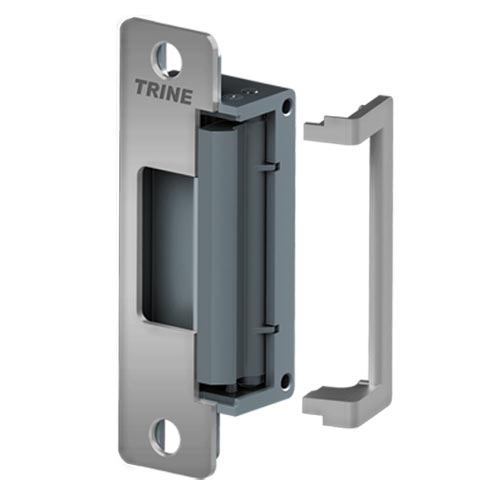
Trine 4200 or 4300 Electric Strike: Rim or Vertical Rod
Posted by Kent on 26th Nov 2026
Two strikes, two kinds of exit device
Panic hardware comes in two broad shapes, and the strike that goes with each is different. A rim device puts its latch on the face of the door and hooks a strike on the frame. A concealed vertical rod device hides rods inside the door and catches at the top of the frame. Trine makes an electric strike for each: the 4200 for the rim device and the 4300 for the concealed vertical rod. This guide sorts them out, and tells you where the catalog listings disagree with each other.
Not sure which kind of device you have? Our guide to PHI 2600 and 2700 concealed vertical rod devices shows the concealed type. And for a rim device on the door, see the Trine 4100 piece for a strike meant for different latches.
The 4200: surface strike for a rim exit device
The 4200 listing says it is built for rim-type exit devices, and names the Von Duprin 22, Sargent 8800 and Corbin Russwin ED5000 and similar panic bars. It is surface mounted on the frame, so no mortise is cut. In the listing's words, you run power, mount the strike, and you have electric release on a panic hardware door.
It takes multi-voltage input, 12 or 24 volts DC and 12 to 24 volts AC. That is handy on a retrofit, because you often do not know what the existing power is until you open the junction box.
Fail secure or fail safe
- 4200-ALUM is the fail secure version in aluminum. The strike stays locked without power.
- 4200RS-ALUM is the RS version, which the listing calls fail safe. The strike releases when power is lost.
The RS in the part number is the fail safe tell on Trine strikes. If a door is a means of egress where the strike has to open in a power outage, you want the RS. If it is a door that must stay locked in an outage, you want the plain one. Either way, the exit device still lets people out from the inside.
Finish
The 4200 comes in colored finishes so the strike matches a painted frame or device. We carry aluminum, black (4200-BLK) and green (4200RS-GRN) among others, and the RS version also appears in dark bronze and white. The listing says the colors are there to match the frame and the exit device.
The 4300: header strike for a concealed vertical rod device
The 4300 is the other shape. The listing says it works with concealed vertical rod exit devices and names the Von Duprin 6211, Sargent 8600 and Corbin Russwin ED5600 and similar. It mounts in the frame header and captures the top rod. Per the listing, this is the strike for electric access control on a door with a concealed vertical rod device.
The catalog lists it in a few forms:
- 4300-32D, satin stainless steel, with 4 faceplates included.
- 4300CC-32D, satin stainless steel, with 2 faceplates included.
- 4300-ALUM, aluminum powder coat, with 4 faceplates included.
All three titles describe a Grade 1 electric strike on 12 or 24 volts DC and 12 to 24 volts AC. The faceplate count is the only difference in the titles between the 4300 and the CC version, and the listing does not say what the CC stands for. I am not going to decode it. Ask us before you pick between the 4-plate and 2-plate version.
Where the listings disagree with themselves
Two things in these listings do not add up, and I want you to know before you order.
- The 4200 body text describes a rim exit device strike, but the web address of the same listing describes a strike for cylindrical locks and deadlatches with a fascia. The two cannot both be right. I follow the body text, which is more specific and names the exit devices. Confirm with us.
- The 4300 title prints a current figure that reads as "240 Amp @ 12 DC." No electric strike draws 240 amps. I do not know what the intended number is, so I am not repeating it. Get the real current draw from the spec sheet before you size a power supply.
The 4300 body text also says to order the appropriate faceplate separately for your exit device brand and model, while the titles say faceplates are included. Ask which faceplate fits your device before you count on the ones in the box.
Power: AC or DC
The listings say these strikes take 12 or 24 volts DC and 12 to 24 volts AC. In practice, pick one supply type for the whole job and stay with it. A common mistake on a retrofit is wiring a 24 volt strike to a 12 volt supply because that is what sat in the ceiling. The strike will not release, and the first call is that the reader is bad. Check the voltage at the strike with a meter before you blame the hardware, and size the supply for the current draw you got from the spec sheet, with some room to spare if the reader and a second strike share it.
How to choose
- Rim exit device, strike on the frame at latch height: 4200 (fail secure) or 4200RS (fail safe).
- Concealed vertical rod device, catching at the head: 4300.
- Painted frame to match: pick the color in the 4200 family.
Do not use a rim strike on a concealed rod device or the other way round. The latch is in a different place, and the strike will not reach it.
What the listings do not say
No current draw, no holding force and no strike dimensions appear in the listings. No fire rating is given for the 4200 or the 4300. Our stock count shows zero on the three 4300 versions while the listings are live and available, so confirm lead time with us. Give us the exit device make and model and the frame, and we will match the strike. The full range is on the Trine electric strike page.