
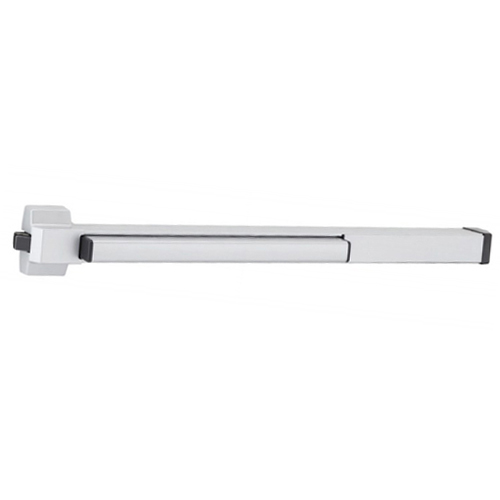
Von Duprin 22 Series: Exit Only, No Trim, No Way Back In
Posted by Kent on 16th Sep 2026
The doors that only need to let people out
Every building has one. The mechanical room off the loading dock. The roof access stair. The trash corridor nobody wants the public wandering into. Nobody needs a key to get out of these doors, and nobody outside should be getting in at all. That's a different problem than a storefront entrance, and it needs a different exit device.
The Von Duprin 22EO is built for exactly that door. Push bar operation from the inside only. No cylinder, no outside trim, no way in from the exterior at all. If somebody's trying to get back in that door, they're supposed to be walking around to the front.
What "exit only" means on the hardware
Most panic hardware conversations start with function codes: which trim, which cylinder, dogging or no dogging. The 22EO skips that whole conversation. There's no outside lever, no outside pull, no keyway cut into the case. The device only does one job, release the latch when the bar is pushed from inside, and it does that job on a wide-stile aluminum storefront or glass door, the kind you'd find on a strip mall service entrance or the side exit of an office building.
Rim mounted. UL listed for panic exit hardware. ANSI/BHMA A156.3 Grade 1 certified. Hex key dogging comes standard, so a manager can hold the bar down and prop the door for a delivery window without leaving it unlatched all night. I wouldn't dog it overnight on anything facing a parking lot. For a two-hour loading window, it's the right tool.
Single door or a pair, a different device, not an accessory
The single-leaf 22EO rim device covers one door in a standard frame. A pair of active leaves is a different animal. That's where the 2227EO-F comes in, a fire-rated surface vertical rod version that latches at the header and the threshold instead of a jamb strike, because on a pair there's no fixed jamb to catch a rim device's latch.
Two things trip people up ordering the 2227EO-F. First: it's fire rated, and fire-rated exit devices don't get mechanical dogging. A fire door has to be free to close and latch on its own every time, so there's no hex key hold-open on this one. If you need a hold-open on a fire door, that's an electrified closer tied into the alarm system, a different piece of hardware entirely. Second, and this one costs people a return shipment: the coordinator is not included. On a pair of fire-rated doors, the inactive leaf has to close first so the astragal seats right, and that sequencing only happens with a coordinator bar mounted in the head frame. Order it separately or the pair won't close in the right order.
The install detail that actually causes callbacks
Strike alignment is where the 22 Series earns its service calls. Storefront aluminum framing often has a shallow strike pocket, sometimes under an inch deep. Measure it before the device shows up. If it's short, you're looking at a shim kit or a surface-applied strike. Five-minute fix if you know it's coming. Return trip if you don't.
When exit-only is the wrong call
Don't spec this for a door anyone needs to enter from outside, obviously, but also think twice about it for a door staff uses constantly during the day. No outside trim means no outside trim, ever, not "we'll add a pull later." If there's any chance someone will need to badge in or key in from that side down the road, order the entry function instead. Converting an exit-only rim device into an entry device down the line means ordering a different part number and, most of the time, cutting a different door prep. There's no adapter kit that bridges the two, and I've had a customer ask.
A quick check before you place the order
Four things, in the order I'd confirm them on a job: door width, so you order the 3-foot device and not something scaled for a wider leaf. Fire rating, because a rated pair needs the 2227EO-F and a coordinator, and a non-rated single door doesn't. Finish, matched to the frame that's actually installed, not the finish schedule from three change orders ago. And whether this door will ever need outside entry, because that's the one decision you can't walk back without buying new hardware. Confirm all four and the order writes itself.
Finish, and where this sits next to the rest of the lineup
The 22EO ships in Sprayed Aluminum to disappear against clear-anodized storefront framing, and in Duranodic Dark Bronze for a bronze storefront system. Match the finish to the framing, not the building's paint color. A mismatched exit device on an otherwise bronze storefront reads as a repair, not a design choice.
If the door you're spec'ing needs full outside trim instead of a blank face, that's a different device altogether. Our 33A storefront breakdown covers that side of the lineup, and the 9927 surface vertical rod piece walks through the pair-of-doors case with trim in play. The rest of what Von Duprin makes for storefront and commercial doors lives on our Von Duprin page.
Common questions
Can I add a cylinder later if we decide we need outside access?
Not as a bolt-on. The 22EO has no cylinder prep in the case, so there's nothing to add a cylinder to. If the door's future changes, you're ordering a different function of the device, not a kit for this one. Worth thinking through before you order, not after.
Does a fire-rated pair still need a closer?
Yes. A fire door has to self-close and latch every time, no exceptions, and the 2227EO-F doesn't do that job by itself. It's the latching device, not the closer. Pair it with a listed closer on both leaves.
What size door does the 22 Series fit?
These ship in a 3-foot width to match a standard single or double door leaf. Measure the actual door width before ordering. Storefront doors vary more than people expect.
Why hex key dogging and not a thumbturn?
Hex key dogging is the standard, tamper-resistant way to hold a non-fire-rated exit device open during business hours. A maintenance tech needs the key; a passerby doesn't. It's not available on the fire-rated 2227EO-F for the reason above: a fire door can't be held open mechanically.