
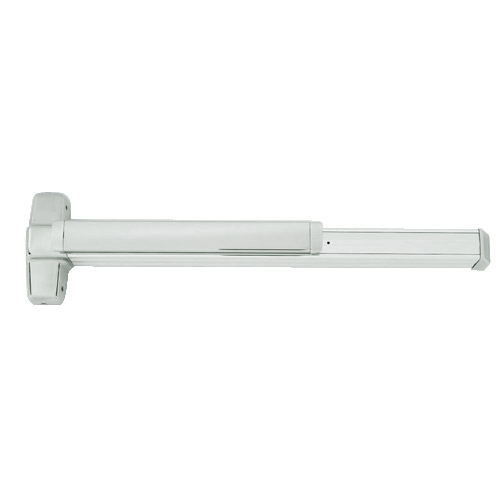
Von Duprin 9847WDC, 9850WDC, 9947WDC: Wood Door Exit Devices
Posted by Kent on 15th Oct 2026
A concealed exit device in a wood door
Most exit device talk is about metal doors. A wood door is a different job. There is no hollow metal stile to bolt to, and a lot of the time the owner wants nothing visible on the door face but a push bar. Von Duprin lists three WDC series for that: the 9847WDC, the 9850WDC and the 9947WDC. The WDC in the name is the catalog's own label, Wood Door Concealed.
All three are ANSI/BHMA A156.3 Grade 1, all three come with hex key dogging standard, and the listings we looked at are satin chrome (US26D / 626) for a 3 foot door. The decision is what runs inside the door: rods or cable.
9847WDC and 9947WDC: concealed vertical rod
The 9847WDC-EO-US26D-3 and the 9947WDC-EO-US26D-3 are both listed as Concealed Vertical Rod, with the top and bottom bolts hidden inside the door. The listing's own pro-tip describes the trade: you get a clean architectural face with no hardware visible, and the cost is that concealed rods are harder to service because you have to open the door to reach the mechanism.
The catalog does not say what separates the 9847 from the 9947 beyond the series number, and I will not invent a difference. The listings read the same on mount type, grade, finish and dogging. If you are matching an existing door, the old part number on the device is the answer. Read it, and we will match it.
9850WDC: concealed vertical cable
The 9850WDC-EO-US26D-3 swaps the rigid rods for a flexible cable. The listing calls it Concealed Vertical Cable and describes it as easier to install than rod devices. Its pro-tip describes the use case: curved door tops, non-standard door prep, or doors that have seen better days. The cable routes through the door more easily and tolerates slight misalignment better than rigid rods.
That is a plain description of where each one wins. A rod device wants a straight, well-prepped door. A cable device is the one you reach for when the door is not that. The listing also warns about the cable: it has to run clean without kinks, because a kinked cable binds and the device malfunctions. Route it through the door channels smoothly and check operation before you finish the install.
What the function letters mean
The same function letters run across all three series. Each lists an exit only version, a dummy trim version and a night latch version at the least.
- EO is exit only: push bar from inside, no outside trim, no cylinder required.
- 9847WDC-DT-US26D-3 is a dummy trim: a pull on the outside with no function.
- 9847WDC-NL-US26D-3, 9850WDC-NL-US26D-3 and 9947WDC-NL-US26D-3 are night latch: the outside lever locks and unlocks by key, and the inside is always free for egress. They ship less cylinder, so order a mortise cylinder separately to match your keyway.
Handing on the night latch listings is field reversible. You do not have to know the swing at the order desk the way you do with a handed device, but we still want to know which way the door opens so we can sort out the trim. For the plainer 98 and 9847 comparison on metal doors, see our write-up of the Von Duprin 98, 9847, 9848, 9857 and 9875 exit only devices.
Door width and finish
The number at the end of the part number is the door width in feet, and the catalog lists these devices for 3 foot and 4 foot doors. Measure the leaf before you order, not the opening. The listings we pulled are satin chrome, but each function is listed in several finishes, so the finish code in the middle of the part number matters as much as the series. If you are matching an older door, read the full old part number rather than the series alone.
Why specify concealed at all
The listings give one reason and one cost. The reason is the clean architectural look with no rods or hardware visible on the door face, which the listings describe as popular on upscale commercial projects where the architect does not want to see rods. The cost is service. You open the door to reach the mechanism, and building movement shows up as a latch that will not engage. If the door is a plain back-of-house door, a surface device is easier to live with. If the door faces the public and is wood, this is the series built for it.
What to have in hand when you order
- The door width in feet, 3 or 4, measured on the leaf.
- The door thickness and a photo of the edge, so we can see the prep.
- The function: exit only, dummy trim or night latch.
- The finish, and the keyway if the trim takes a cylinder.
- The old part number, if there is a device on the door now.
Which one do I order?
- Matching an existing device: read the part number off it. Rod or cable is already decided.
- A new wood door with clean prep: the 9847WDC rod device is the straight answer.
- A door that is out of true, curved at the top, or hard to bore: the 9850WDC cable device is the one the catalog describes for it.
One more service note from the listings: if a 9847 or 9947 will not latch, check the top bolt first. Building settling can throw off the top bolt engagement, and a strike adjustment often fixes what looks like a device failure.
Common questions
What does WDC mean on a Von Duprin exit device?
Wood Door Concealed, per the catalog's own series names.
What is the difference between the 9847WDC and the 9850WDC?
The 9847WDC uses concealed vertical rods. The 9850WDC uses a flexible vertical cable.
Do the night latch versions ship with a cylinder?
No. They ship less cylinder; order a mortise cylinder to match your keyway.
Why would I pick cable over rod?
The listing says it is easier to install and tolerates slight misalignment better, for curved or non-standard door prep.
The full range is on our Von Duprin page. Send the door size, the thickness and the old part number and we will match the device.