
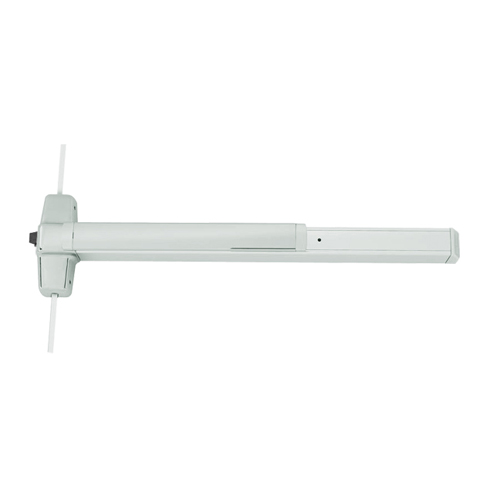
Von Duprin 9957 Three Point Latch: Trim Codes and -2 vs -3
Posted by Kent on 21st Nov 2026
Three latch points on one push bar
Most rim exit devices latch in one place, at the strike on the jamb. The Von Duprin 9957 latches in three: the rim latch at the strike, plus a bolt at the top and a bolt at the bottom. The listings call it a surface three point latch device, and the reason to buy one is a door that will not stay shut against a pry or a warp with a single latch point holding it. If you are weighing it against the vertical rod style, our 9927 piece for a pair of doors covers that choice. This article is for the 9957 once you have picked it and have to read the part number.
The letters after 9957 are the outside trim
Our catalog carries the 9957 in eight finishes and a run of outside trim options. The letters between 9957 and the finish code tell you what is on the outside of the door. Here is what each listing says, with an example in satin chrome (US26D):
| Code | What the listing says | Cylinder | Example |
|---|---|---|---|
| EO | Exit only. Push bar from inside only, no outside trim. | None needed | 9957EO-US26D-3 |
| DT | Dummy trim. A non-functional outside pull for appearance. | None needed | 9957DT-US26D-3 |
| NL | 990NL night latch. Outside lever locks and unlocks by key. | Ships less cylinder, mortise | 9957NL-US26D-3 |
| NL-OP | 110MD/WD night latch with optional pull. | Ships less cylinder, mortise | 9957NL-OP-US26D-3 |
| TP | 990TP thumbpiece. Night latch function with thumbpiece activation. | Ships less cylinder, mortise | 9957TP-US26D-3 |
| K | 996K knob. Key locks and unlocks. | Ships less cylinder, rim | 9957K-US26D-3 |
| L | 996L lever, classroom function. Locked until key unlocks, relocks when the door closes. | Ships less cylinder, mortise | 9957L-US26D-3-LHR |
Notice the cylinder column. Five of the seven ship less cylinder, and the knob trim wants a rim cylinder where the others want a mortise cylinder. That is straight from the listings, and it is the order mistake we see: a box arrives, the cylinder is missing, and the job stops until the right one is ordered. Order the cylinder with the device, in the keyway the building already uses.
The lever trim has a hand
The lever listing carries LHR in the part number, left hand reverse, and the listing says it is factory set LHR and field reversible. The other 9957 trims are listed as field reversible handing without a factory hand. If you are ordering the lever, look at the door from the outside and write down the hand before you call. A lever ordered in the wrong hand means a return and a new part number.
What -2 and -3 mean, and what the listings say they mean
Every 9957 comes in two versions at the tail of the part number, ending in -2 or -3. The -3 listings say they are sized for 3 foot doors. The -2 listings say the same thing: sized for 3 foot doors, door size 3 foot. They disagree with the suffix, and the catalog does not tell us what the -2 stands for.
The simple reading is that -2 and -3 are different door widths, 2 foot and 3 foot, and the listing text was copied across. Another reading is that they are different versions that happen to share a width. We cannot tell from the listings, and the part number alone is not proof. Do not order a -2 for a 3 foot door on the strength of the suffix, and do not order a -3 for a narrower one. Send us the leaf width, or the existing device number, and we will check the listing before the order goes in. One more difference you will see: the -3 titles say "Non Fire Rated," while the -2 titles leave it out, though the specification table on the -2 page also reads non fire rated.
Finish codes
The catalog carries eight finishes on the 9957: US26D, US28, 313, US10, US4, US3, US26 and 315. The examples above are satin chrome, US26D, which the listing describes as 626. Match the finish to the hardware already on the door and the frame.
What the listings say about service
One listing carries a locksmith tip that is worth keeping. When you service a 9957, check all three latch points independently. A misaligned top or bottom bolt can make the whole device bind. Adjust the strikes one at a time, starting with the rim latch, then the top, then the bottom.
The listings also say the device is ANSI/BHMA A156.3 Grade 1 with hex key dogging as standard, so you can hold the latch back during business hours. The tip lines call it a go-to for high-security applications and for large doors where a single latch point does not keep the door sealed. We take that as the maker's sales line. Whether a particular door needs three points is a decision for whoever wrote the security spec for the building. For a comparison with the standard 98 and 99 trim, see our 990 trim piece.
What I would put on the order
- Measure the leaf width. Confirm -2 or -3 with us if there is any doubt.
- Pick the outside function: EO, DT, NL, NL-OP, TP, K or L.
- If it is a lever, note the hand from the outside.
- Add the cylinder with the right style for the trim, mortise or rim, in the building's keyway.
- Match the finish to the door.
A three point latch is only as good as its alignment. Plan time on the install to set each point, and leave the strikes loose until the door closes without a fight.
Common questions
What do the letters after 9957 mean?
They name the outside trim. EO is exit only, DT is a dummy pull, NL and NL-OP are night latch, TP is a thumbpiece, K is a knob, and L is a lever with classroom function.
Does the 9957 come with a cylinder?
The keyed trims ship less cylinder. The knob wants a rim cylinder, and the night latch, thumbpiece and lever trims want a mortise cylinder per the listings.
Is the 9957 fire rated?
The listings call it non fire rated.
What is the difference between -2 and -3?
The listings do not say. Both read as sized for 3 foot doors. Send us the leaf width and we will check before you order.
Is the handing field reversible?
Yes, per the listings. The lever version ships factory set to left hand reverse and is also field reversible.