
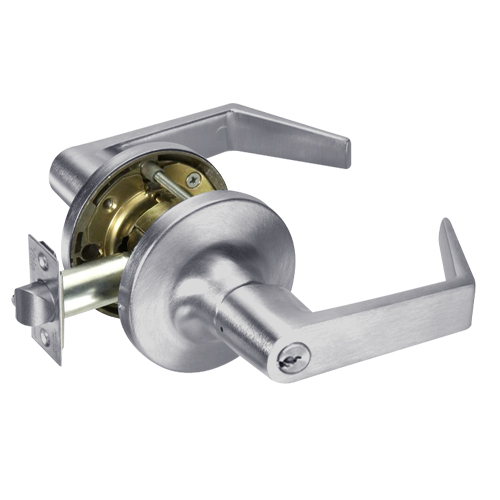
Yale 5400LN AU5404, AU5405, AU5406, AU5408
Posted by Kent on 14th Oct 2026
Four keyed functions that look the same on the box
Open a Yale 5400LN order and you will often see four numbers in a row: AU5404LN, AU5405LN, AU5406LN and AU5408LN. All four are single cylinder, keyed from the outside, with the Augusta lever in satin chrome (626). All four are Grade 1 cylindrical (bored) locks. The catalog certifies the series to ANSI/BHMA A156.2, Series 4000, Grade 1, and describes it as built for the abuse of schools, offices and healthcare corridors.
Yale is now sold as Accentra. The catalog calls it the commercial line formerly known as Yale, so a lock marked Yale on a drawing is the same lock. The difference between these four is what the key does and what the door does when nobody is there to ask.
AU5404LN: entry
AU5404LN-626 is the entry function. The catalog says the key locks the outside lever, and the inside lever is always free to exit. It calls this the workhorse setup for offices and main entrances. If a door has to be secured at night and nobody should be trapped inside, this is the default answer.
The catalog lists a second entry lock, the AU5407LN, with the same description. I do not have a documented difference between the two on this page, so if your schedule calls out one by number, order that number.
AU5405LN: storeroom or closet
AU5405LN-626 is the storeroom function. The outside lever is always locked and works by key only. The inside lever always allows free egress. There is nothing to leave unlocked by mistake. If somebody props the door and walks off, the next person to close it finds it secured again. That is why storerooms, janitor closets and supply rooms use this function, and why it gets chosen when you cannot rely on people to lock up.
The Free Wheeling lever mechanism, which the catalog says is on all 5400LN locking functions, suits a door like this. When the outside lever is locked it rotates freely up and down without retracting the latch, so working the lever does not open the door.
AU5406LN: service station
AU5406LN-626 is the service station function. The catalog describes it as keyed locking with a visual indicator, common on stockrooms and service counters. The indicator tells you at a glance whether the lock is engaged. That helps in a back-of-house setup where a lot of people use the same door and nobody wants to test the lever to see whether it is locked.
AU5408LN: classroom
AU5408LN-626 is the classroom function. The key locks and unlocks the outside lever from the corridor, and the inside lever is always free for egress. The point of this function is control from the hall. A teacher or staff member can secure a room without opening the door, and anyone in the room can still leave. It is what a school hardware schedule means when it says classroom.
On paper, the entry and classroom descriptions read very much alike: key from outside, free egress inside. The schedule decides which one to order, so do not swap them. If you want to know what the same series does with a communicating door between two rooms, we cover it in a separate guide.
Side by side
| Part | Function | Outside lever | Inside lever |
|---|---|---|---|
| AU5404LN | Entry | Locked by key | Always free |
| AU5405LN | Storeroom or closet | Always locked, key only | Always free |
| AU5406LN | Service station | Keyed locking, visual indicator | Per catalog function listing |
| AU5408LN | Classroom | Locked and unlocked by key | Always free |
The catalog does not spell out the inside lever on the service station function, so I have not filled that cell in.
Picking by door
Ask what happens when the room is empty. If the door should lock itself back up every time, the answer is the storeroom lock. If staff lock the door by key at close and open it in the morning, the answer is entry. If the room sits off a corridor and the teacher needs to secure it from the hall, it is classroom. If the door is a counter or a stockroom where people need to see the lock state, it is service station.
One planning point. These are keyed, so decide your keyway before you order. The catalog lists the Yale 5400LN as a standard cylindrical lock, and the keying you want is separate from the function. Ask for what you need on your master key system and we will line it up.
Mistakes that cost a return trip
Three come up again and again. The first is ordering by the word on the door, not the number on the schedule. "Office" can mean entry on one project and classroom on another, and the lock will not tell you it is wrong until someone tries the key. The second is using a storeroom lock where staff expect to leave the door unlocked during the day. It cannot be left unlocked, and that is the whole point of it, so people end up propping it with a wedge and defeating the function. The third is mixing finishes across a corridor. Every lock in this listing is satin chrome 626, so if you are matching existing hardware, check the finish on the doors beside it first.
Common questions
What is the difference between entry and storeroom?
On the entry function, the outside lever is locked by key and can be left unlocked. On storeroom, the outside lever is always locked and works by key only.
What is the Free Wheeling lever?
When the outside lever is locked, it rotates freely up and down while remaining securely locked. The catalog says every 5400LN locking function has it.
Do I have to order left or right hand?
The catalog lists the non-keyed models as non-handed. I do not have handing for the keyed models on this page, so check the listing for the exact part.
Is this the same lock as Accentra?
Yes. The catalog describes Accentra as the commercial line formerly known as Yale.
Where do the non-keyed functions fit?
Passage, privacy, patio and exit latch are separate part numbers in the same series.
The full range is on our Yale hardware page. For the corridor and communicating classroom functions, see the 5400LN corridor guide. Send us the door list and we will match the part numbers.